
Guide
How long to keep utility bills
The FTC suggests keeping utility bills for about a year, and shredding the paper copies if you can see them online. Keep them longer when they back up your taxes, for example a home office deduction, where the IRS says to keep records as long as they matter for the return, usually 3 years. And keep the latest bill handy: most states accept a utility bill as proof of address for a REAL ID.

This page is general information from the FTC, the IRS and USAGov, not tax or legal advice. Check the pages under Sources for your case.
About a year, by default
Utility bills are some of the easiest papers to let go of. The FTC’s keep-or-shred list puts credit card and utility bills in its keep-for-a-year group, next to bank statements and pay stubs, and adds: if you can access these documents electronically, consider shredding your paper copies.
Many utilities also show your billing history in your online account. So for most households, the paper bill only needs to stay until it is paid and the next one shows no surprises.
| Bill | Keep it | Keep it longer when | Source |
|---|---|---|---|
| Electricity, gas, water | About 1 year | You deduct a home office, or a charge is in dispute | FTC, IRS |
| Internet and phone | About 1 year | You deduct part of it as a business cost | FTC, IRS |
| Trash, sewer, other services | About 1 year | A charge is in dispute | FTC |
| The latest bill of any kind | Until the next one arrives | You need proof of address | USAGov |
| The final bill when you move out | Until any deposit is refunded and the balance is zero | A dispute about the last reading | Practical rule |
Three reasons to keep a bill longer
A home office or a business
If you claim a deduction for the business use of your home, some of your utility costs become tax records. Publication 587 says you don’t have to use a particular method of recordkeeping, but you must keep records that show the information needed to figure the deduction, including canceled checks, receipts and other evidence of the expenses you paid. It also says how long: as long as the records are important for any tax law, usually the later of 3 years from the return’s due date or the date you filed, or 2 years after you paid the tax.
So for a home office, keep every utility bill for the year with that year’s return. Phone and internet bills follow the same rule when you deduct part of them. For a business, see how long a small business should keep its records.
Proof of address
A recent utility bill is one of the most common proofs of where you live. USAGov’s REAL ID page lists a utility bill, along with a deed, mortgage statement, lease agreement or bank statement, as documents most states accept to show residency in the state. Banks, schools and benefit programs ask for the same thing.
What they want is recent: usually a bill from the last few months, in your name, at your current address. So there is no need to keep a stack. Keep the latest one, as a scan, and replace it as new ones arrive. The proof of address guide lists what else counts, and the REAL ID checklist has the rest of what the DMV asks for.
A dispute or a deposit
If a bill looks wrong, keep it and every bill after it until the utility has fixed the error in writing. When you move, keep the final bill until the account is closed with a zero balance and any deposit has come back to you. These are not official rules, just what common sense and a calm phone call usually need. The moving house paperwork guide covers closing accounts.
A quick check each month
Before you file or shred a bill, a 1-minute check catches most problems:
- Is the service address right?
- Is the reading marked as actual or estimated? A run of estimated readings can lead to a catch-up bill later.
- Does the amount look like the same month last year?
- Did last month’s payment arrive?
Then the bill can go into a folder for this year, and last year’s folder can go to the shredder once the year is up.
Shred, don’t toss
Utility bills carry your name, address and account number, which is exactly what someone needs to pretend to be you when opening an account. When it is time, shred them. The keep or shred chart has every other household paper in one table.
Where Scanner One helps, and where it doesn’t
Your utility’s own website or app is the best place to see your billing history and pay. Scanner One is for the bills that arrive on paper, and for keeping the one you need as proof of address ready to send.
Point your camera at any piece of paper. Scanner One finds the edges, straightens the page, cleans it up and saves a real PDF. Then it reads the text, names the document, tags it and puts it in the right folder. Search looks inside the text of every document and shows the matching line and page. If you deduct a home office, a year of bills sits in one folder, and you can ask for the total. Ask your documents anything. When does the lease end? What did I spend at the shop? The answer comes back with the page it came from.
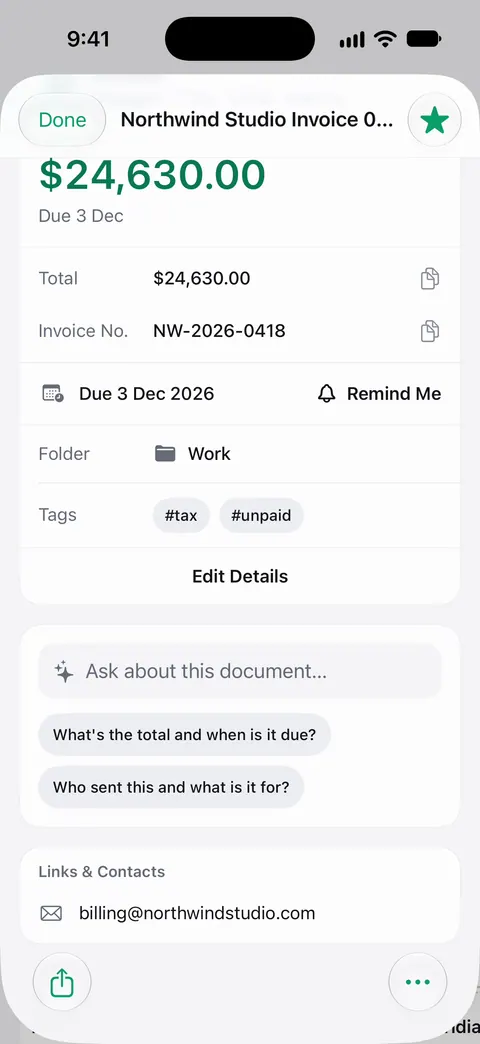
The info card on each document shows what was found on it, including a due date, with its folder and tags.
With Siri and Shortcuts you can open, find, share and ask your documents by voice, and see what’s due.
When you send a bill as proof of address from a free account, On a free account, pages you share, print or export carry a small “Scanned with Scanner One” label at the bottom right. Pro removes it.
If you already get every bill by email and file them in a folder, that works too. Scanner One helps when the paper piles up.
Questions and answers
Can I throw away old utility bills?
After about a year, yes, unless one backs up a tax deduction, an open dispute or a deposit you are still owed. The FTC puts utility bills in its keep-for-a-year group and suggests shredding the paper if you can see the bills online.
Does a utility bill count as proof of address?
Often, yes. USAGov’s REAL ID page lists a utility bill among the documents most states accept as proof of residency. Each state, bank or school sets its own rules, including how recent the bill must be and whose name must be on it, so check their list.
What if my utility bills are only online?
Download a PDF of the latest bill when you need proof of address, and the year-end summary if your utility offers one. If you deduct a home office, save every bill for that year with your tax records.
Should I keep utility bills for a home office deduction?
Yes. Publication 587 says to keep canceled checks, receipts and other evidence of the expenses you claim, for as long as they matter for the return. That is usually the later of 3 years from the due date or filing date, or 2 years after you paid the tax.
Sources
What this page says about Scanner One was checked against the app on .
- FTC Consumer Alert, Protecting your personal information: Which documents to keep and which to shred — credit card and utility bills in the keep-for-a-year group, and shredding paper copies you can access electronically; dated 10 June 2025
- IRS, Publication 587 (2025), Business Use of Your Home — keep canceled checks, receipts and other evidence of expenses for a home office, for as long as they are important for any tax law, usually the later of 3 years from the due date or filing date or 2 years after the tax was paid; for use in preparing 2025 returns
- IRS, How long should I keep records? — the general 3-year period and the longer cases; page last reviewed or updated 30 June 2026
- USAGov, How to get a REAL ID and use it for travel — a utility bill, lease, deed, mortgage statement or bank statement as proof of residency in most states; read 2026-11-13
- Scanner One on the App Store — the app’s own listing
Get Scanner One
Scanner One is free, with generous limits: scanning, clean PDFs and text search never stop.

Scanner OneScan, sign and ask anything
Scanner One is free, with generous limits: scanning, clean PDFs and text search never stop.