
Situation
You need to prove your address: what counts and how to send it
Most offices want a recent document from a company or agency that shows your name and current home address: a utility or phone bill, a bank statement, a signed lease, a mortgage statement, insurance papers, a tax return or a government letter. For a REAL ID you need two different ones. Check that the name matches your ID and the document is recent, then send the full page, or bring the printed original if they ask for paper.

What usually counts
Proof of address is a document from someone else, a company or an agency, that shows your name at your home address. The documents most offices accept:
- Utility bills: electricity, gas, water, internet or a cell phone bill.
- Bank or credit card statements.
- A signed lease or rental agreement. California’s DMV wants it signed by both landlord and tenant.
- A mortgage statement, deed or property tax bill.
- Insurance documents: home, renters, car or health.
- A tax return or a letter from a tax agency.
- Government letters: Social Security, a benefits office, a court.
- Car registration or title.
- Pay stubs or employer documents that show your address.
- A USPS Change of Address Confirmation, which some offices accept after a move.
Who asks, and what they look for
| Who | What they usually want |
|---|---|
| DMV, for a REAL ID | Two proofs of address of your principal residence, at a minimum. States can add rules. In California, both must show your first and last name and the same address as your application, and they must be printed documents. |
| A bank or credit union | Banks verify your name, date of birth, address and an ID number. A bill with your name and address is a common way to show the address. |
| A school district | Proof that you live inside the district: often phone or water bills, a lease or an affidavit. The rule must be the same for every child. |
| A landlord, employer or doctor | Usually a recent bill or statement. Ask. |
If you are getting a REAL ID, start from your own state’s DMV list; the REAL ID documents checklist covers the rest of what to bring. For a bank, see documents to open a bank account, and for a school, the school enrollment checklist.
When the bills are not in your name
Living with family, sharing a house or just moved in? You have options:
- A linking document. California’s DMV accepts a residency document in a relative’s name together with a birth certificate, marriage license or domestic partner certificate that links you to them. Minors can use a parent’s document.
- The lease. If you are on the lease, it is often the strongest proof you have.
- A letter from a shelter or organization that you live there. California lists this.
- An affidavit. School districts typically accept one, along with bills and leases.
- Your own new statements. Change your address with your bank first; its next statement, or the PDF of the current one with the new address, is often the quickest proof you can get.
Just moved and have nothing yet
In your first weeks, these are the quickest to get:
- Your lease or closing papers.
- A bank statement after you update your address online.
- Your renters or home insurance declarations page.
- The USPS confirmation of your change of address.
- Your first utility bill, often available as a PDF in the provider’s account before the paper arrives.
Our page on moving house paperwork lists who to tell about the move.
How to send it so it gets accepted
- Paper or PDF: check first. For a counter visit, bring printed originals if that is what the list says. For an upload or email, a clean PDF is better than a photo.
- Download, don’t screenshot. A statement downloaded as a PDF from the bank or utility’s website shows the company’s name, your name, the address and the date. A screenshot of an app often cuts one of those off.
- Send the whole page. Don’t crop away the logo, the date or your name.
- Hide only what they allow. Some offices accept a statement with the account number or transactions covered; others need to see it all. Ask, and if you hide something, do it properly: see redacting a PDF.
- Name the file. “Proof_of_address_Oct_2026.pdf”.
The mistakes that get it rejected
- The name doesn’t match your ID. A missing middle name or an old surname can be enough. Bring a marriage certificate or name-change document if your names differ.
- It is too old. Each office sets its own window.
- It shows a P.O. Box only. In California, one of your two documents must show both the P.O. Box and your home address.
- It is someone else’s bill with no linking document.
- It is the envelope, not the bill.
- It is a screenshot that leaves out the date or the sender.
Keep your best proof of address handy: the guide to how long to keep utility bills explains which ones are worth saving.
Where Scanner One helps, and where it doesn’t
It can’t make a document count: the office decides what it accepts. It helps you get a clean copy fast.
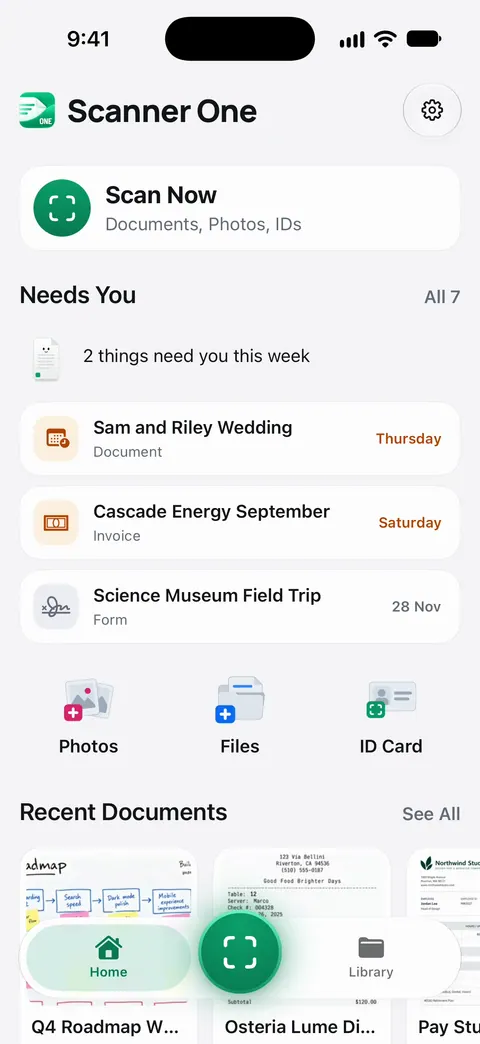
From Home you can bring in pictures from Photos and files from the Files app, or scan an ID card. So a statement you downloaded from your bank can come straight in from Files. The To PDF tool turns files and photos into PDFs. Point your camera at any piece of paper. Scanner One finds the edges, straightens the page, cleans it up and saves a real PDF.
The PDF tools merge, split, compress, password-protect, add page numbers and watermarks, and extract text. Free accounts can run the PDF tools and the Word, Excel and CSV exports 3 times a week, from one shared allowance. Redaction is permanent. Pro adds redaction, the smart eraser, edit text, auto-export and five alternate app icons.
On a free account, pages you share, print or export carry a small “Scanned with Scanner One” label at the bottom right. Pro removes it. If a label on the page could matter to the office, scan that bill with the Notes or Files scanner instead.
Packs: say what you’re applying for, like a visa, a lease or your taxes, and see which papers you have and what’s missing.
For one bill, the Notes or Files scanner is enough.
Questions and answers
What counts as proof of address?
Usually a recent document from a company or agency that shows your name and home address: a utility or phone bill, a bank or credit card statement, a signed lease, a mortgage statement, insurance documents, a tax return, a car registration or a letter from a government agency. Each office has its own list.
Can I use a bank statement as proof of address?
Usually yes. Banks themselves, most DMVs and many schools accept one. Download the full statement as a PDF from your bank’s website, rather than a screenshot of the app, so the bank’s name, your name, your address and the date are all on it.
Can I show an electronic statement instead of paper?
It depends on who is asking. Many offices accept a PDF by email or upload, but some, such as California’s DMV for a REAL ID, ask you to bring printed documents in person. Check their list before you go.
What if no bills are in my name?
Ask what else they accept. Some offices take a document in a parent’s or spouse’s name together with a birth or marriage certificate that links you, a signed lease, a letter from a shelter, or an affidavit. Schools, for example, typically accept affidavits.
How recent does proof of address need to be?
Each office sets its own window, so check its list. A document from the last month or two is the safest choice, and it must show your current address.
Sources
What this page says about Scanner One was checked against the app on .
- TSA, REAL ID frequently asked questions — the minimum REAL ID documents, including two proofs of address of principal residence, and that states may add requirements; no page date shown, read 2026-11-13
- California DMV, REAL ID checklist — an example state list of residency documents, the same name and address on both, printed documents, linking documents for a relative’s bill, and the P.O. Box rule; no date shown, read 2026-11-13
- CFPB, Checklist for opening a bank or credit union account — banks verify name, date of birth, address and an ID number, and generally ask for a Social Security card, a bill with your name and address, or a birth certificate; undated PDF, read 2026-11-13
- U.S. Department of Justice and Department of Education, Fact sheet on the rights of all children to enroll in school (ERIC copy) — school districts may ask for proof of residency such as phone and water bills, leases or affidavits, applied the same way for every child; undated PDF, read 2026-11-13
- Scanner One on the App Store — the app’s own listing: scanning, importing from Files, To PDF, merge
Get Scanner One
Scanner One is free, with generous limits: scanning, clean PDFs and text search never stop.

Scanner OneScan, sign and ask anything
Scanner One is free, with generous limits: scanning, clean PDFs and text search never stop.