
Guide
Keep or shred: the chart for every household paper
Keep birth certificates, Social Security cards, passports, marriage and divorce papers, wills and military records forever, locked up. Keep titles, deeds, loan papers and home improvement receipts while you own the thing. Keep tax returns and their records for at least 3 years, longer in the cases the IRS lists. Keep bank statements, pay stubs, utility and card bills for about a year. Shred ATM receipts, credit offers, expired cards and expired warranties now.

This chart is general information from the FTC, the IRS, the Department of Labor and USCIS, not tax or legal advice. Your situation can call for longer, and rules change. Each row names its source; the pages are linked under Sources.
The chart
Find the paper, read across. “Source” says who set the period. “Reasoning” means no official source gives one, and the row says what most people do and why.
| Document | Keep it | Why | Source |
|---|---|---|---|
| Keep forever, and lock up | |||
| Birth certificate or adoption papers | Forever | Proof of identity and citizenship | FTC |
| Social Security card | Forever | Hard to replace | FTC |
| Valid passport, citizenship or residency papers | Forever | Proof of identity and status | FTC |
| Marriage license, divorce decree | Forever | Proof of name and status | FTC |
| Military records | Forever | Benefits and proof of service | FTC |
| Wills, living wills, powers of attorney | Forever | Your wishes, and who acts for you | FTC |
| Retirement and pension plan papers | Forever | Benefits you may claim decades later | FTC |
| Death certificates of family members | Forever | Needed to settle affairs and claim benefits | FTC |
| Vital health records, especially from before electronic records | Forever | Your medical history | FTC |
| Keep while you own it | |||
| Vehicle title | While you own the vehicle | Proof of ownership | FTC |
| Title or deed to your home | While you own the home | Proof of ownership | FTC |
| Mortgage or vehicle loan documents | While you own it | Proof of the loan and its payoff | FTC |
| Home purchase papers and home improvement receipts | While you own the home, then until 3 years after the due date of the return for the year you sell | Your basis, which sets the taxable gain | IRS, FTC |
| Rental agreements and leases | While the lease is in force, and until the deposit is settled | Your terms and your deposit | FTC |
| Sales receipts and warranties for major appliances | While you own the appliance | Proof of purchase date for warranty claims | FTC |
| Warranty and receipt, any item | Until the warranty ends | Needed to claim | FTC |
| Tax papers | |||
| Copies of filed tax returns | At least 3 years; the IRS recommends keeping copies | Amending, audits, next year’s return | FTC, IRS |
| Records behind a return: receipts, canceled checks, 1099s | 3 years after filing | The general period of limitations | IRS |
| The same, if you left out over 25% of your gross income | 6 years | Longer period of limitations | IRS |
| The same, for a worthless securities or bad debt loss | 7 years | Longer period of limitations | IRS |
| The same, if you did not file or filed a fraudulent return | Indefinitely | No period runs | IRS |
| W-2, Copy C | Until you begin receiving Social Security benefits | Proof of your earnings record | IRS |
| Health coverage records | With that year’s tax records | The IRS asks for them | IRS |
| Records of selling a home | At least 3 years after the return for the year of sale | Proof of the sale | FTC, IRS |
| Keep about a year | |||
| Bank statements | 1 year | Errors and proof of payment | FTC |
| Pay stubs | 1 year, until checked against your W-2 | Errors in pay or withholding | FTC |
| Credit card bills | 1 year | Disputes and proof of payment | FTC |
| Utility bills | 1 year | Disputes, proof of address | FTC |
| Deposited checks | 1 year | Proof of income received | FTC |
| Undisputed medical bills | 1 year | Settled, with nothing left to prove | FTC |
| Keep a short while | |||
| Everyday shopping receipts | Until the return window closes and the charge is right on your statement | Returns are often limited to periods like 30 or 90 days; card errors must be disputed within 60 days | FTC |
| Insurance policies | The current one while in force; old ones until no claim can arise | No official period | Reasoning |
| Shred now | |||
| ATM receipts | Shred | Nothing to prove | FTC |
| Offers of credit or insurance | Shred | Personal details you don’t need to keep | FTC |
| Cleared checks | Shred after 14 days | Once on your statement | FTC |
| Credit reports | Shred | Full of personal details | FTC |
| Prescription information for medicines you no longer take | Shred | Private health details | FTC |
| Expired warranties | Shred | No longer useful | FTC |
| Expired credit cards, driver’s licenses and other IDs | Shred | Identity details | FTC |
| If you employ people | |||
| Employment tax records | At least 4 years after the tax is due or paid | IRS rule | IRS |
| Payroll records | At least 3 years; time cards 2 years | Labor Department rule | DOL |
| Form I-9 | 3 years after hire or 1 year after employment ends, whichever is later | USCIS rule | USCIS |
How to use it
- Start with the shred group. It is the quickest win, and often a big part of the pile.
- Pull out the keep-forever papers and put them together, in one fire-safe place. The emergency document binder shows how to set one up, with a digital copy.
- Make a folder per tax year, and write the year it can go on the front.
- Put the one-year papers in a box for this year. Next January, shred last year’s box.
To print the chart, use your browser’s Print command, or share the page to your printer from your phone.
When to keep something longer
The chart gives the usual period. Keep a paper longer when:
- It proves something still open: a dispute, a claim, an appeal, a refund you haven’t received.
- Someone else needs it. The IRS reminds you to check whether your insurer or creditors require you to keep records longer before you discard them.
- It backs up your taxes. A bank statement or a medical bill that supports a deduction follows the tax rule, not the one-year rule.
- It is about property you still own. Basis records stay until you sell, however old they are.
Each of the main rows has its own page with the details: tax records, receipts, bank statements, pay stubs, medical bills, utility bills, insurance policies, home purchase papers and business records.
Scan, then shred: which originals to keep
Many papers in the one-year and tax groups are fine as scans, and the FTC itself suggests shredding paper copies of statements and bills you can access electronically. The originals in the keep-forever and keep-while-you-own groups are different: a scan of a birth certificate, a passport or a car title does not replace it. Keep those originals, and keep the scan as a backup. Which papers to keep after scanning and whether you can throw away the original go into the details.
How to shred
The FTC’s advice is short: when it is time to dispose of documents with your personal or financial information, shred them. If you don’t own a shredder, look for a community shred day. Don’t put statements or bills in recycling whole.
If you are clearing years of paper at once, the paperless weekend method breaks it into three passes.
Where Scanner One helps, and where it doesn’t
Scanner One does not decide what to keep. This chart, and the sources behind it, do that.
It helps with the scan-then-shred part. Point your camera at any piece of paper. Scanner One finds the edges, straightens the page, cleans it up and saves a real PDF. Then it reads the text, names the document, tags it and puts it in the right folder. Search looks inside the text of every document and shows the matching line and page. So a year of statements becomes a folder you can search instead of a box. Text recognition runs on every page for everyone, free or Pro.
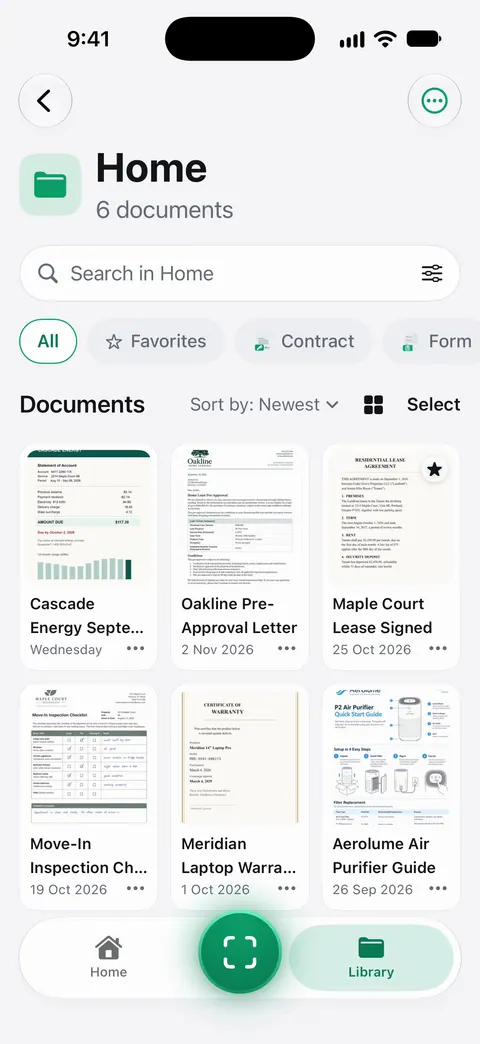
Documents stay on your iPhone unless you share them or turn on iCloud Sync. You can lock the app with Face ID. Deleted documents wait in Recently Deleted for 30 days before they are deleted for good.
Scanner One is free, with generous limits: scanning, clean PDFs and text search never stop. Smart filing on a free account covers 10 documents a month. If you share or print a scan from a free account, On a free account, pages you share, print or export carry a small “Scanned with Scanner One” label at the bottom right. Pro removes it.
If you only keep a few papers, a folder in the Files app is enough. The chart works the same either way.
Questions and answers
What documents should I keep forever?
The FTC’s list: birth certificates or adoption papers, Social Security cards, valid passports and citizenship or residency papers, marriage licenses and divorce decrees, military records, wills, living wills, powers of attorney, retirement and pension plans, death certificates of family members, and vital health records. Keep them locked up.
Can I shred bank statements after a year?
The FTC puts bank statements in its keep-for-a-year group, and suggests shredding paper copies you can access electronically. Keep any statement longer if it backs up your taxes or a dispute.
How long should I keep tax returns?
The FTC says at least three years, and the IRS recommends keeping copies of your returns, which you need to amend a return or answer a question. Many people keep the returns themselves for good, since they take little space.
Is it safe to throw away papers after scanning them?
For most bills and statements, yes, once the scan is readable and backed up. Keep the originals of the papers in the keep-forever and keep-while-you-own groups: a scan of a birth certificate or a title does not replace it.
What is the safest way to get rid of old documents?
Shred anything with your name, account numbers or personal details. The FTC’s advice is to shred, and if you don’t own a shredder, to look for a community shred day.
Sources
What this page says about Scanner One was checked against the app on .
- FTC Consumer Alert, Protecting your personal information: Which documents to keep and which to shred — the keep-for-a-year, keep-at-least-three-years, keep-while-you-own, keep-forever and shred groups used for most rows; dated 10 June 2025
- IRS, How long should I keep records? — the 3, 6 and 7 year periods, the indefinite cases, employment tax records and property records; page last reviewed or updated 30 June 2026
- IRS, Publication 17 (2025), Your Federal Income Tax — keep copies of returns; keep W-2 Copy C until you begin receiving Social Security benefits; for use in preparing 2025 returns
- IRS, Publication 523 (2025), Selling Your Home — keep home basis records until 3 years after the due date of the return for the year of sale; for use in preparing 2025 returns
- IRS, Topic no. 305, Recordkeeping — keep records of health coverage; page last reviewed or updated 13 October 2026
- U.S. Department of Labor, Fact Sheet #21: Recordkeeping Requirements under the FLSA — payroll records at least three years, time cards two years; read 2026-11-13
- USCIS, 10.0 Retaining Form I-9 (Handbook for Employers M-274) — three years after hire or one year after employment ends, whichever is later; last reviewed or updated 18 July 2023
- FTC, Warranties — save the warranty with the receipt; dated July 2023
- FTC, Solving Problems With a Business: Returns, Refunds, and Other Resolutions — many stores will not take returns after a certain time, like 30 or 90 days; dated September 2024
- FTC, Using Credit Cards and Disputing Charges — the 60-day window to dispute a billing error; dated May 2022
- Scanner One on the App Store — the app’s own listing
Get Scanner One
Scanner One is free, with generous limits: scanning, clean PDFs and text search never stop.

Scanner OneScan, sign and ask anything
Scanner One is free, with generous limits: scanning, clean PDFs and text search never stop.