
Guide
How long a small business should keep its records
The IRS says to keep business records as long as they support your tax return: generally 3 years after you file, 6 years if you left out more than 25% of your gross income, 7 years for a bad debt or worthless securities loss, and indefinitely if you did not file. Keep employment tax records for at least 4 years, and records about business property until the period runs out for the year you sell it. The DOL, EEOC and USCIS add their own periods for payroll, personnel files and Form I-9.

This page is general information from the IRS, the Department of Labor, the EEOC and USCIS, not tax or legal advice. States, lenders and your industry may require longer periods. Check the pages under Sources, or ask your accountant.
The IRS periods for business records
Publication 583 sets the principle: keep records as long as they may be needed for the administration of any provision of the tax law. In practice that means until the period of limitations for the return runs out. The IRS lists the periods like this.
| If this applies to the return | Keep the records |
|---|---|
| None of the cases below | 3 years |
| You file a claim for a credit or refund after filing | 3 years from filing, or 2 years from paying the tax, whichever is later |
| You claim a loss from worthless securities or a bad debt deduction | 7 years |
| You left out income worth more than 25% of the gross income shown on the return | 6 years |
| You did not file, or filed a fraudulent return | Indefinitely |
| Employment taxes | At least 4 years after the tax is due or paid, whichever is later |
| Records about property | Until the period expires for the year you dispose of the property |
The IRS also reminds you that other people may need your records for longer. Lenders, insurers and creditors can ask for them, so check before you shred.
Which records, and their clocks
Publication 583 groups the supporting documents a business keeps. Here is each group with the period that usually applies.
| Record | Examples from the IRS | Keep it |
|---|---|---|
| Gross receipts | Cash register tapes, bank deposit slips, receipt books, invoices, credit card charge slips, Forms 1099-MISC and 1099-NEC | The return’s period, usually 3 years |
| Inventory | Canceled checks, cash register tape receipts, credit card sales slips, invoices | The return’s period |
| Expenses | Canceled checks, cash register tapes, account statements, credit card sales slips, invoices, petty cash slips | The return’s period |
| Travel, transportation and gifts | Specific rules, set out in Publication 463 | The return’s period |
| Assets | When and how you got the asset, the purchase price, improvements, depreciation and casualty losses, how you used it, and when and how you disposed of it | Until the period expires for the year you dispose of it |
| Employment taxes | Your EIN, employee names, addresses and SSNs, dates of employment, tax deposits, Forms W-4 | At least 4 years |
If you don’t have employees, the first five rows are your whole system. A one-person business can keep it simple: one folder per tax year, plus one long-lived folder for equipment and other assets. The small business records checklist and the freelancer tax documents list go item by item.
Employer records: three agencies, three clocks
Once you hire, three more sets of rules apply. Keep each record for the longest period that touches it.
- Employment taxes, IRS: keep all records of employment taxes for at least 4 years after filing the 4th quarter for the year. Records that support certain credits, such as qualified sick leave wages, stay at least 6 years. IRS Topic 752 also asks employers to keep a copy of each Form W-2 and W-3 for at least 4 years.
- Wages and hours, Department of Labor: under the Fair Labor Standards Act, keep payroll records, collective bargaining agreements and sales and purchase records for at least 3 years. Keep the records wages are computed from, such as time cards, wage rate tables and work schedules, for 2 years.
- Personnel files, EEOC: keep personnel or employment records for one year, and for one year from the date of an involuntary termination. Payroll records under the age discrimination rules stay 3 years. If a charge of discrimination is filed, keep the related records until it is finally resolved.
- Form I-9, USCIS: keep each employee’s Form I-9 for three years after the date of hire, or one year after employment ends, whichever is later.
Keeping business records electronically
The IRS accepts electronic records. Its “What kind of records” page says all requirements that apply to hard copy books and records also apply to electronic ones. Publication 583 adds the conditions for an electronic storage system:
- It must give a complete and accurate record of your data that the IRS can access.
- It must be able to reproduce the records in legible form.
- Once the system has been tested to show it reproduces the records as the IRS requires, and you have procedures to keep it that way, the original paper may be destroyed.
The full rules are in Revenue Procedure 97-22. In plain terms: scan clearly, keep the files organized so any record can be found and printed, and keep a backup.
A yearly routine
Pick a quiet week each year, after your return is filed:
- Close the year’s folder and write its “keep until” year on it: the filing year plus 3, or later if one of the special cases applies.
- Move asset records for anything you sold into that year’s folder, with a “keep until” date 3 years after that return.
- Shred the folders whose “keep until” year has arrived, unless a lender, an insurer or an open question needs them.
- Check your backup opens.
If you are new to this, the papers to keep from day one as a freelancer is a good place to start, and the keep or shred chart covers the household side.
Where Scanner One helps, and where it doesn’t
Scanner One is not accounting software. It does not keep books, run payroll or know which expenses you can deduct. Your accountant and your bookkeeping tool do that.
It is a good place to capture the paper: receipts, invoices, signed contracts, W-4s. Point your camera at any piece of paper. Scanner One finds the edges, straightens the page, cleans it up and saves a real PDF. A scan can have many pages, and you can reorder them. Then it reads the text, names the document, tags it and puts it in the right folder. Search looks inside the text of every document and shows the matching line and page.
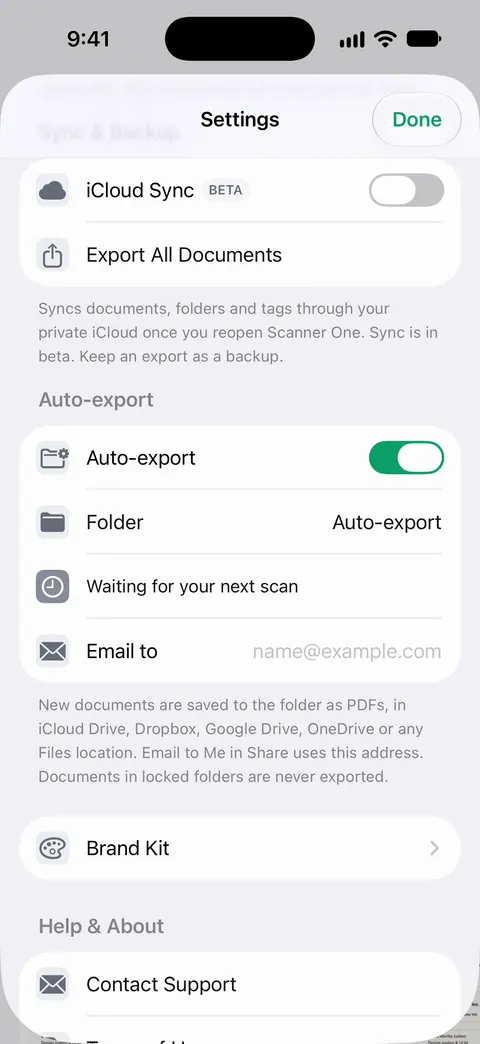
Scanner One exports to Word, keeping headings, lists and tables, and to Excel and CSV. On a free account, the PDF tools and exports run 3 a week. Pro adds redaction, the smart eraser, edit text, auto-export and five alternate app icons. The screenshot below shows auto-export turned on, with the folder new documents go to as PDFs.
Documents stay on your iPhone unless you share them or turn on iCloud Sync. You can lock the app with Face ID. If you send records to an accountant or a client from a free account, On a free account, pages you share, print or export carry a small “Scanned with Scanner One” label at the bottom right. Pro removes it. Pro means no ads and no watermark.
For a business with a few receipts a month, the Files app scanner and a folder per year may be enough. For a comparison of apps for this, see scanner apps for a small business.
Questions and answers
Is 7 years the rule for business records?
Not as a general rule. The IRS’s general period is 3 years after you file. Seven years applies to a claim for a loss from worthless securities or a bad debt deduction. Many businesses keep 7 years of tax records as a simple margin, but that is a choice, not the IRS rule.
Can my business keep scanned records and shred the paper?
Publication 583 says an electronic storage system must give a complete and accurate record that the IRS can access and reproduce in legible form, and that the paper originals may be destroyed once the system has been tested. The details are in Revenue Procedure 97-22.
How long do I keep payroll records?
Several clocks run at once. The IRS says employment tax records stay at least 4 years. The Department of Labor says payroll records stay at least 3 years and time cards 2 years. Keep each record for the longest period that applies.
How long do I keep a former employee’s Form I-9?
USCIS says three years after the date of hire, or one year after employment ends, whichever is later.
Sources
What this page says about Scanner One was checked against the app on .
- IRS, How long should I keep records? — the 3, 6 and 7 year periods, the indefinite cases, employment tax records, property records and records for nontax purposes; page last reviewed or updated 30 June 2026
- IRS, Publication 583, Starting a Business and Keeping Records — supporting documents by type, employment tax records for at least 4 years, asset records, electronic storage systems and Revenue Procedure 97-22; revised December 2024
- IRS, Employment tax recordkeeping — keep employment tax records at least 4 years after filing the 4th quarter for the year, and records for certain credits at least 6 years; page last reviewed or updated 12 June 2026
- IRS, What kind of records should I keep — gross receipts, purchases, expenses, travel and assets, and that the requirements for paper records also apply to electronic ones; page last reviewed or updated 3 August 2026
- U.S. Department of Labor, Fact Sheet #21: Recordkeeping Requirements under the FLSA — payroll records at least three years, time cards and wage computation records two years; read 2026-11-13
- EEOC, Recordkeeping Requirements — personnel or employment records for one year, longer once a charge is filed; read 2026-11-13
- USCIS, 10.0 Retaining Form I-9 (Handbook for Employers M-274) — three years after the date of hire, or one year after employment ends, whichever is later; last reviewed or updated 18 July 2023
- Scanner One on the App Store — the app’s own listing
Get Scanner One
Scanner One is free, with generous limits: scanning, clean PDFs and text search never stop.

Scanner OneScan, sign and ask anything
Scanner One is free, with generous limits: scanning, clean PDFs and text search never stop.