
Checklist
Documents you need for a college application
For a first-year application you gather your courses and grades, your activities, any test scores you’re sending, details about your parents' jobs and education, honors, and your essays. Your counselor sends the School Report with your official transcript and school profile, and usually a recommendation; teachers send evaluations if the college asks. You pay each college’s fee or use a fee waiver. Each college sets its own requirements for essays, tests and recommendations, so check its page on the Common App or its own site.

A college application has two halves: what you put in yourself, and what your school and recommenders send. This checklist follows the Common App’s first-year guide and its definitions of each form, read on 13 November 2026. Colleges that don’t use the Common App ask for much the same, on their own portals.
What you gather yourself
- Your courses and grades. The Education section asks for grades and current courses, and some colleges also ask you to self-report your transcript. Keep an unofficial copy of your transcript in front of you while you type.
- Your activities list: work, clubs, sports, hobbies, community engagement, family responsibilities, with roles and hours.
- Test scores and test dates, if you’re sending them. Requirements vary, and some colleges are test optional.
- Your parents’ or guardians’ details: occupation, employment status, education level, and colleges attended and degrees earned.
- Academic honors and achievements from high school.
- Your personal essay, if a college requires it. Each college makes it required or optional.
- College-specific questions and writing supplements, which some colleges add.
- A portfolio, audition recording or writing sample, for programs that ask for one.
What others send for you
Your counselor
- The School Report: Common App calls it mandatory, and it includes the school profile and your transcript. It is the first form the counselor submits.
- The counselor recommendation: required or optional depending on the college.
- The Mid Year Report: sent when first semester or trimester grades are in, if a college asks for it.
- The Final Report: sent after you have all your admission decisions, to the college you’ll attend.
First-year applicants must invite a counselor in the Common App.
Your teachers
- Teacher evaluations: a written recommendation and optional ratings. Each college sets how many it requires and accepts.
- Ask early, and tell each teacher which colleges and deadlines you have.
Other recommenders
- A coach, employer, mentor or peer, if a college allows other recommenders.
Your parents
- Only if you apply Early Decision. Common App says parents submit a form only for a college’s Early Decision deadline.
Fees
- Each college’s application fee, or
- A fee waiver: the Common App waiver, confirmed by your counselor, or a college’s own waiver.
Money for college
Financial aid is a separate set of forms with its own papers: tax returns, records of savings and the like. Start with documents you need for the FAFSA, and check whether any of your colleges also ask for their own financial aid forms.
Check each college’s requirements
Common App’s guide says to look at each college’s information page in My Colleges, or its requirements grid, for testing, writing and deadlines. Make a simple table: college, deadline, essay required, supplements, test policy, number of teacher evaluations, fee or waiver. One missing supplement can hold up a whole application.
Mistakes that cost applicants
- Inviting teachers a week before the deadline.
- Self-reported grades that don’t match the transcript your counselor sends.
- Missing a college’s writing supplement because it only appears after another answer.
- Forgetting the Early Decision agreement.
- Using a nickname on the application and your legal name on your transcript and test scores.
- An activities list with no hours or dates.
Keep copies of what you can’t replace
Award certificates, a past transcript from another school, and letters from a summer program or job are easy to lose. Scan them now, while you’re gathering everything, and put the pages of each into one file: several pages into one PDF. If a portal limits file size, make the PDF smaller first.
Where Scanner One helps, and where it doesn’t
Scanner One doesn’t write essays, submit applications or talk to your counselor. Official transcripts go from your school, not from you.
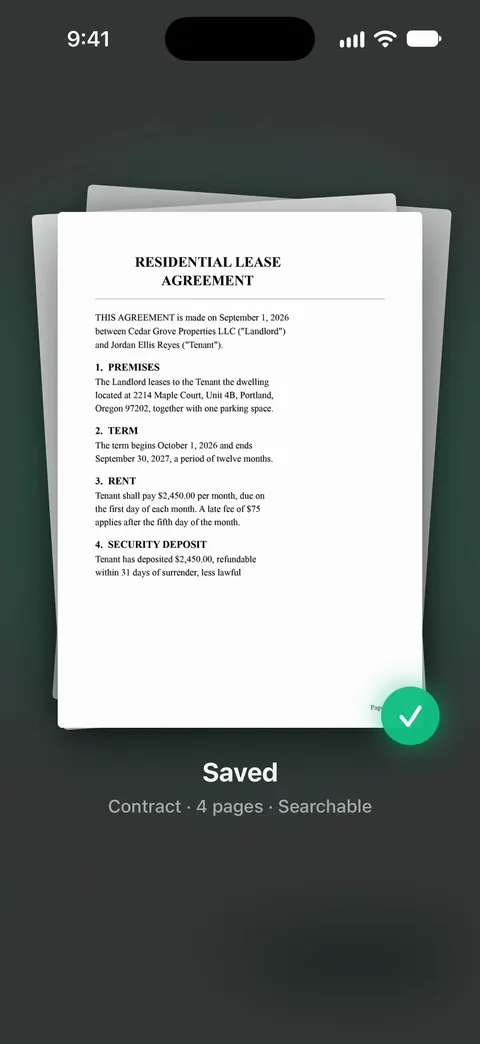
It helps with your own papers. Point your camera at any piece of paper. Scanner One finds the edges, straightens the page, cleans it up and saves a real PDF. Text recognition runs on the device, in 29 languages. Search looks inside the text of every document and shows the matching line and page. The PDF tools merge, split, compress, password-protect, add page numbers and watermarks, and extract text. Free accounts can use the PDF tools 3 a week. Students comparing apps can see the scanner apps for students.
Before you upload anything: On a free account, pages you share, print or export carry a small “Scanned with Scanner One” label at the bottom right. Pro removes it.
Coming in 1.0.1. Packs: say what you’re applying for, like a visa, a lease or your taxes, and see which papers you have and what’s missing.
Questions and answers
Do I send my own transcript to colleges?
Usually not for the Common App. Your counselor submits the School Report, which includes your transcript and the school profile. Some colleges also ask you to self-report your courses and grades in the application, so have an unofficial copy handy.
How many recommendation letters do I need?
It depends on the college. On the Common App, you must invite a counselor, and each college decides how many teacher evaluations it requires and accepts. Some allow other recommenders, such as a coach or employer.
Do I have to send SAT or ACT scores?
Only where a college requires them. Common App says testing requirements vary by college and some are test optional. Each college’s page in My Colleges shows its policy.
Can I apply without paying the application fee?
Yes, if you qualify for a fee waiver. Common App’s fee waiver must be confirmed by your counselor, and some colleges have their own waivers. Either way, you won’t pay that college’s fee.
Sources
What this page says about Scanner One was checked against the app on .
- Common App, Application guide for first-year students — what to gather, recommenders, fee waivers, each college’s requirements, essays and writing supplements; read 2026-11-13
- Common App, Application key terms — School Report, counselor recommendation, teacher evaluation, Mid Year and Final Reports, who must be invited; read 2026-11-13
- Scanner One on the App Store — the app’s own listing
Get Scanner One
Scanner One is free, with generous limits: scanning, clean PDFs and text search never stop.

Scanner OneScan, sign and ask anything
Scanner One is free, with generous limits: scanning, clean PDFs and text search never stop.