
Checklist
Documents you need for the FAFSA (2027-28)
For the 2027-28 FAFSA, the student and each person who must provide information (usually a parent, sometimes a spouse) need their Social Security number, contact details and consent for the IRS to transfer their 2025 federal tax information. Have your 2025 tax returns nearby, plus child support received, current cash, savings and checking balances, the net worth of investments and businesses, and the list of schools. Eligible noncitizens need their A-Number. Federal applications open October 1, 2026, and state deadlines can come early.

This is general information for the 2027-28 award year, not financial advice. The FAFSA changes every year. Check StudentAid.gov, your state’s aid agency and each college’s financial aid office for current rules and deadlines.
The FAFSA itself is free and takes far less time when everyone has their numbers ready. This list follows the form’s own sections. Gather a set for the student and one for each contributor.
Who has to take part
The form has five sections: student, student spouse, parent, parent spouse or partner, and preparer. The student always fills in the student section. Whether a parent or spouse must too depends on the student’s answers, and the form’s “Who must provide information” page explains it. Everyone who provides information is a contributor, and each one must give consent and approval for the IRS to transfer their tax information.
Identity and contact, for each person
- Full legal name: as it appears on the Social Security card. If you already have a StudentAid.gov account, use exactly the name on it.
- Date of birth.
- Social Security number: or an ITIN, if the person has one.
- Mobile number, email and mailing address.
About the student
- Marital status: as of the day you file.
- State of residence: and the month and year the student became a resident.
- Citizenship status: and the A-Number for an eligible noncitizen.
- High school completion: diploma, GED or another state-recognized equivalent, and the issuing state.
- College plans: year in school for 2027-28, and whether the student will already have a bachelor’s degree.
- Personal circumstances: active duty, veteran status, foster care, ward of the court, emancipation, legal guardianship, homelessness, or children the student supports. If any apply, keep the papers that show it, in case the school asks.
2025 tax information
Most of this transfers from the IRS once consent is given. Keep the 2025 returns nearby anyway, in case a figure is needed or the transfer misses something:
- IRS Form 1040 for 2025: with schedules. The form refers to adjusted gross income, income tax paid, the earned income credit, IRA deductions, education credits and Schedule C net profit.
- Returns from Puerto Rico or another US territory: if filed.
- If someone didn’t file: their W-2s and other income records.
- An IRS online account: lets you view return details and download a transcript if the paper copy is missing.
Federal benefits in 2025 or 2026
Whether anyone in the family got: Medicaid, SNAP, free or reduced-price school lunch, the earned income tax credit, lower premiums for a Marketplace health plan, WIC, Supplemental Security Income, federal housing assistance, or TANF. Award letters help you answer accurately.
Money and assets
Values as of the day you file:
- Child support received: the total for the last complete calendar year.
- Cash, savings and checking: the current total. Don’t include student aid or retirement accounts.
- Investments’ net worth: value minus debts on them, including real estate other than your home, rental property, 529 plans and other education savings, CDs, stocks and bonds. Don’t include the home you live in or retirement accounts.
- Businesses and farms’ net worth: the form excludes a family business with 100 or fewer full-time employees and a farm where the family lives.
Recent statements for each account make these quick.
The schools
- The list of colleges: up to 20 online, 10 on paper.
Deadlines for 2027-28
- Federal aid: submit as early as possible, from October 1, 2026. The last day is June 30, 2028.
- State and college aid: deadlines can be as early as October 1, 2026, and some aid goes first come, first served. Check your state’s date and each college’s.
After you submit
You get a FAFSA Submission Summary. When you sign, you agree to give the school information that verifies your answers, and your tax forms, if asked. Keep a copy of everything you used. For the rest of the college paperwork, see college application documents.
Mistakes that hold up aid
- A name that doesn’t match Social Security’s records.
- A contributor who never gives consent.
- Reporting the family home or retirement accounts as assets.
- Missing a state or college deadline while waiting on the federal one.
- Paying a website to submit a free form.
Scan and send them safely
If the financial aid office asks for papers, scan each as one complete PDF (scan several pages into one PDF) and upload through the school’s portal. If you must email a tax return, password-protect it and send the password separately, and redact what the school doesn’t need, after checking with them. Schools sometimes send their own forms as PDFs: fill out a PDF form on iPhone.
Where Scanner One helps, and where it doesn’t
The FAFSA is filled in online, and most tax data comes from the IRS directly, so you may not need to scan anything. The Notes app or the Files app is enough for an occasional request.
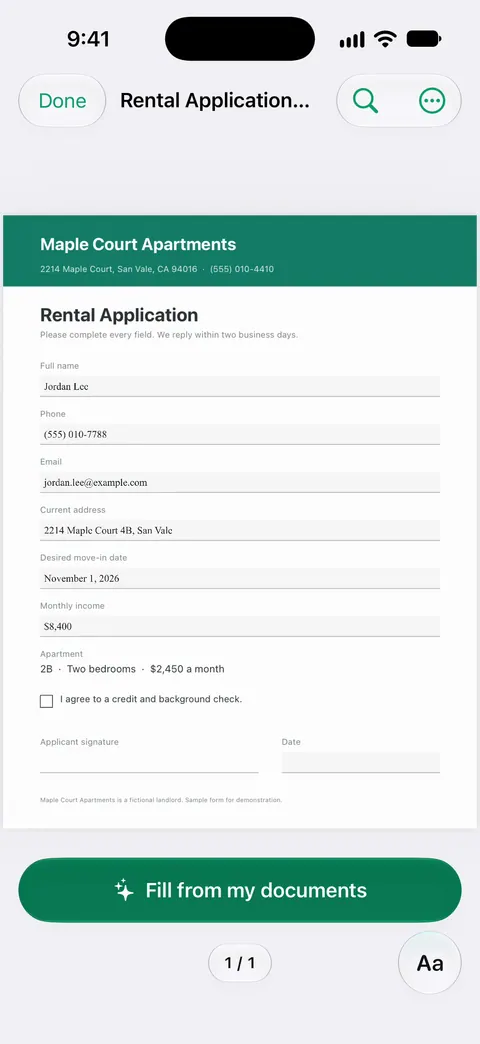
Scanner One helps when the school wants papers. A scan can have many pages, and you can reorder them. Fill Form lets you type into the fields of a PDF form. The PDF tools merge, split, compress, password-protect, add page numbers and watermarks, and extract text. Free accounts can run them 3 a week. Documents stay on your iPhone unless you share them or turn on iCloud Sync.
On a free account, pages you share, print or export carry a small “Scanned with Scanner One” label at the bottom right. Pro removes it.
Scanner One doesn’t fill in the FAFSA, transfer IRS data or tell you how much aid you’ll get.
Questions and answers
What tax year does the 2027-28 FAFSA use?
2025. The form asks about the 2025 federal tax return for the student and each contributor, and most of it is transferred from the IRS once everyone gives consent.
What happens if a parent doesn’t give consent?
The form is plain about it: without consent and approval to transfer federal tax information from the IRS, the student will not be eligible for federal student aid. Every contributor has to give it.
Do I report my house or my retirement account as an asset?
No. The form tells you not to include the home you live in or retirement accounts. You do report cash, savings and checking, and the net worth of investments such as other real estate and 529 plans.
Does it cost money to file the FAFSA?
No. FAFSA stands for Free Application for Federal Student Aid. File it yourself at fafsa.gov; you never need to pay a website to submit it.
What if my school asks for more documents after I file?
When you sign, you agree to provide information that verifies your answers, and your tax forms, if asked. Send exactly what the financial aid office requests, through its portal, before its deadline.
Sources
What this page says about Scanner One was checked against the app on .
- Federal Student Aid, 2027-28 FAFSA form (PDF) — the questions, the 2025 tax year, consent and approval, assets, schools, federal and state deadlines; PDF dated August 2026
- IRS, Get ready to file your taxes — the IRS online account, where you can view return details and download transcripts; last reviewed 2026-11-10
- IRS, Gather your documents — the income forms behind a tax return, for families still finishing a return; last reviewed 2026-10-26
- Apple Support, Scan documents on your iPhone or iPad (108963) — scanning several pages in Notes and Files; published 2026-02-13
- Scanner One on the App Store — the app’s own listing
Get Scanner One
Scanner One is free, with generous limits: scanning, clean PDFs and text search never stop.

Scanner OneScan, sign and ask anything
Scanner One is free, with generous limits: scanning, clean PDFs and text search never stop.