
Checklist
Documents for a first US passport
Bring Form DS-11, filled in but not signed, proof of US citizenship such as a US birth certificate or Certificate of Naturalization with a photocopy of it, an original photo ID such as a driver’s license with a photocopy of the front and back, one color photo 2x2 inches, and the fees from the State Department’s fee page. You apply in person at an acceptance facility. For a child under 16, both parents usually come and bring proof of their relationship to the child.

This checklist follows the instructions printed on Form DS-11 (edition 04-2025) and USA.gov’s application pages, read on 13 November 2026. Fees change, and both the form and USA.gov send you to the State Department’s fee page for the current amounts, so they aren’t repeated here.
This is general information, not legal advice. If anything here differs from the State Department’s current instructions, theirs win.
Who applies in person with Form DS-11
The form says you must apply in person if any of these is true:
- This is your first US passport.
- You are under 16.
- Your last passport was issued before you turned 16, more than 15 years ago, or it was lost, stolen or damaged.
Everyone else may be able to renew by mail: see documents to renew a US passport. Applications go to an acceptance facility, often a post office or library, and USA.gov notes that some require appointments.
The first passport checklist
Form DS-11, not signed
- Fill it in with black ink, without corrections.
- Don’t sign it. The acceptance agent gives you the oath and watches you sign.
- The form asks for your Social Security number. If you were never issued one, you enter zeros and attach a signed, dated statement in the wording the form gives.
Proof of US citizenship, plus a photocopy
Bring an original or certified copy of one of these, and a photocopy of the front, and of the back if it has printed information:
- A US birth certificate that was issued by the city, county or state of birth and lists your full name, date and place of birth, your parents’ full names, a filing date within 1 year of birth, the registrar’s signature and seal, and your sex at birth.
- A fully valid, undamaged US passport, which may be expired.
- A Consular Report of Birth Abroad or Certification of Birth Abroad.
- A Certificate of Naturalization or Certificate of Citizenship.
If your birth certificate was filed more than a year after you were born, or no record exists, the form asks for a combination of secondary evidence instead: a registrar’s letter saying no record exists, plus early records such as a hospital birth record, an early baptismal certificate, census, school, medical or family Bible records, or published birth announcements. Born abroad, claiming citizenship through a parent or through adoption? The DS-11 lists the parent’s papers to bring for each case.
Proof of identity, plus a photocopy of both sides
Bring the original and a front-and-back photocopy. It must have a photo that looks like you. The form’s examples:
- A driver’s license (not a temporary or learner’s permit)
- A previous or current US passport book or card
- A Certificate of Naturalization or Citizenship
- A military ID
- A federal, state or city government employee ID
One photo
Color, 2x2 inches, taken less than 6 months ago, on a plain white or off-white background, no glasses, no uniform, and no head covering unless you bring the signed religious or medical statement the form describes.
Fees
Two separate payments: the passport fee to the State Department, and an execution fee paid to the acceptance facility in whatever method it accepts. Expedited service and 1 to 2 day delivery cost extra.
For a child under 16
USA.gov says the child appears in person and a parent, preferably both, must be present and sign. The DS-11 instructions ask for:
- Proof of the parents’ relationship to the child, such as a birth certificate listing both parents.
- Each parent’s photo ID, original plus a front-and-back photocopy.
- If only one parent can come: the other parent’s notarized statement or Form DS-3053 consenting to the passport, no more than 3 months old, signed and notarized the same day, with a copy of that parent’s ID. Alternatives are a death certificate, a court order or birth certificate showing sole authority, or a statement (or DS-5525) explaining why the other parent can’t be reached.
Passports for children under 16 are valid for 5 years and can’t be renewed by mail. For 16 and 17 year olds, a parent must know about the application. The agent may accept the parent’s presence or a signed note, or ask for a notarized consent.
Mistakes that slow a first passport down
- A short-form or hospital birth certificate without the registrar’s seal or the parents’ names.
- Forgetting the photocopies, or copying only the front of the ID.
- A temporary paper driver’s license as your only ID.
- Signing the DS-11 at home.
- One parent showing up for a child under 16 without the other parent’s DS-3053, or with a consent that is older than 3 months.
Getting the papers you’re missing
A certified birth certificate comes from the vital records office of the state where you were born. USA.gov’s birth certificate page points to the CDC’s directory of state offices, and says to have the city and county of birth ready. Order it early: it can take a while to arrive. Getting papers for a newborn at the same time? See documents to get after a baby is born.
Making the photocopies
You need paper copies, not a file on your phone. If you have no copier, scan the document and print it: print a PDF from your iPhone shows how. The Notes and Files apps both have Scan Documents, which is enough for a one-off copy. How to scan a passport has tips for a glare-free copy of an ID.
Where Scanner One helps, and where it doesn’t
Scanner One can’t replace the originals. The agent wants to see your actual birth certificate and ID, and the form still has to be signed in front of them.
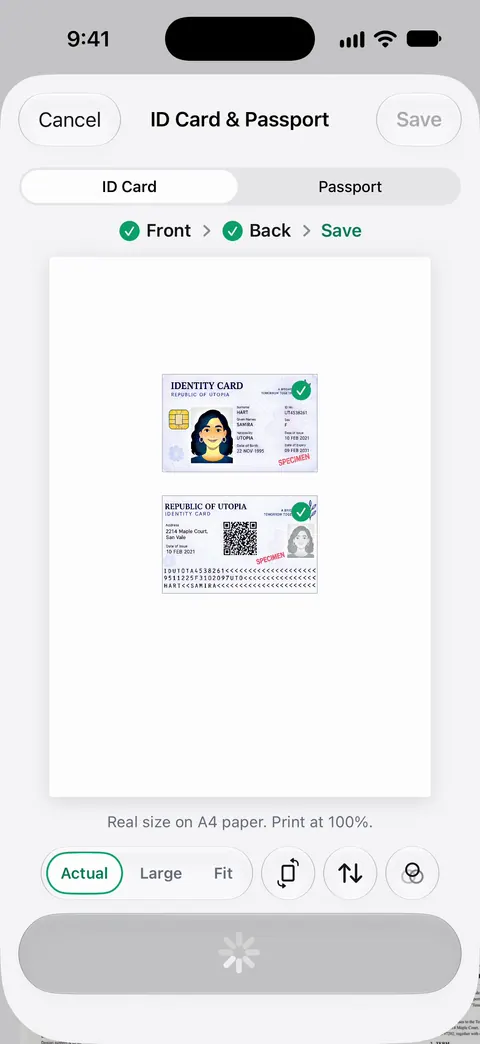
It helps with the copies around them. ID cards and passports are scanned with both sides on one printable page. That is the front-and-back copy of your ID that the DS-11 asks for, on one sheet. Scanner One finds the edges of the page automatically and corrects the perspective. Share & Export can also print a document or email it to you.
One thing to know before you print the photocopies: On a free account, pages you share, print or export carry a small “Scanned with Scanner One” label at the bottom right. Pro removes it. If you’d rather hand over an unmarked copy, print it from the Notes or Files scan instead.
Coming in 1.0.1. Packs: say what you’re applying for, like a visa, a lease or your taxes, and see which papers you have and what’s missing. See Packs.
Questions and answers
Can I use a hospital birth certificate to get a passport?
Not as your main proof. The DS-11 instructions want a birth certificate issued by the city, county or state, with the registrar’s signature and seal and a filing date within a year of birth. A hospital birth record is listed only as secondary evidence, for when no qualifying certificate exists.
Do they keep my birth certificate?
No. The State Department returns citizenship evidence that isn’t damaged, altered or forged, usually in a separate mailing from the new passport. Photocopies are not returned.
Can I sign the DS-11 at home?
No. The form says not to sign until the acceptance agent asks you to. The agent gives the oath and watches you sign.
Does the photocopy need to show the back of my ID?
Yes. The DS-11 asks for a photocopy of the front and back of your identification, and of the front and back of your citizenship document if the back has printed information.
Sources
What this page says about Scanner One was checked against the app on .
- US Department of State, Form DS-11: Application for a U.S. Passport — who must apply in person, proof of citizenship, proof of identity, photocopies, photo, parental consent for minors, fees; form edition DS-11 04-2025, OMB expiration 06/30/2028
- USA.gov, Apply for a new adult passport — who uses DS-11, the documents and photocopies to bring, acceptance facilities; last updated 2026-03-23
- USA.gov, Get a passport for a minor under 18 — children apply in person, a parent must be present and sign, 5-year validity under 16; last updated 2026-03-23
- USA.gov, How to get a certified copy of a U.S. birth certificate — order from the vital records office of the birth state, the CDC directory; last updated 2025-11-17
- Apple Support, Scan documents on your iPhone or iPad (108963) — Scan Documents in Notes and Files; published 2026-02-13
- Scanner One on the App Store — the app’s own listing
Get Scanner One
Scanner One is free, with generous limits: scanning, clean PDFs and text search never stop.

Scanner OneScan, sign and ask anything
Scanner One is free, with generous limits: scanning, clean PDFs and text search never stop.