
Checklist
Schengen visa documents checklist
For a short-stay Schengen visa you give the consulate of your main destination a signed application form, a passport valid at least 3 months after you leave the Schengen area, a photo, travel medical insurance covering the whole Schengen area, and papers showing why you’re going, where you’ll stay, how you’ll pay and that you’ll go home. A national checklist such as the Dutch one adds details: bank statements, an employer letter, a travel reservation and €30,000 of insurance cover. Your consulate’s own list is the one that counts.

Who needs this visa depends on your passport. The EU keeps the list: nationals of the countries in Annex I of its visa regulation need a visa, and those in Annex II can visit for up to 90 days in any 180-day period without one. This checklist is for the first group, for short stays such as tourism or visiting family. It follows the EU’s own page and one national checklist, both read on 13 November 2026.
This is general information, not legal or immigration advice. Requirements change and differ by consulate and by country of residence. The consulate’s own list, for your purpose and where you live, is the one that counts. Fees are set by the consulate: check its page, they aren’t repeated here.
Where and when to apply
- Apply to the consulate of the country you’ll visit. Several countries? The one where you’ll stay longest; equal stays, the one you’ll enter first.
- Apply where you legally live, as a rule, through the consulate that covers your country of residence.
- No earlier than 6 months and at least 15 days before you travel. You may need to book an appointment before you can hand in the application.
- Expect fingerprints at the appointment, unless you’re in an exempt group.
The core documents, from the EU
The EU’s page lists what every short-stay application includes:
- The visa application form, completed and signed.
- A passport or travel document valid at least 3 months after you leave the Schengen area (for a multiple-entry visa, 3 months after you leave the last time).
- A photo that meets the ICAO standard.
- Travel medical insurance covering emergency medical care, hospital treatment and repatriation, including in the event of death.
- Supporting documents showing the purpose of your stay, your money for it, where you’ll stay, and that you intend to return home.
The consulate may ask for more.
What a national checklist adds: the Dutch example
The Netherlands publishes a checklist for tourism visas (updated 24 March 2025). It shows how much detail sits behind each line above:
Identity and form
- Application form: filled in online, printed with its unique code, and signed.
- Passport: no more than 10 years old, at least 2 empty visa pages, valid at least 3 months after you leave, and signed by you.
- Photo: color, no older than 6 months, 3.5 x 4.5 cm, light background. Not needed when a service provider takes a digital photo at the appointment.
- Proof of legal residence, if you live in a country you’re not a citizen of: a residence permit valid 3 months beyond your trip, a visa or a work permit.
Ties to home
- Employed: an employer statement with your job title, contract length and salary, plus 3 months of bank statements or payslips.
- Self-employed: a business permit or your tax return, plus 3 months of bank statements.
- Student: proof of enrollment showing your field and program length.
- Other ties: property you own, children’s school enrollment, or caring for someone at home.
The trip itself
- Accommodation for the whole trip: hotel reservations, a rental agreement, or proof of property you own there.
- Means: who pays. If it’s you, 3 months of bank statements and, if employed, your 3 latest payslips.
- Travel reservation in your name, to and from the Schengen area. A paid ticket is not required.
- Travel medical insurance in your name, valid in all Schengen countries for the whole stay, with at least €30,000 of medical cover.
Most items are asked for as a color copy, with originals for the form, passport and photo. Other countries’ lists are similar but not identical, so download the one for your consulate.
For a child under 18
The Dutch list asks, for a minor traveling without one or both parents, for the child’s birth certificate extract (original and copy), a parental consent form, and copies of the non-traveling parents’ passports. A death certificate, guardianship papers or a court decision may be needed in some cases. More on this in documents to travel with a child.
Mistakes that get applications refused or returned
- Insurance that covers one country instead of the whole Schengen area, or ends before your trip does.
- A passport that runs out less than 3 months after your return date, or is older than 10 years.
- Applying to the wrong consulate: not your main destination, or not the one for where you live.
- Bank statements that don’t cover the months asked for, or don’t show where the money came from.
- Hotel bookings that leave nights uncovered.
- A form printed without its online code, or unsigned.
The Dutch missions ask you to sign a declaration that incomplete applications may be rejected and fees are not refunded. A complete file the first time matters.
Getting the papers ready
Book the appointment first, then gather. If it is next week, your visa appointment is next week puts the steps in order. For the copies, scan each set into one file: all the bank statements together, all the bookings together (several pages into one PDF). Print in color when the checklist says color copy.
ETIAS, the EU’s new travel authorization, is for visa-exempt travelers only. On the day we checked, the EU’s site said it is not in operation yet.
Where Scanner One helps, and where it doesn’t
Scanner One doesn’t know your consulate’s list, book appointments or judge whether a document is enough. The consulate decides.
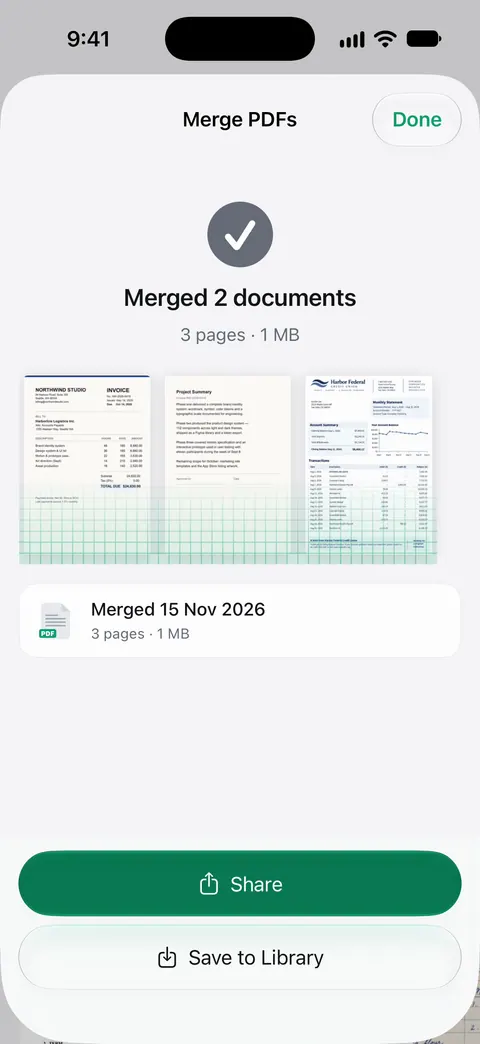
It helps with the paper. A scan can have many pages, and you can reorder them. Scanner One finds the edges of the page automatically and corrects the perspective. ID cards and passports are scanned with both sides on one printable page. The PDF tools merge, split, compress, password-protect, add page numbers and watermarks, and extract text. That covers merging statements into one file and shrinking a PDF for an upload limit; free accounts can run those tools 3 a week.
Before you print or upload copies: On a free account, pages you share, print or export carry a small “Scanned with Scanner One” label at the bottom right. Pro removes it.
Coming in 1.0.1. Packs: say what you’re applying for, like a visa, a lease or your taxes, and see which papers you have and what’s missing. Pro checks each paper in a Pack against what’s asked. See Packs.
More trip lists are on the checklists page.
Questions and answers
Which country’s consulate do I apply to?
The country you’re visiting. If you visit several, the EU says to apply to the one where you’ll spend the longest time; if the stays are equal, the one you’ll enter first. As a rule you apply in the country where you legally live.
How early can I apply for a Schengen visa?
The EU says no earlier than 6 months before your trip and at least 15 days before it. Many consulates need an appointment first, so start looking for one as soon as your dates are firm.
Do I need a paid flight ticket?
Not at the Dutch missions: their checklist asks for a reservation in your name to and from the Schengen area, and says a paid ticket is not required. Other consulates set their own rules, so check theirs.
Is ETIAS a visa, and do I need it now?
No to both. ETIAS is a travel authorization for visa-exempt travelers, not a visa. On 13 November 2026, the EU’s ETIAS site said it is not in operation and that no applications are being collected. The EU says it will announce the start date several months ahead.
Sources
What this page says about Scanner One was checked against the app on .
- European Commission, Migration and Home Affairs: Applying for a Schengen visa — where and when to apply, the required documents, travel medical insurance, fingerprints; page dated 2025-12-02
- European Commission, Migration and Home Affairs: Visa policy — who needs a visa (Annex I) and the 90 days in 180 rule for visa-exempt travelers; page dated 2025-06-23
- NetherlandsWorldwide, Checklist: Applying for a Schengen visa for tourism — a national mission’s item-by-item checklist; published 2025-03-12, updated 2025-03-24
- European Union, ETIAS official website — ETIAS is not in operation and no applications are collected; read 2026-11-13
- Scanner One on the App Store — the app’s own listing
Get Scanner One
Scanner One is free, with generous limits: scanning, clean PDFs and text search never stop.

Scanner OneScan, sign and ask anything
Scanner One is free, with generous limits: scanning, clean PDFs and text search never stop.