
Checklist
Documents you need for a UK Standard Visitor visa
For a UK Standard Visitor visa you need a passport valid for your whole stay, and evidence that you’ll leave at the end of the visit, can pay for yourself and your journey home, and won’t make the UK your home. GOV.UK’s supporting documents guide suggests an employer or school letter, recent bank statements showing where the money comes from, copies of old passports showing travel, and, if someone else pays, their proof of funds and relationship to you. Documents not in English or Welsh need a certified translation.

The UK’s visitor rules turn on one question: are you a genuine visitor who will leave on time and can pay your way? Every document on this list answers part of it. Requirements here come from GOV.UK’s Standard Visitor guide and its supporting documents guide (updated 8 October 2026), both read on 13 November 2026.
This is general information, not legal or immigration advice. UK requirements change, and GOV.UK’s current pages win over anything here. Visa fees change too: they are on GOV.UK, not repeated on this page.
Visa, ETA or neither
Depending on your nationality, GOV.UK says you will either need a Standard Visitor visa before you travel, need an electronic travel authorisation (ETA) that allows visits of up to 6 months, or be able to visit for up to 6 months with neither. Check which applies before you collect anything. People with a past refusal of entry or a criminal record may want a visa even if they don’t strictly need one.
Documents you must have
- A passport or travel document valid for the whole of your stay in the UK.
- Evidence that you’ll leave at the end of your visit.
Details the online form asks for
Have these in front of you before you start:
- Your travel dates and where you’ll stay
- How much you think the trip will cost
- Your home address and how long you’ve lived there
- Your parents’ names and dates of birth, if known
- Your yearly income, if you have one
- Any criminal, civil or immigration offences
Depending on your situation, also your travel history for the past 10 years, your employer’s address and phone number, your partner’s name, date of birth and passport number, who is paying for the trip, and details of family members in the UK. Visiting for more than 6 months? You may need a tuberculosis test certificate.
Supporting documents that show a genuine visit
GOV.UK’s guide lists the kinds of papers that help, and says the list isn’t exhaustive:
Your life at home
- A letter from your employer on headed paper, with your role, salary and how long you’ve worked there.
- A letter from your school or university on headed paper confirming you’re enrolled and have leave.
- Business registration documents or recent invoices, if you’re self-employed.
- Copies of previous passports showing travel to other countries.
- Proof of legal residence, if you live in a country you’re not a citizen of.
Money for the trip
- Bank statements that show where the money came from.
- Building society books, with the same detail.
- Proof of earnings, such as an employer letter with start date, salary, role and company contact details.
If someone else pays
The person supporting you should show what support they’re giving and how, that they can afford it, how they’re related to you, and that they’re legally in the UK if they live there.
Business visits
A letter of invitation from the organizer of a conference or business event. For visits to work with UK colleagues, a letter from your employer saying so.
For a child under 18
- Proof of the relationship to at least 1 parent or guardian, such as a birth certificate or adoption papers.
- A copy of a parent’s passport photo page, with their signature and passport number, if that parent isn’t applying too.
- If the child isn’t traveling with a parent: a signed letter from the parent or guardian with their consent, who the child travels with (with that adult’s passport number), who will look after the child in the UK, and how the child will travel.
Documents to travel with a child covers consent letters more broadly.
Translations and copies
- Anything not in English or Welsh needs a full translation with the translator’s confirmation that it’s accurate, the date, their full name and signature, and their contact details.
- GOV.UK says that wherever possible, digital images should be taken of original documents, not copies.
- Families applying together don’t need to send the same document more than once.
Mistakes that weaken an application
- Bank statements that show a balance but not where the money came from: the guide asks for statements that detail the origin of the funds.
- No proof of a job, studies or other ties at home.
- A sponsor’s letter with no evidence of the sponsor’s own funds.
- Untranslated documents, or a translation without the translator’s details.
- Photos of photocopies instead of the originals.
GOV.UK warns that presenting these documents doesn’t guarantee a visa, so wait for the decision before booking anything you can’t cancel. If the appointment is close, your visa appointment is next week helps you order the week. The Schengen area has its own list: Schengen visa documents.
Where Scanner One helps, and where it doesn’t
Scanner One can’t tell you whether your evidence is strong enough, and it doesn’t translate certified documents. Those are for you, a translator and the Home Office.
It helps make the clear images of originals that GOV.UK asks for. Scanner One finds the edges of the page automatically and corrects the perspective. A scan can have many pages, and you can reorder them. Put each kind of evidence in its own PDF, such as 6 months of statements in one file. The PDF tools merge, split, compress, password-protect, add page numbers and watermarks, and extract text. Free accounts can use the PDF tools 3 a week. Documents stay on your iPhone unless you share them or turn on iCloud Sync.
Before you upload or print: On a free account, pages you share, print or export carry a small “Scanned with Scanner One” label at the bottom right. Pro removes it.
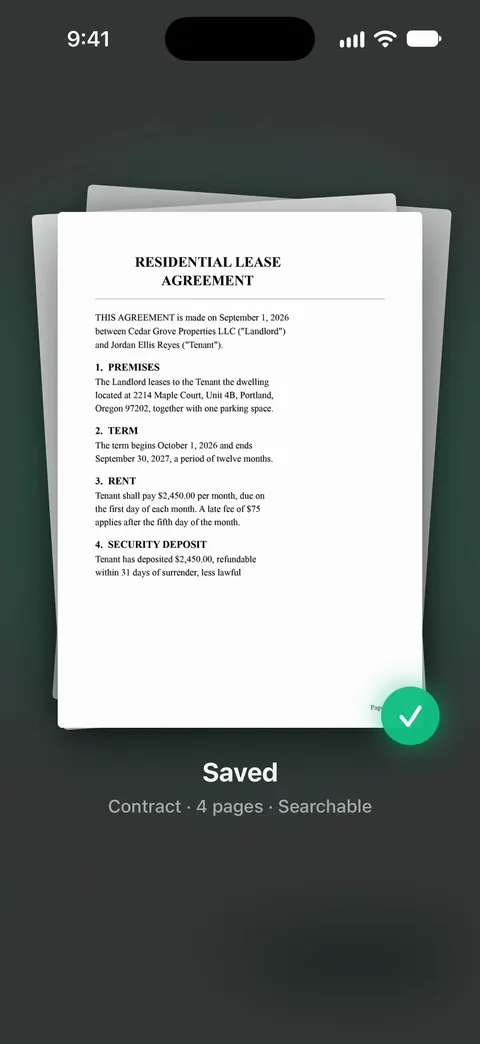
Coming in 1.0.1. Packs: say what you’re applying for, like a visa, a lease or your taxes, and see which papers you have and what’s missing. See Packs.
Questions and answers
Do I need a visa or an ETA to visit the UK?
It depends on your nationality. GOV.UK says some nationalities must get a Standard Visitor visa, some must get an electronic travel authorisation (ETA), and some can visit for up to 6 months with neither. Use GOV.UK’s check before you apply for anything.
How far ahead can I apply?
GOV.UK says the earliest you can apply is 3 months before you travel. You apply online, then go to a visa application centre to give your fingerprints and photo.
Do I need an invitation letter?
Not as a rule. GOV.UK’s guide asks for a letter of invitation from the organizer if you’re attending a business event or conference, and suggests letters from inviting organizations for work or study-related visits. For a family visit, evidence of who is paying and your relationship to them helps if someone else funds the trip.
Do they keep my passport?
No. GOV.UK says you get your passport or travel document back the same day as your appointment. The visa application centre may keep some other documents while it processes the application.
Sources
What this page says about Scanner One was checked against the app on .
- GOV.UK, Visit the UK as a Standard Visitor — who needs a visa or an ETA, permitted activities, eligibility, the information and documents for the online application, biometrics appointment, eVisa; read 2026-11-13
- GOV.UK, Visiting the UK: guide to supporting documents — the documents that show a genuine visit, sponsors, children, business visits, translations; updated 2026-10-08
- Scanner One on the App Store — the app’s own listing
Get Scanner One
Scanner One is free, with generous limits: scanning, clean PDFs and text search never stop.

Scanner OneScan, sign and ask anything
Scanner One is free, with generous limits: scanning, clean PDFs and text search never stop.