
Guide
How long to keep medical bills and records
Keep a medical bill until it is paid, matches what your insurer or Medicare says you owe, and nothing about it is in dispute; the FTC suggests about a year for undisputed bills. Keep bills longer if you deduct medical costs on your taxes: the IRS says to keep the records behind a deduction, usually for 3 years after you file. Keep vital health records, such as vaccinations and major illnesses, for good.

This page is general information from the FTC, the IRS and Medicare, not medical, tax or legal advice. Rules change and vary by state, so check the pages under Sources.
Four kinds of paper, four clocks
Health paperwork comes in four kinds, and each one has its own reason to keep it.
- The bill, from the doctor, hospital, lab or pharmacy. It says what they want you to pay.
- The insurer’s statement, often called an explanation of benefits. It says what was billed, what the plan paid and what you may owe. People with Original Medicare get a Medicare Summary Notice instead, which Medicare says is not a bill.
- The record of payment: a receipt, a card statement, a canceled check.
- The medical record itself: test results, vaccinations, surgeries, diagnoses, discharge summaries.
| Paper | Keep it | Keep it longer when | Source |
|---|---|---|---|
| Medical bills, paid and undisputed | About 1 year | You deduct medical expenses on your taxes | FTC, IRS |
| Insurer statements and Medicare Summary Notices | Until the matching bill is settled | An appeal or dispute is open, or they back a deduction | Medicare, IRS |
| Proof of payment | With the bill | It supports a tax deduction | IRS |
| Records of your health coverage | With that year’s tax records | You claim the premium tax credit | IRS |
| Disputed bills and every letter about them | Until the dispute is settled in writing | The amount could still come up | Practical rule |
| Vital health records | Forever | Always | FTC |
| Prescription information for medicines you no longer take | Shred | Never | FTC |
Check the bill against the notice before you file it
The most useful thing you can do with a medical bill is compare it. Medicare’s advice for the Medicare Summary Notice works for any insurance:
- Keep your receipts and bills, and compare them with the notice to be sure you got every service, supply or piece of equipment listed.
- If you paid a bill before the notice came, check that you paid the right amount.
- If something was denied, call the provider’s office to make sure they sent the right information. They may resubmit.
- If you disagree with a decision, you can appeal. Medicare’s notice explains how on its last page. For other insurance, ask the plan’s member services how to appeal.
Medicare says you get a Summary Notice every 6 months if you had services in that period, and you can choose to get them electronically instead.
If a bill makes no sense at all, the guide to a medical bill you do not understand lists what to gather and who to ask.
Disputed bills: keep everything until it is closed
Keep the bill, the insurer’s statement, any estimate you were given, and every letter, email and note of each call. The No Surprises Act, which CMS explains on its medical bill rights page, protects most people from many unexpected out-of-network bills, for example after emergency care. If you don’t have or use insurance, providers usually must give you a good faith estimate when you schedule care in advance or ask for one, and you may be able to dispute a bill that comes in well above it. The CMS page gives the threshold and the steps.
Keep the whole file until the dispute is settled in writing, and then keep the final letter.
Bills you deduct: the tax clock applies
If you itemize and deduct medical and dental costs, Publication 502 says to keep records of those expenses to support the deduction, and not to send them with a paper return. They become tax records, so the IRS periods apply: usually 3 years after you file. Topic 305 also asks you to keep records of your own and your family’s health coverage. The full set of periods is in how long to keep tax records.
Your medical records: keep the important ones for good
The FTC’s keep-or-shred list puts “vital health records (especially those that pre-date electronic health records)” in its keep-forever group, next to birth certificates and passports. These are the papers that would be hard to rebuild: vaccination records, surgery and hospital summaries, results that show a long-term condition, records for a child.
Ask your doctor’s office or patient portal for copies of the ones you would want, while they are easy to get. Keep them somewhere you could reach in an emergency, and somewhere a family member could find them. The guide to keeping medical records on your iPhone covers the phone side, and anyone signing up for Medicare will find the Medicare enrollment checklist useful.
Shred with care
Medical papers carry insurance numbers, diagnoses and your date of birth. Shred them when they are done rather than putting them in recycling. For every other paper in the house, the keep or shred chart has the full list.
Where Scanner One helps, and where it doesn’t
Scanner One does not read your insurance plan, and it does not tell you whether a bill is right. The comparison is yours, and your insurer or Medicare has the final word.
What it does is keep the bill and the notice side by side and easy to find. Point your camera at any piece of paper. Scanner One finds the edges, straightens the page, cleans it up and saves a real PDF. Then it reads the text, names the document, tags it and puts it in the right folder. Search looks inside the text of every document and shows the matching line and page. So the lab bill from March is a search for the lab’s name.
Ask your documents anything. When does the lease end? What did I spend at the shop? The answer comes back with the page it came from. You can ask what a bill says you owe, or when it is due, and see the page the answer came from. On a free account you can ask 3 questions a day.
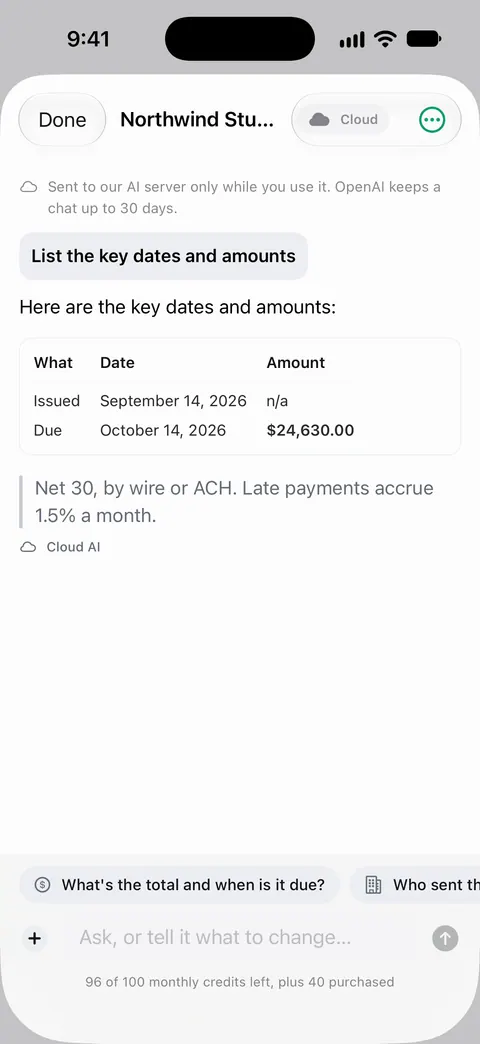
Medical papers are private. Documents stay on your iPhone unless you share them or turn on iCloud Sync. Cloud AI is off until you switch it on, and page images are a separate permission. You can lock the app with Face ID.
If you get your bills and statements in your insurer’s app and pay them there, that may be all you need. Scanner One helps most with the paper that still comes by mail.
Questions and answers
Should I keep paid medical bills?
Keep a paid bill until you are sure it is settled: the insurer’s or Medicare’s notice shows the same amount you paid, and the provider shows a zero balance. The FTC suggests about a year for undisputed bills. If you deduct medical expenses, keep the bill with that year’s tax records instead.
How long should I keep explanation of benefits statements?
Treat them like the bills they explain: keep each one until the matching bill is paid and settled, and longer if it supports a tax deduction or an open dispute or appeal.
Do I need to keep my own medical records if my doctor has them?
The FTC lists vital health records among the papers to keep forever, especially records from before your providers used electronic health records. Doctors' offices close and move, and a copy of your own history, vaccinations and major treatments is easy to keep.
What medical papers can I shred?
The FTC lists prescription information for medicines you no longer take. Settled, undisputed bills you do not deduct can go after about a year. Shred rather than recycle anything with your name, insurance numbers or diagnoses on it.
Sources
What this page says about Scanner One was checked against the app on .
- FTC Consumer Alert, Protecting your personal information: Which documents to keep and which to shred — undisputed medical bills kept for a year; vital health records kept forever, especially those that pre-date electronic health records; prescription information for medicines you no longer take shredded; dated 10 June 2025
- IRS, Publication 502 (2025), Medical and Dental Expenses — keep records of medical and dental expenses to support your deduction, and don’t send them with a paper return; for use in preparing 2025 returns
- IRS, How long should I keep records? — the period of limitations for records that support a return; page last reviewed or updated 30 June 2026
- IRS, Topic no. 305, Recordkeeping — keep records of your own and your family’s health coverage, and premium tax credit information; page last reviewed or updated 13 October 2026
- Medicare.gov, Medicare Summary Notice (MSN) — the MSN is not a bill; it comes every 6 months if you had services; keep receipts and bills and compare them; appeal steps on the last page; read 2026-11-13
- CMS, Medical bill rights (No Surprises Act) — protection from many surprise out-of-network bills, the good faith estimate for people without insurance, and when you may dispute a bill; read 2026-11-13
- Scanner One on the App Store — the app’s own listing
Get Scanner One
Scanner One is free, with generous limits: scanning, clean PDFs and text search never stop.

Scanner OneScan, sign and ask anything
Scanner One is free, with generous limits: scanning, clean PDFs and text search never stop.