
Guide
How long to keep receipts
Keep a receipt for as long as it proves something. Receipts that back up your tax return stay for as long as the IRS can question that return, usually 3 years. Receipts for home improvements and major appliances stay as long as you own the home or the appliance, with the warranty. Everyday receipts can go once the return window has passed and the charge looks right on your statement. The FTC says to shred ATM receipts.

This page is general information from the IRS and the FTC, not tax or legal advice. Your situation may call for a longer period, so check the official pages under Sources.
Keep a receipt as long as it proves something
A receipt is proof. It proves you paid for a deduction, what you spent on your home, when you bought the fridge, or that the store charged you twice. Once nothing is left to prove, it can go. So the question is never “how long do receipts last” but “what is this one for”.
That gives four kinds of receipt, each with its own clock.
The receipt-by-receipt table
| Receipt | Keep it | Why | Source |
|---|---|---|---|
| Receipts that back up a deduction or credit on your tax return | Usually 3 years after you file; longer in the cases the IRS lists | It proves the number on the return | IRS |
| Home improvement receipts | As long as you own the home, then until 3 years after the return for the year you sell | Improvements add to the home’s basis and lower the taxable gain | IRS, FTC |
| Major appliance receipts | As long as you own the appliance, with the warranty | Proof of purchase date and that you are the original owner | FTC |
| Receipts for anything under warranty | Until the warranty ends | A warranty claim usually needs the purchase date | FTC |
| Work expense receipts you are reimbursed for | Until the reimbursement is paid and your employer’s own deadline passes | Your employer may ask for them | Your employer’s policy |
| Everyday shopping | Until the return window closes and the charge is right on your statement | Returns and billing disputes | FTC |
| ATM receipts | Shred | Nothing to prove after the statement arrives | FTC |
Tax receipts: as long as the return can be questioned
The IRS says to keep the records that support your return until the period of limitations runs out. For most people that is 3 years after filing. It is 6 years if you left out income worth more than 25% of the income on your return, 7 years if you claimed a loss from worthless securities or a bad debt, and indefinitely if you did not file or filed a fraudulent return.
Which receipts count: anything behind a deduction or credit. Charity gifts, medical costs you deduct, childcare, education, business costs if you are self-employed. The full set of periods is in how long to keep tax records.
The FTC’s own keep-or-shred list puts “tax-related documents, like canceled checks, receipts, W-2s, and 1099s” in its keep for at least three years group, and adds that the IRS sometimes asks for longer.
Receipts for your home: until you sell, and then some
Publication 523 explains that improvements add to the value of your home, prolong its life or adapt it to new uses, and that they raise your basis, which lowers the gain when you sell. Its examples include an added bedroom or deck, a new driveway or fence, landscaping, a new heating system, central air and new wiring. Routine repairs and painting generally do not count.
Because those receipts can lower your tax years from now, keep them for as long as you own the home. After the sale, the IRS rule for property records applies: until the period of limitations ends for the year you sold. The FTC’s list agrees: home improvement receipts stay while you own the home.
Receipts for big purchases: with the warranty
The FTC advises saving your receipt with the warranty, because it proves the date you bought the item and that you are the original owner. Its keep-or-shred list puts “sales receipts and warranty information for major appliances” in the keep while you own group.
A good habit: scan the receipt and the warranty card together as one document the day you buy, and note when the warranty ends. The warranty end dates guide shows how to get a reminder before it runs out.
Everyday receipts: until the statement and the return window clear
For groceries, clothes and most shopping, a receipt has two jobs: a return, and catching a billing mistake.
- Returns. The FTC notes that many stores will not take returns after a certain time, like 30 or 90 days. Check the window on the receipt or the store’s site.
- Billing errors. To dispute an error on a credit card bill, the FTC says your letter must reach the card issuer within 60 days after the first bill with the error was sent to you. Keep the receipt until the charge appears correctly on your statement.
After both have passed, the receipt has done its job. If it shows part of your card number, shred it rather than tossing it.
If a receipt is faded or lost
Scan the receipts you need to keep soon after you get them, while the print is still dark. The receipt scanning guide covers getting a sharp copy.
If the paper is gone, there are still ways to prove a payment. Publication 17 lists a financial account statement among the records that can show proof of payment, as long as it is legible. Many sellers can also find a purchase from your card or order number. For a warranty claim without the receipt, see what to do when you cannot find the receipt.
Where Scanner One helps, and where it doesn’t
Scanner One does not decide when a receipt can go. It keeps the ones you need readable and easy to find.
Scans come with Auto Clean, Color, Grayscale and Receipt filters. Here is a receipt after the Receipt filter, with crisp black text on white.
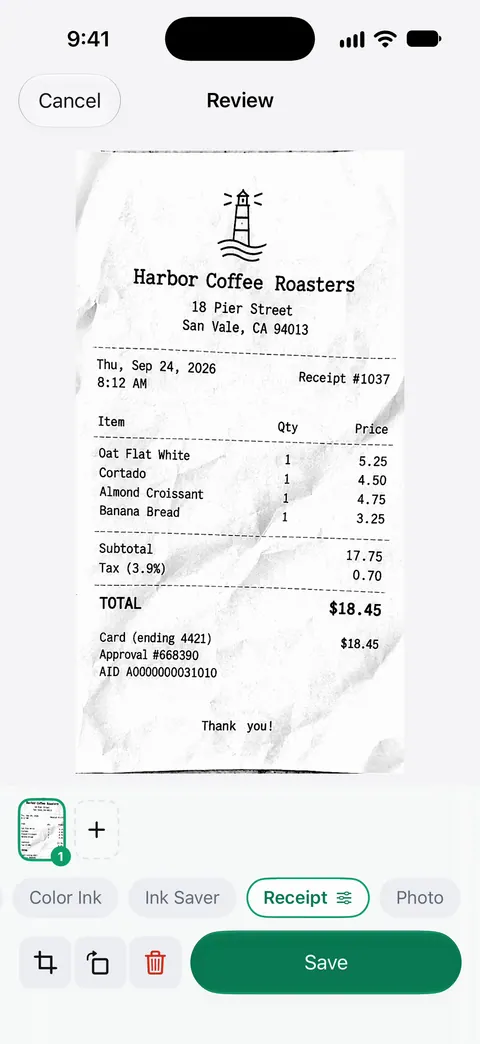
Then it reads the text, names the document, tags it and puts it in the right folder. Search looks inside the text of every document and shows the matching line and page. So the fridge receipt from three years ago is a search for the shop’s name, not an afternoon in a shoebox. Ask your documents anything. When does the lease end? What did I spend at the shop? The answer comes back with the page it came from.
On a free account, smart filing covers 10 documents a month and you can ask 3 questions a day. Text recognition runs on every page for everyone, free or Pro. If you send scanned receipts to your employer or accountant from a free account, On a free account, pages you share, print or export carry a small “Scanned with Scanner One” label at the bottom right. Pro removes it.
If you only keep a handful of receipts a year, a folder in the Files app or a scan in Notes is enough. Scanner One helps when there are hundreds and you need to find one.
Questions and answers
Do I need to keep grocery receipts?
Not for long. Once the charge shows correctly on your card or bank statement and you are past any return, there is nothing left for the receipt to prove. The exception is a purchase you deduct or get reimbursed for: keep that one with your tax or expense records.
How long should I keep receipts for taxes?
As long as the IRS can question the return they support. That is usually 3 years after you file, 6 years if you left out more than 25% of your income, and 7 years for a loss from worthless securities or a bad debt. Receipts that change the cost of property, like home improvements, stay until 3 years after you file the return for the year you sell.
What if a receipt fades or I lose it?
Scan receipts soon after you get them, while the print is still dark. If one is lost, the IRS accepts a legible bank or credit card statement as proof of payment, and many sellers can look up a purchase from your card or order number.
Should I shred receipts or just throw them away?
Shred anything with part of a card number, your name or an account on it. The FTC lists ATM receipts among the things to shred.
Sources
What this page says about Scanner One was checked against the app on .
- FTC Consumer Alert, Protecting your personal information: Which documents to keep and which to shred — tax receipts for at least three years, home improvement receipts and major appliance receipts while you own, ATM receipts to shred; dated 10 June 2025
- IRS, How long should I keep records? — the 3, 6 and 7 year periods and property records; page last reviewed or updated 30 June 2026
- IRS, Publication 17 (2025), Your Federal Income Tax — receipts, canceled checks and account statements as proof of payment; for use in preparing 2025 returns
- IRS, Publication 523 (2025), Selling Your Home — which improvements add to the basis of a home, and that repairs generally do not; for use in preparing 2025 returns
- FTC, Warranties — save the receipt with the warranty as proof of the purchase date; dated July 2023
- FTC, Using Credit Cards and Disputing Charges — a billing error letter must reach the issuer within 60 days after the first bill with the error was sent; keep your receipts; dated May 2022
- FTC, Solving Problems With a Business: Returns, Refunds, and Other Resolutions — many stores will not take returns after a certain time, like 30 or 90 days; dated September 2024
- Scanner One on the App Store — the app’s own listing
Get Scanner One
Scanner One is free, with generous limits: scanning, clean PDFs and text search never stop.

Scanner OneScan, sign and ask anything
Scanner One is free, with generous limits: scanning, clean PDFs and text search never stop.