
Situation
A warranty claim when you cannot find the receipt
Look for other proof of purchase first: the order confirmation email, the charge on your card or bank statement, your purchase history in the store’s app or account, a product registration you made, or a gift receipt. Read the warranty terms for what it covers and what it asks of you. Contact the seller, then write to the manufacturer with your proof, the model and serial number, and photos. If you never kept a copy of the receipt, a scan can’t help now, but other proof often can.

First, find proof another way
The receipt is not the only proof of purchase. What the seller and the manufacturer want to know is when you bought it and that you are the one who bought it. Work through these:
- Your email. Search for the store’s name, “order”, “receipt” or the product name. Online orders and many in-store purchases send a confirmation.
- The store’s app or website. Many keep a purchase history in your account, including in-store purchases linked to a loyalty card.
- Ask the store. Some can look a purchase up by the card you paid with or by your loyalty account and reprint it.
- Your card or bank statement. The line shows the store, the date and the amount. Download that month’s statement as a PDF.
- A product registration you made when you set it up: check your email for the confirmation.
- Delivery records, such as a shipping confirmation.
- The gift giver, if it was a present. A gift receipt or their order email works.
Put together whatever you find. Two partial proofs, such as a statement line and the delivery email, make a stronger case together than either does alone.
Read the warranty itself
You need the terms before you ask for anything. If the leaflet is gone, look up the model on the manufacturer’s website; by law, written warranties have to be available for you to read before you buy, so they are usually easy to find. Check:
- How long it lasts, and from when: usually the purchase date, which is why the receipt matters.
- What it covers: which parts, which problems, repair or replacement or refund.
- What you pay: labor, shipping, or nothing.
- What it asks of you, such as registration or using an authorized repairer.
- Whether it is “full” or “limited”. Under federal law, a full warranty can’t make you do things like return a registration card before you get service. A limited one can set conditions.
A warranty generally can’t require you to use a particular brand of parts or service to keep your coverage, unless those are provided free or the FTC has given a waiver.
Make the claim
The FTC’s order is simple:
- Contact the seller first. Explain the problem, show your proof, and ask what they can do.
- If that fails, write to the manufacturer. The warranty lists its address. Send the letter by certified mail with a return receipt, so you can prove it arrived.
- Include: the product, model and serial number; the date and place you bought it; your proof of purchase; a short description of the problem and when it started; photos; and what you are asking for.
- Keep copies of everything you send and a note of every call.
The company may have the right to try to fix it before it refunds you. And if you report a defect during the warranty period and it isn’t properly fixed, the company has to correct it, even if the warranty runs out in the meantime.
If they still say no
- Implied warranties may still apply. State law gives you unspoken promises, such as that a product does what it is meant to do. Unless the seller sold it “as is” where state law allows, these can apply even without a written warranty, and in some states they last up to four years.
- Complain. You can report the company to the FTC at ReportFraud.ftc.gov, to your state attorney general, or to your state or local consumer protection office.
Next time: keep the receipt with the warranty
The FTC’s advice is to keep the receipt together with the warranty, printed or downloaded if you bought online. The receipt proves the purchase date and that you are the original owner.
The simplest habit: when you unpack something with a warranty, scan the receipt and the warranty page together, and write the serial number on the scan’s name. Our guides to keeping warranties in one place and tracking warranty end dates set it up, and how long to keep receipts tells you when you can let go.
This page is general information, not legal advice. Warranty terms differ by product, and implied warranty rules differ by state.
Where Scanner One helps, and where it doesn’t
Honestly: a scan only helps if you made one when you bought the thing. If the receipt is already lost, Scanner One can’t bring it back. The steps above are your route.
For next time, it makes the habit easy. Point your camera at any piece of paper. Scanner One finds the edges, straightens the page, cleans it up and saves a real PDF. Scans come with Auto Clean, Color, Grayscale and Receipt filters. Then it reads the text, names the document, tags it and puts it in the right folder.
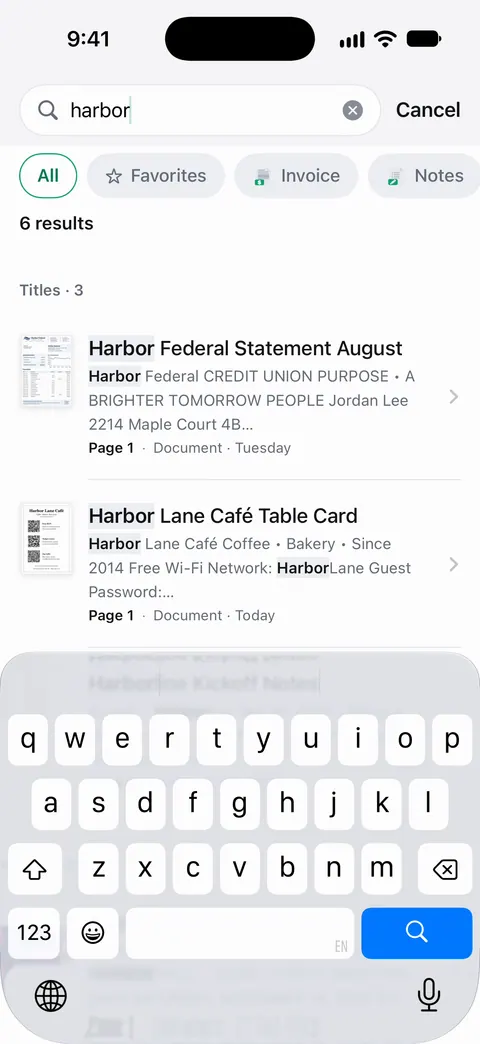
Search looks inside the text of every document and shows the matching line and page. Two years later, searching for the store’s name or the product finds the receipt and the warranty together.
Free accounts get smart filing for 10 documents a month. Documents stay on your iPhone unless you share them or turn on iCloud Sync. On a free account, pages you share, print or export carry a small “Scanned with Scanner One” label at the bottom right. Pro removes it.
Needs You gathers bills due, return windows and IDs about to expire on Home, from your own papers. That covers return windows, so a faulty purchase can go back to the store before the deadline.
Our guide to finding a document by a word inside it shows the built-in search too.
Questions and answers
Can I make a warranty claim without a receipt?
Often, yes, if you can prove when you bought it another way: an order email, a card or bank statement, the store’s purchase history, or a product registration. The receipt matters because it shows the purchase date and that you are the original owner, so any document that shows those helps.
Is a bank statement accepted as proof of purchase?
It can be. A card or bank statement that shows the store, the date and the amount answers the question a receipt answers: when and where you bought it. Whether it is enough is up to the seller or manufacturer, so ask, and send it with the serial number and the rest of your claim.
Do I have to register a product for the warranty to count?
Not for a full warranty: the FTC says requiring a registration card is not allowed in a full warranty. A limited warranty can make it a condition, so read the terms. A registration you did make is useful proof of the date.
What if the warranty runs out while I am waiting for a repair?
The FTC says that if you report a defect during the warranty period and it isn’t properly fixed, the company must correct it, even if the warranty expires in the meantime. Keep the record of when you first reported it.
Where can I complain if a company won’t honor the warranty?
To the FTC at ReportFraud.ftc.gov, your state attorney general, or your state or local consumer protection office.
Sources
What this page says about Scanner One was checked against the app on .
- FTC Consumer Advice, Warranties — written and implied warranties, keeping the receipt with the warranty as proof of the date and that you are the original owner, contacting the seller then the manufacturer in writing, defects reported during the warranty period, and where to complain; dated July 2023
- FTC, Businessperson’s guide to federal warranty law — Magnuson-Moss basics: full and limited warranties, registration cards not allowed as a condition of a full warranty, warranties available before purchase, tie-in sales; dated December 2006, tie-in sections updated March 2018
- Scanner One on the App Store — the app’s own listing: scanning, Receipt filter, search, filing
Get Scanner One
Scanner One is free, with generous limits: scanning, clean PDFs and text search never stop.

Scanner OneScan, sign and ask anything
Scanner One is free, with generous limits: scanning, clean PDFs and text search never stop.