
Situation
Your first job: the papers to keep
Keep your offer letter, a copy of your Form W-4 and any benefits or direct deposit forms, your pay stubs at least until you have checked them against your W-2, and each year’s W-2 with the tax return you file. For the Form I-9 on day one, you show the documents themselves: a U.S. passport, or a driver’s license plus a Social Security card or birth certificate. Then keep the originals safely at home. Tax records generally need keeping for 3 years.

Before day one: the documents you show
Every employer in the U.S. has to check your identity and that you can work, using Form I-9. You choose which documents to show from the lists USCIS publishes:
- One document from List A, which proves both. The common ones are a U.S. passport or passport card, a Permanent Resident Card, or an Employment Authorization Document with a photo. If you show a List A document, you shouldn’t be asked for anything else.
- Or one from List B plus one from List C.
- List B proves identity: a driver’s license or state ID card, a school ID with a photo, a voter registration card, a military ID and a few others. If you are under 18, a school record or a doctor’s or hospital record can count.
- List C proves you can work: an unrestricted Social Security card, a birth certificate (original or certified copy), and a few other government documents.
Two things trip people up. Documents must be unexpired, and a Social Security card that says it is valid only with work authorization is not acceptable as a List C document. A plain photocopy of a birth certificate won’t do either. If you need a replacement, start now; the Social Security card documents checklist shows what that takes, and the Form I-9 documents checklist has the full lists.
The forms you will fill in
Expect a small stack in your first week:
- Form W-4. It tells your employer how much federal income tax to withhold from your pay. You can give a new one whenever your situation changes.
- Your state’s withholding form, in most states.
- Direct deposit. Your bank’s routing and account numbers, often from a voided check or a letter from your bank.
- Benefits enrollment. Health insurance, retirement plan, and who your beneficiaries are.
- The handbook acknowledgment and any agreements, such as a confidentiality agreement.
- Emergency contacts.
Read each one before you sign. Ask HR for a copy of anything you sign, so you keep a record of what you agreed to.
The papers to keep, and why
| Paper | Why keep it | How long |
|---|---|---|
| Offer letter | Your pay, title, start date and anything promised | As long as you work there, and a little after |
| Signed agreements | What you agreed to, such as a non-compete | As long as they can apply to you |
| Copy of your W-4 | To check your withholding later | Until you file a new one |
| Benefits and retirement plan papers | What you are covered for and who your beneficiaries are | While you are enrolled |
| Pay stubs | To check against your W-2, and as proof of income | At least until the W-2 matches; longer if you are renting or borrowing |
| W-2 | You need it to file your taxes | With that year’s return, generally 3 years |
| Raise letters and reviews | The record of your progress | As long as you work there |
| Final pay and separation papers | If there is ever a question about what you were owed | Several years |
The IRS rule behind the last column: keep tax records for 3 years in most cases, longer in a few, and keep copies of your filed returns. Our guides on how long to keep pay stubs and how long to keep tax records go through the exceptions.
Check your first pay stub
Your first stub is the one most worth reading line by line:
- Hours and rate match what you worked and what the offer letter says.
- Taxes are being withheld: federal income tax, Social Security, Medicare, and state tax where it applies.
- Deductions are the ones you chose: health insurance, retirement contributions.
- Your name, address and the last digits of your Social Security number are right.
A mistake caught on the first stub is a quick fix. Caught in December, it is a long one.
At tax time
Early in the year your employer sends your W-2. With it, you have most of what a first-job tax return needs. The IRS’s list of what to gather also asks for your Social Security number and your bank details for a refund. Next year you will also need this year’s adjusted gross income, so keep a copy of the return.
Keep your ID papers safe
Once the I-9 is done, your Social Security card and birth certificate go back home, somewhere safe, not in your wallet. A scan on your phone covers almost every day-to-day need.
The new job paperwork checklist covers the rest of the first week.
This page is general information, not legal or tax advice. Employment and tax rules change: check the USCIS and IRS pages linked here.
Where Scanner One helps, and where it doesn’t
A first job brings a lot of single sheets that matter later. Point your camera at any piece of paper. Scanner One finds the edges, straightens the page, cleans it up and saves a real PDF. Then it reads the text, names the document, tags it and puts it in the right folder. Free accounts get smart filing for 10 documents a month.
Scan each pay stub when it arrives and the details on it are read for you.
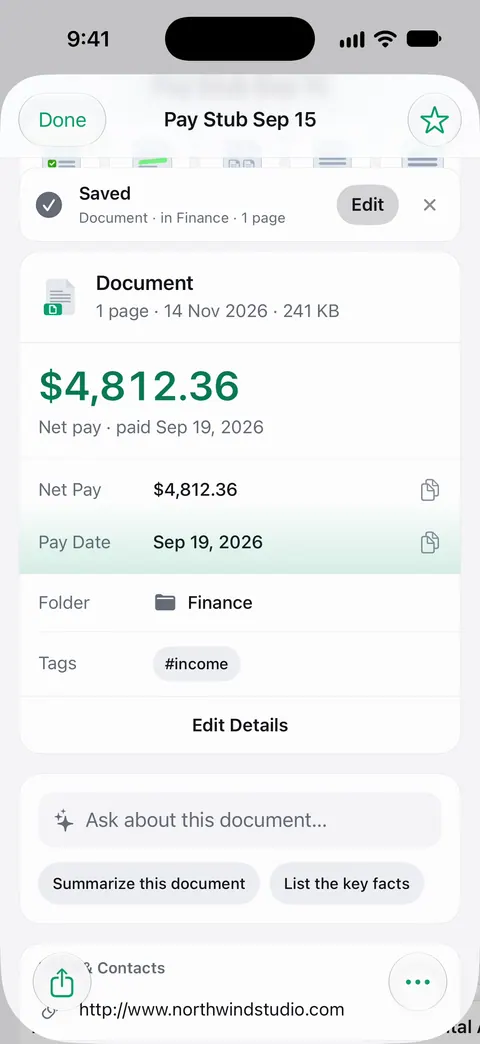
Search looks inside the text of every document and shows the matching line and page. Documents stay on your iPhone unless you share them or turn on iCloud Sync. You can lock the app with Face ID.
When you later send pay stubs to a landlord: On a free account, pages you share, print or export carry a small “Scanned with Scanner One” label at the bottom right. Pro removes it.
A scan doesn’t replace the documents you show for the I-9, and for a birth certificate only an original or a certified copy counts. For a few pages a year, the Notes scanner is enough too. See where to keep important documents on your iPhone.
Questions and answers
What documents do I need to start my first job?
For the Form I-9, either one List A document, such as a U.S. passport, or one List B document, such as a driver’s license or school ID with a photo, plus one List C document, such as an unrestricted Social Security card or a birth certificate. You choose which to bring. Your employer will also give you a W-4 and its own forms.
Can I use a photocopy of my birth certificate for the I-9?
No. USCIS says an employer may only accept an original or a certified copy of a birth certificate. A certified copy comes from the vital records office of the state where you were born.
Should I keep my pay stubs?
Yes, at least until you have checked them against your W-2 at the end of the year. Landlords and lenders often ask for recent ones as proof of income, and they are the first place to spot a payroll mistake.
What is a W-4 and do I need to fill in a new one?
It tells your employer how much federal income tax to take out of your pay. The IRS suggests a new one each year and whenever your situation changes, such as a second job, marriage or a child.
What if I lose my W-2?
Ask your employer for a copy. You can also see wage and income information in your IRS online account.
Sources
What this page says about Scanner One was checked against the app on .
- USCIS, Form I-9 acceptable documents — Lists A, B and C, the employee’s choice of documents, unexpired documents, restricted Social Security cards not acceptable, original or certified birth certificates only; last reviewed 2026-10-05
- IRS, About Form W-4 — what the W-4 is for and when to give your employer a new one; page last reviewed 2026-09-10
- IRS, Gather your documents — the W-2 and other papers needed to file; page last reviewed 2026-10-26
- IRS, How long should I keep records? — the 3-year rule and its exceptions; page last reviewed 2026-06-30
- Scanner One on the App Store — the app’s own listing: scanning, filing, search
Get Scanner One
Scanner One is free, with generous limits: scanning, clean PDFs and text search never stop.

Scanner OneScan, sign and ask anything
Scanner One is free, with generous limits: scanning, clean PDFs and text search never stop.