
Checklist
Insurance claim documents: what to gather for home, renters and auto claims
Report the claim quickly with your policy number and what happened. Then gather photos and video of the damage before you clean up, a list of everything damaged or lost, receipts for the items and for repairs, contractor or body shop estimates, and the police report number for theft or a crash. For a car accident, add the other driver’s name, insurer and plate, and witnesses' contacts. Keep a dated log of every call with your adjuster, and ask for decisions in writing.

A claim moves on evidence. The insurer pays for what you can show: what happened, what was damaged, what it was worth and what it costs to fix. Most of that evidence disappears quickly once the cleanup starts, so the order matters. This checklist follows the NAIC’s consumer guides and FEMA’s Emergency Financial First Aid Kit, read on 13 November 2026.
This is general information, not legal advice. Policies differ and so do state rules on deadlines. Your policy and your state insurance department are the final word.
First: report it
Call your agent or insurer, or use its app. The NAIC says to have ready:
- Your policy number
- Your name, address and phone number
- What happened and how bad the damage is
Write down the claim number and the adjuster’s name. The NAIC notes that the deadline to report damage varies by state, so don’t wait until you’ve gathered everything.
For every claim
- Your policy, with the declarations page, so you know your coverage limits and deductible.
- Photos and video of the damage, taken before anything is moved or cleaned.
- A dated log of every call and email with your agent or adjuster: who, when, what was said.
- Receipts for emergency repairs that stopped more damage, such as a tarp or a plumber.
- Written estimates for repairs.
Home and renters claims
- A list of all your damaged property. The NAIC says you’ll need it when you meet the adjuster.
- Receipts for the damaged items, and for repairs and replacements.
- Your home inventory, if you made one: photos or video of each room and your valuables, such as electronics, jewelry and collectibles.
- Appraisals for valuable items, if you have them.
- Contractor estimates. The NAIC suggests your contractor can meet you and the adjuster together.
- Receipts for living elsewhere, such as a hotel and meals, if the damage forced you out and your policy covers it.
- A police report number, for a burglary or vandalism.
No receipts? The NAIC suggests working from photos on your phone and from family and friends, and using online retailers to estimate prices. Renters insurance documents covers what to keep before anything happens.
Auto claims
At the scene, the NAIC lists:
- The other driver’s name, address, insurer and the insurer’s phone number, usually on their proof-of-insurance card. If you can’t get those, their driver’s license number and plate.
- The other car’s make, model, year and plate.
- Witnesses’ names and contact details.
- The officer’s name, badge number and contact, and how and when to get the accident report and its number.
- The time, date and exact location, with notes on the weather, road conditions and any skid marks.
- Photos or a sketch of the scene.
For a hit-and-run or a stolen car, call the police promptly. Then add the repair shop’s estimate, receipts for a rental car or towing, and any medical bills. After a car accident goes through the scene step by step.
If you disagree with the result
- Ask the adjuster for a written explanation of any decision.
- For a dispute over value, check your policy for an appraisal clause.
- You don’t have to accept a payment you think is unfair. If you can’t settle it, contact your state insurance department, with your documents, photos, emails and your call log.
Before you need it
FEMA’s financial first aid checklists suggest keeping copies of your policies (home, renters, auto, life, flood) and photos of your property and contents, with an extra copy somewhere safe in case the main one is damaged. The NAIC suggests storing your inventory off-site and updating it each year. When the renewal arrives, what to check at renewal helps you catch changes.
Mistakes that shrink a payout
- Throwing out damaged things before they’re photographed.
- No list of what was lost, just “the living room”.
- Agreeing to repairs you’re unsure about. The NAIC says not to feel rushed.
- Phone calls with no notes.
- Not knowing your deductible before you file.
Where Scanner One helps, and where it doesn’t
Scanner One doesn’t file claims, value your property or talk to adjusters. It also isn’t a camera roll for damage photos: take those with the Camera app.
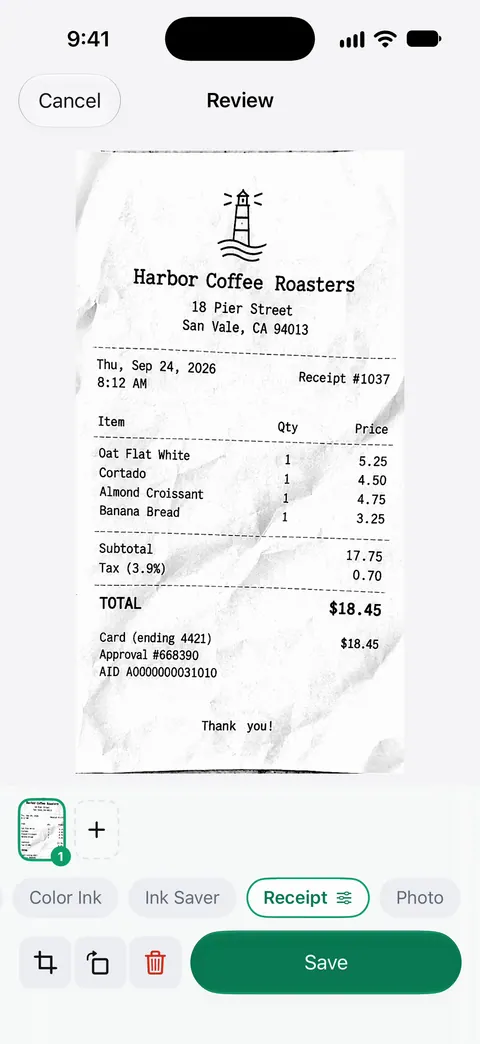
It is a good place for the paper side of a claim. Scans come with Auto Clean, Color, Grayscale and Receipt filters. The frame below shows a receipt after the Receipt filter, crisp black text on white. Scan paper receipts early, before they get lost or fade (scan receipts). A scan can have many pages, and you can reorder them. Search looks inside the text of every document and shows the matching line and page. Ask your documents anything. When does the lease end? What did I spend at the shop? The answer comes back with the page it came from. Documents stay on your iPhone unless you share them or turn on iCloud Sync.
Before you send pages to an adjuster: On a free account, pages you share, print or export carry a small “Scanned with Scanner One” label at the bottom right. Pro removes it.
Coming in 1.0.1. What changed compares the new version of a lease or policy with the one you signed. Packs: say what you’re applying for, like a visa, a lease or your taxes, and see which papers you have and what’s missing.
How long to hold on to old policies afterward: how long to keep insurance policies.
Questions and answers
How soon do I have to file an insurance claim?
As soon as you can. The NAIC says the deadline to report damage varies by state, and your policy sets its own. Report first, then gather the rest of the documents.
What if I don’t have receipts for things that were destroyed?
Work from what you have. The NAIC suggests going through photos on your phone and photos from family and friends, and checking online retailers to estimate what items cost. Bank and card statements can also show when and where you bought them.
Should I clean up before the adjuster comes?
Photograph and film everything first. Then do what you must to stop more damage, keep the receipts for it, and ask the adjuster before you throw damaged items away.
What can I do if I disagree with the claim decision?
Ask the adjuster to explain the decision in writing. For a dispute over the value, check your policy for an appraisal clause. If you still can’t agree, the NAIC says to contact your state insurance department, with your documents, photos, emails and a log of your calls.
Sources
What this page says about Scanner One was checked against the app on .
- NAIC, What you need to know when filing a homeowners claim — what to tell your insurer, photos and video, the damaged property list, receipts, home inventory; published 2022-04-20, modified 2024-06-11
- NAIC, What you should know about filing an auto claim — what to collect at the scene, reporting the claim, notes on conversations, disputes and the state insurance department; published 2022-03-28, modified 2024-04-26
- FEMA and Operation HOPE, Emergency Financial First Aid Kit: Checklists and Forms (FEMA P-2063) — policies, photos of property and contents, appraisals, keeping an extra copy; dated September 2019
- Scanner One on the App Store — the app’s own listing
Get Scanner One
Scanner One is free, with generous limits: scanning, clean PDFs and text search never stop.

Scanner OneScan, sign and ask anything
Scanner One is free, with generous limits: scanning, clean PDFs and text search never stop.