
Checklist
Documents to register a car: new, used or from another state
To register a car, bring proof you own it (the title signed over to you, or for a new car the manufacturer’s certificate of origin and the bill of sale), proof of insurance that meets your state’s rules, your driver’s license or ID, your state’s registration application, and payment for the fees and taxes. Many states also want a smog, emissions or safety inspection and an odometer statement. A dealer often registers the car for you. Deadlines, fees and forms differ by state, so check your DMV’s page.

Registering a car is mostly about proving three things: the car is yours, it’s insured, and it meets your state’s inspection rules. Each state’s motor vehicle agency sets its own forms, fees and deadlines, so this page gives the list that holds nearly everywhere, then shows how California, New York and Texas differ. Their DMV pages were read on 13 November 2026.
This is general information, not legal advice. Registration rules, fees and taxes change and differ by state, and sometimes by county. Find your own state’s motor vehicle agency through USA.gov and check its page before you go.
The core list
Proof that the car is yours
- The title, signed over to you. The seller (and any lienholder) signs it to transfer ownership. California asks for the seller’s signature on line 1 and yours on the title too. New York also accepts a transferable registration signed over to you, and wants the original, not a photocopy.
- For a new car: the manufacturer’s certificate of origin and the dealer’s bill of sale. New York lists both for a new car bought from an out-of-state dealer.
- A bill of sale. Useful in every private sale, and sometimes required: California asks for one signed by both the seller and the title owner when they aren’t the same person.
- An odometer disclosure. California asks for the mileage on cars less than 10 years old, on the title or on its form REG 262.
Proof of insurance
- An insurance ID card for the car, with coverage that meets your state’s minimum. New York tells you to insure the car first and register it within 180 days of the effective date on that card. Texas asks for the card at the county office.
Proof of who you are
- Your driver’s license or state ID. New York asks for proof of identity and age with a mail application. A new resident may need a new license too: the REAL ID checklist covers what DMVs ask for.
The application and payment
- Your state’s registration form: California’s REG 343 for a new car, New York’s MV-82. Many forms can be downloaded from your DMV’s site, so fill yours in before you go.
- Fees and taxes. New York’s first-time registration usually includes sales tax, a plate fee, a title fee, a use tax in most counties, and the registration fee itself. Amounts depend on the car and where you live, so use your DMV’s fee calculator. Payment methods vary; Texas says they vary by county.
An inspection, if your state requires one
- Smog or emissions: California asks for a smog certification for many gas cars. In Texas, an emissions inspection is needed before registration only in certain counties.
- Safety: New York gives you a 10-day inspection extension when you register, and the car must pass inspection before it runs out. Texas stopped requiring a safety inspection before registration for non-commercial vehicles on 1 January 2025.
Bought from a dealer
Dealers often do the paperwork. California says many are authorized to transfer the title and issue temporary registration until the plates and stickers arrive by mail. New York says a dealer can register and title a new car and issue plates, for a fee. Ask the dealer what they file, what you’ll get that day, and when the title comes. If your dealer doesn’t offer it, you register the car yourself with the papers above. The car buying checklist covers the rest of what to take home from the dealer.
Bought from a private seller
You do it all yourself, and fast. California gives the buyer 10 days to transfer ownership, and the seller 5 days to report the sale. Before you hand over money, check that:
- The name on the title matches the seller’s ID, and the VIN on the title matches the car.
- No lender is listed, or the seller gives you the lender’s release.
- The seller has signed every place they need to.
- You have the odometer reading in writing.
If the title has been lost, ask for a replacement to be applied for before you pay. In California, form REG 227 covers a lost, stolen or damaged title. The seller’s side of the deal is in selling your car: the paperwork.
Moving from another state
New York and Texas both give new residents 30 days after the move. Check your new state’s deadline as soon as you have an address.
- Your out-of-state title, or in Texas, the registration or title from your previous state as proof of ownership.
- Insurance for the new state. New York wants proof of New York liability insurance, not your old policy.
- If a lender holds your title: New York accepts a copy of the title with your name on it, certified by the lender on the same sheet, plus a letter on the lender’s letterhead with the owner, year, make and VIN.
- Where to go: in Texas, your county tax assessor-collector’s office.
New York even lets you apply by mail from out of state. It sends the plates, registration and a 10-day inspection sticker in one package, and the title separately. For the rest of the move, see moving house: the paperwork.
Three states side by side
| California | New York | Texas | |
|---|---|---|---|
| Where you go | DMV field office, or by mail for a private sale | DMV office, or by mail from out of state | County tax assessor-collector’s office |
| Deadline | 10 days after a private purchase | 30 days after moving; 180 days from the insurance card date | 30 days after moving |
| Application | REG 343 for a new car | MV-82 | Ask the county office |
| Inspection | Smog certification for many gas cars | Within 10 days after registering | Emissions in some counties; no safety inspection for non-commercial cars |
What you get, and what to keep
New York hands over or mails plates, a window sticker and the registration document, and mails the title within 90 days. When the title arrives, check that it matches the registration: name, VIN, make and year. Keep the title at home in a safe place, not in the glove box. The registration and insurance card ride in the car. Keeping car documents on your iPhone covers the copies.
Mistakes that send you back
- Bringing a photocopy of the title. New York wants the original.
- A title the seller forgot to sign, or signed in the wrong place.
- Insurance from your old state, or a card that has lapsed.
- Missing the deadline. California charges a late penalty if transfer fees aren’t paid in time.
- A seller whose name isn’t on the title, with no bill of sale from the owner.
- Skipping the inspection after registering, so the extension runs out.
Scan and send safely
Before you mail anything, scan the title (front and back), the bill of sale and the insurance card, so you have a copy if the envelope goes missing: scan several pages into one PDF. Send original documents only where the DMV asks for originals, and keep the scans until the new title arrives. More lists are on the checklists page.
Where Scanner One helps, and where it doesn’t
Scanner One doesn’t register a car, pay DMV fees or check a title’s history. Those go through your state.
For one bill of sale, the Notes app or the Files app on your iPhone scans the pages into a document, and that’s enough. Scanner One helps when you want the title, the bill of sale, the registration and the insurance cards kept together and findable for as long as you own the car. A scan can have many pages, and you can reorder them. Then it reads the text, names the document, tags it and puts it in the right folder. Search looks inside the text of every document and shows the matching line and page. Documents stay on your iPhone unless you share them or turn on iCloud Sync.
If you email those scans to a DMV or an insurer: On a free account, pages you share, print or export carry a small “Scanned with Scanner One” label at the bottom right. Pro removes it.
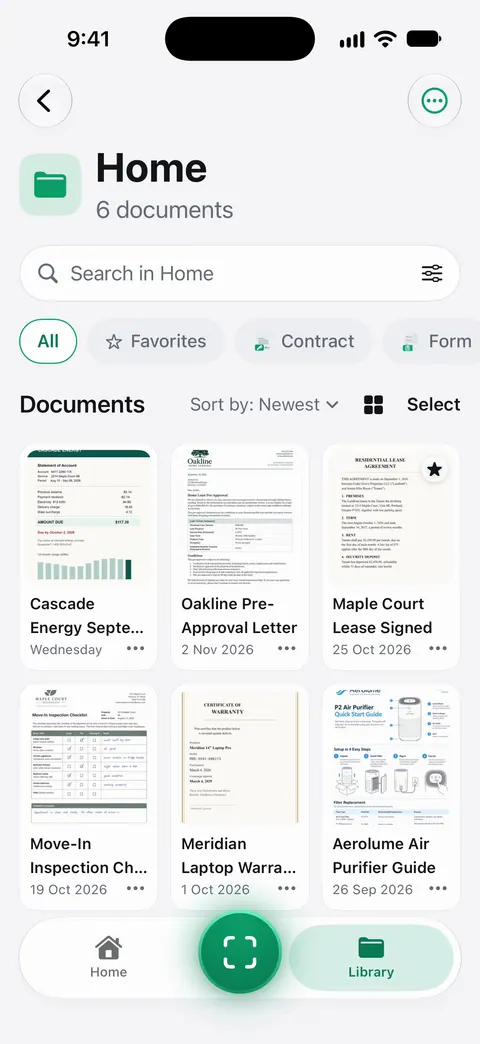
Coming in 1.0.1. Packs: say what you’re applying for, like a visa, a lease or your taxes, and see which papers you have and what’s missing. A car registration is that kind of list: title, insurance, ID, inspection.
Questions and answers
How long do I have to register a car after buying it?
It depends on the state. California gives a buyer 10 days after a private purchase to transfer ownership. New York and Texas give new residents 30 days after moving. Missing a deadline can cost a penalty, so check your DMV’s deadline on the day you buy.
Can I register a car without the title?
Usually not, because the title is the proof of ownership. If it was lost, a replacement has to be applied for first; in California, form REG 227 covers a lost title. If a lender holds the title, New York accepts a certified copy from the lender with a letter on its letterhead.
Do I need insurance before I register a car?
Plan on it. New York tells you to insure the car first and register it within 180 days of the effective date on your insurance ID card, and Texas asks for your insurance card at the county office.
Does the dealer register the car for me?
Often, yes. California says many dealers are authorized to transfer the title and issue temporary registration, and New York says a dealer can register and title a new car and issue plates, for a fee. Ask what the dealer files and when your plates and title will arrive.
Sources
What this page says about Scanner One was checked against the app on .
- USA.gov, State motor vehicle services — links to each state’s motor vehicle agency for registering a car; read 2026-11-13
- California DMV, Registration for a vehicle purchased from a private party — 10 days for the buyer, signed title, REG 227 for a lost title, bill of sale when the seller isn’t on the title, odometer record, smog certification; modified 2026-08-07
- California DMV, Registration for a vehicle purchased from a dealer — dealers often handle registration and issue temporary registration, REG 343 for a new car, signatures on the title, smog rules, transfer fees due within 10 days; modified 2026-10-30
- New York DMV, Register and title a vehicle — insure first, register within 180 days of the insurance card date, MV-82, what the fees cover, payment, plates and sticker, title by mail within 90 days, inspection within 10 days; read 2026-11-13
- New York DMV, Register an out-of-state vehicle — 30 days after moving, original proof of ownership, NY insurance, proof of identity and age, sales tax, proof of ownership for new and used cars, titles held by a lender; read 2026-11-13
- Texas DMV, Register your vehicle — 30 days for new residents, county tax assessor-collector office, insurance card and proof of ownership, no safety inspection for non-commercial vehicles since 1 January 2025, emissions inspection in some counties; read 2026-11-13
- Scanner One on the App Store — the app’s own listing
Get Scanner One
Scanner One is free, with generous limits: scanning, clean PDFs and text search never stop.

Scanner OneScan, sign and ask anything
Scanner One is free, with generous limits: scanning, clean PDFs and text search never stop.