
Checklist
Documents for a Medicaid application
Apply for Medicaid through your state’s Medicaid agency or HealthCare.gov, any time of year. Have each household member’s Social Security number and date of birth, your address, how you file taxes, current income for everyone (pay stubs, W-2s, self-employment, benefits, pensions), any current health coverage with policy numbers, and immigration document details for non-citizens. States check much of this electronically and ask for papers only when they can’t, so answer requests quickly. Citizenship proof can be a US passport, or a birth certificate plus ID.

This page is the paper side of applying for Medicaid, the state health coverage for people with limited income. If you’re turning 65 and signing up for Medicare, that’s a different program: see documents you need to sign up for Medicare. Medicaid is run by each state, so this is a national overview from HealthCare.gov and the federal Medicaid rules, read on 13 November 2026.
This is general information, not legal, financial or medical advice. Each state runs its own Medicaid program, with its own forms, income limits and rules for long-term care, and they change. Check your state Medicaid agency’s site, or HealthCare.gov, before you apply. Income limits are not repeated here.
How to apply
- Through your state Medicaid agency, online, by phone, by mail or in person.
- Or through HealthCare.gov. If it looks like someone qualifies, the Marketplace sends your information to the state, which contacts you.
- Any time of year. There’s no enrollment period.
- Apply even if you’re unsure. HealthCare.gov says states consider more than income, including pregnancy, children and disability.
What the state checks, and why that matters
Federal rules say states verify what they can from electronic data sources first. They ask you for documents only when the data isn’t available or doesn’t match what you said, and they must give you a reasonable time to answer. So you may need fewer papers than you fear. Have them ready anyway, so a request doesn’t stall your case.
About everyone in the household
- Full name, date of birth and relationship to you, for each person.
- Social Security number for each person, including people not applying. If someone has none, you may need to give more information later.
- Home and mailing address. Where you live decides which state’s program you apply to.
- How you file taxes: jointly or separately, and who you claim as dependents.
Proof of income
For everyone in the household, including people not applying:
- Pay stubs, usually the most recent ones.
- W-2s, and your latest tax return if you have one.
- Tips.
- Self-employment income: your records of what you earned and spent, or Schedule C.
- Unemployment benefits: the state’s letter or payment record.
- Social Security, including disability payments, but not SSI.
- Pensions and retirement withdrawals, including most IRA and 401(k) withdrawals.
- Interest, dividends and rental income.
- Alimony from divorces finalized before 2019.
If your income changes month to month, HealthCare.gov says to give your best estimate and update it later.
Citizenship or immigration status
US citizens
Federal rules accept these on their own:
- US passport or passport card.
- Certificate of Naturalization or Certificate of Citizenship.
- A data match with Social Security or the state’s birth records, which the state may do for you.
Or a citizenship document plus an ID:
- A US birth certificate, or a Consular Report of Birth Abroad, plus
- A driver’s license, school ID, military ID or other government photo ID.
Non-citizens
- Your immigration document details: the type, number and dates. HealthCare.gov’s checklist says the application asks for information from these documents.
Health coverage
- Any current coverage, for anyone in the household: Medicaid, CHIP, Medicare, TRICARE, VA, COBRA, retiree, employer or individual plans, with policy numbers from the insurance card.
- Job-based coverage offered to anyone in the household, even if they didn’t take it. HealthCare.gov’s Employer Coverage Tool is a worksheet for collecting this from the employer.
Situations that need more
- Pregnancy, disability or long-term care coverage: your state may ask for more, and the rules differ most here. Follow your state agency’s own checklist.
- Proof of address, if the state can’t confirm it: a lease, utility bill or official letter. How to prove your address has ideas.
If you don’t have a document
Federal rules let you attest to some facts when documents don’t exist or aren’t reasonably available, for example if you’re homeless, fleeing domestic violence or affected by a disaster. That doesn’t cover proof of citizenship or immigration status, which federal law requires.
Mistakes that delay applications
- Leaving out a household member who isn’t applying.
- Old pay stubs that no longer match your income.
- Missing the deadline on a request for information.
- A birth certificate sent without an ID to go with it.
- Not reporting a change after you’re approved.
Sending documents
States take documents in different ways, online, by mail or in person, and the request letter says how. Scan clearly and keep a copy of everything you send. Scan a birth certificate covers that one, and how long to keep pay stubs explains why recent ones are worth holding on to. If you also need food help, documents for a SNAP application overlaps a lot with this list. More lists are on the checklists hub.
Where Scanner One helps, and where it doesn’t
Scanner One doesn’t apply for Medicaid, check your eligibility or talk to your state. Those happen on the state’s site or HealthCare.gov.
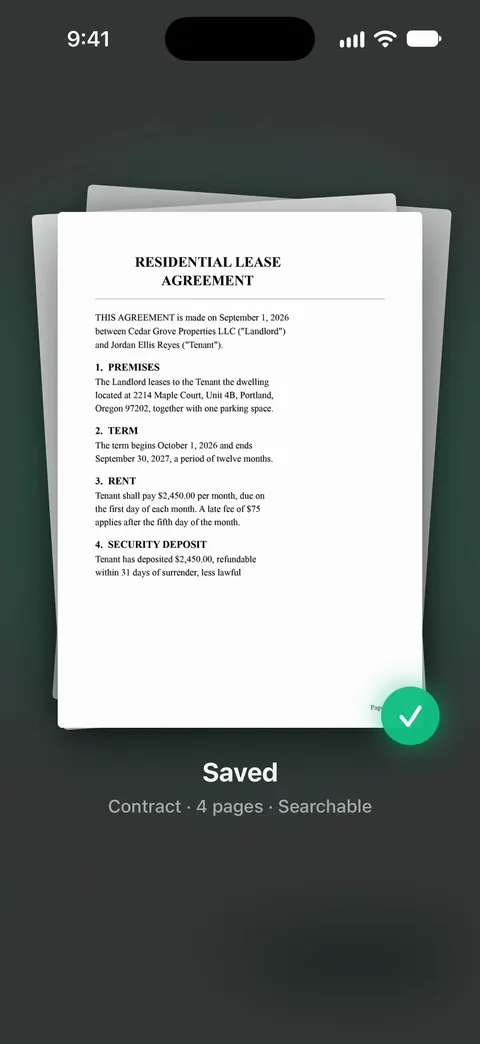
It helps you answer a request for documents fast. A scan can have many pages, and you can reorder them. So a month of pay stubs becomes one PDF. The To PDF tool turns files and photos into PDFs. A screenshot of a benefits letter can go in that way. Search looks inside the text of every document and shows the matching line and page. Documents stay on your iPhone unless you share them or turn on iCloud Sync.
On a free account, pages you share, print or export carry a small “Scanned with Scanner One” label at the bottom right. Pro removes it. Check your files before you upload them from a free account.
Questions and answers
When can I apply for Medicaid?
Any time of year. HealthCare.gov says Medicaid and CHIP have no enrollment period, and suggests applying even if you think your income is too high, since states also look at pregnancy, children and disability.
What counts as proof of income for Medicaid?
Whatever shows the household’s current income: pay stubs, W-2s, self-employment records, unemployment or Social Security letters, pension statements. HealthCare.gov’s checklist lists wages, tips, self-employment, unemployment, Social Security, retirement, investment and rental income.
What proves US citizenship for Medicaid?
Federal rules accept a US passport or passport card, a Certificate of Naturalization or Citizenship on their own, or a data match with Social Security. A US birth certificate also works, together with an ID such as a driver’s license or school ID.
Will the state ask me for documents after I apply?
Maybe. Federal rules say states check information electronically first and ask you for documents only when they can’t verify it or the data doesn’t match what you reported. They must give you reasonable time to respond.
Sources
What this page says about Scanner One was checked against the app on .
- HealthCare.gov, How to apply for Medicaid and CHIP — applying through the Marketplace or the state agency, applying any time of year; no page date shown
- HealthCare.gov, My Marketplace Application Checklist (CMS Product No. 11896) — household members, SSNs, addresses, immigration information, tax filing, income types counted, current coverage and policy numbers, the employer coverage tool; dated September 2026
- 42 CFR 435.952, Use of information and requests of additional information from individuals (Cornell LII) — states ask for documents only when electronic data is unavailable or doesn’t match, a reasonable time to respond, self-attestation when documents don’t exist; read 2026-11-13
- 42 CFR 435.407, Types of acceptable documentary evidence of citizenship (Cornell LII) — stand-alone proof of citizenship, citizenship documents that need identity proof too, and the ID documents accepted; read 2026-11-13
- Scanner One on the App Store — the app’s own listing
Get Scanner One
Scanner One is free, with generous limits: scanning, clean PDFs and text search never stop.

Scanner OneScan, sign and ask anything
Scanner One is free, with generous limits: scanning, clean PDFs and text search never stop.