
Checklist
Moving out of an apartment: the papers to keep
When you move out, keep the lease and any renewals, a copy of your written notice to vacate and proof of when you sent it, your move-in checklist and photos, dated move-out photos and video, any pre-move-out inspection report, receipts for cleaning and repairs, proof you returned the keys, your forwarding address in writing, and the landlord’s itemized deposit statement. Those papers are what settle a deposit dispute, and states set deadlines for returning deposits (21 days in California, for example).

This page is the paperwork that protects you when you leave a rental: what to save, what to send, and what to ask for. Getting the money back is the next step, covered in getting your deposit back. Deposit rules are set by each state and sometimes each city. California’s are used as the worked example here, from the California Courts and the Attorney General, read on 13 November 2026.
This is general information, not legal advice. Deposit deadlines, allowed deductions and notice rules differ by state and city, and they change. USAGov links to state tenant rights agencies and handbooks. Read your lease and your state’s rules, and contact legal aid if a dispute starts.
Before you give notice
- Your lease and every renewal or addendum. USAGov’s first piece of advice for a dispute is to read the lease. Look for the notice period, how notice must be given, and any cleaning or move-out terms. How to scan a lease or contract gives you a searchable copy.
- Your move-in checklist or inspection report, signed by both of you if you have it.
- Your move-in photos and video. They show what was already worn or damaged when you arrived.
- The deposit receipt, showing what you paid.
Giving notice
- Your written notice to vacate, with your move-out date and the address. Keep a copy.
- Proof it was delivered: a certified mail receipt, an email, or a portal confirmation, whatever your lease allows.
- The landlord’s reply, if any. In California, after you give notice the landlord must tell you in writing that you can ask for a pre-move-out inspection.
The pre-move-out inspection
- Your written request for an inspection, if your state allows one. In California it happens within the 2 weeks before you leave, and you can be there.
- The landlord’s itemized list of what they plan to charge for. It’s your chance to fix things first.
- Receipts for the repairs you then make.
Move-out day
- Dated photos and video of every room: walls, floors, inside the fridge, oven and cabinets, bathrooms, windows. Take the same shots you took at move-in.
- Receipts for professional cleaning or carpet cleaning, if you paid for it.
- Proof you returned the keys: a signed note, an email, or a photo of the drop box with the date.
- Final meter readings, photographed, and the utility shutoff confirmations.
- Your forwarding address, in writing, so the deposit and statement can reach you.
After you leave
- The itemized deposit statement. In California it must come within 21 days, explain each deduction, and include copies of invoices or receipts for charges over 125 dollars. If the landlord did the work, it must show the time spent and hourly rate.
- A good-faith estimate, if repairs couldn’t be finished in 21 days, then the final receipts within 14 days of the work being done.
- The check or deposit confirmation for what was returned.
What a landlord can and can’t deduct (California example)
They can deduct for:
- Unpaid rent.
- Repairing damage caused by you or your guests, beyond ordinary wear and tear.
- Cleaning to get the unit as clean as when you moved in.
- Replacing furniture or other items, only if the lease allows it.
They can’t charge for:
- Damage that was already there when you moved in.
- Ordinary wear and tear.
- Unreasonable or unnecessary costs.
If you disagree with the deductions
- Write a demand letter asking for the money back, and keep a copy.
- Gather your evidence: lease, photos, inspection reports, receipts, emails.
- File in small claims court if it isn’t resolved. In California, a court can award up to twice the deposit on top of it if the landlord acted in bad faith. Evidence for small claims court shows how to organize it.
Mistakes that cost renters their deposit
- No move-in photos, so old damage looks new.
- Notice given by text when the lease requires writing.
- No forwarding address on file.
- Throwing away cleaning receipts.
- Deleting photos before the deposit is settled.
Moving on
Your next landlord may ask for papers from this tenancy: documents to rent an apartment lists them, and moving house paperwork covers address changes. More lists are on the checklists hub.
Where Scanner One helps, and where it doesn’t
Scanner One doesn’t take your move-out video or argue with your landlord. The Camera app is the right tool for photos and video of the rooms.
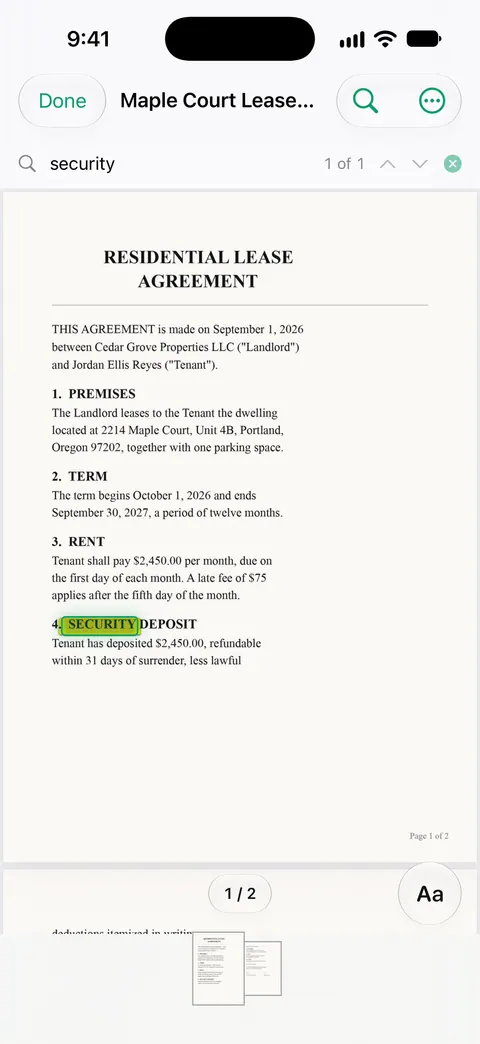
It helps with the paper trail. A scan can have many pages, and you can reorder them. So a lease and its addenda stay one document. Search looks inside the text of every document and shows the matching line and page. So “notice” or “deposit” finds the clause. Scans come with Auto Clean, Color, Grayscale and Receipt filters. The Receipt filter suits cleaning receipts. Documents stay on your iPhone unless you share them or turn on iCloud Sync. Deleted documents wait in Recently Deleted for 30 days before they are deleted for good.
On a free account, pages you share, print or export carry a small “Scanned with Scanner One” label at the bottom right. Pro removes it. If you send a demand letter with attachments from a free account, they carry that label.
Questions and answers
What documents should I keep after moving out of an apartment?
Your lease, the notice you gave and proof it was delivered, move-in and move-out photos, inspection reports, cleaning and repair receipts, proof you returned the keys, and the landlord’s deposit statement. Keep them until the deposit is settled and any dispute is over.
How long does a landlord have to return a security deposit?
It depends on the state. In California, the Attorney General says the landlord has 21 days after you move out to return the deposit with an itemized statement of any deductions. Check your own state’s tenant handbook for its deadline.
Can I ask for an inspection before I move out?
In California, yes: once you give notice, the landlord must tell you in writing that you can ask for one, and it happens within the 2 weeks before you leave so you can fix problems. Other states differ, but asking is always worth it.
What can a landlord take out of my deposit?
In California: unpaid rent, repairing damage beyond ordinary wear and tear, cleaning back to move-in condition, and replacing furniture only if the lease allows it. Damage that was there at move-in and normal wear and tear can’t be charged.
Sources
What this page says about Scanner One was checked against the app on .
- California Courts Self-Help Guide, Guide to security deposits in California — the pre-move-out inspection notice, the 21-day deadline, itemized statements and receipts for deductions over 125 dollars, allowed deductions, demand letters and small claims; no page date shown
- California Attorney General, Know your rights as a California tenant: security deposits — what deposits can and can’t be used for, the inspection within 2 weeks before move-out, the itemized statement within 21 days, local rules; file dated 2024-02-07
- USAGov, Tenant rights — reading your lease first, state tenant rights agencies and handbooks, legal aid; last updated 2026-04-15
- Scanner One on the App Store — the app’s own listing
Get Scanner One
Scanner One is free, with generous limits: scanning, clean PDFs and text search never stop.

Scanner OneScan, sign and ask anything
Scanner One is free, with generous limits: scanning, clean PDFs and text search never stop.