
Checklist
Documents for a SNAP (food stamps) application
Apply for SNAP with your state agency. Within 30 days you’ll have an interview and must give proof of what you reported. Have proof of identity (a driver’s license, work or school ID, pay stub or birth certificate all count), proof of where you live, Social Security numbers, and income for everyone in the household, such as recent pay stubs and benefit letters. Rent or mortgage, utility, child care, child support and, for older or disabled members, medical bills can lower countable income, so bring proof of those too.

This page is the proof a SNAP office asks for, the program many people still call food stamps. Proving where you live is the part that trips people up most, and how to prove your address goes deeper on that. The rules here come from the USDA’s SNAP eligibility page and the federal SNAP regulation on verification, read on 13 November 2026.
This is general information, not legal or financial advice. Each state runs SNAP with its own forms and may ask for different documents, and the USDA says it is still updating its page for changes in federal law. Income limits and benefit amounts change every October and are on the USDA site, not repeated here. Your state agency has the final word.
How it works
- Apply in the state where you live, online if your state offers it, at a local office, by mail or by phone.
- Have an interview, usually by phone or in person.
- Give proof of what you put on the application.
- Get a decision, in most cases within 30 days. Some households with very little money qualify for benefits within 7 days.
You can name an authorized representative in writing to apply and do the interview for you.
The rule that helps you
Federal rules put the job of giving proof on the household, but they also say the state must help you get it if you cooperate, must accept any reasonable document, and can’t make you bring it to the office in person. If a document doesn’t exist, the office can contact someone who knows your situation instead, such as a landlord or employer.
Proof of identity
- Driver’s license or state ID.
- Work or school ID.
- An ID card for health benefits or another assistance program.
- Voter registration card.
- Pay stubs.
- Birth certificate.
If someone else applies for you, both their identity and the head of household’s are checked.
Proof of where you live
The rules don’t fix a list: any document that reasonably shows where you live must be accepted, and the office can check it along with your rent and utility costs. Common choices:
- A lease, rent receipt or mortgage statement.
- A utility bill in your name.
- A letter from the person you live with, if nothing is in your name. The office may call them instead. A proof of residence letter template shows what to put in it.
The rules make exceptions for people who are homeless or newly arrived.
Social Security numbers
- A number for each person applying. The state checks it with Social Security, and can’t delay your benefits only because that check is pending.
Income for everyone in the household
A household is everyone who lives together and buys and prepares food together. Spouses and most children under 22 count even if they eat separately.
- Recent pay stubs. Your state says how many weeks it wants.
- A letter from your employer, if you’re new or stubs aren’t available.
- Self-employment records: what came in and what went out.
- Benefit letters: Social Security, SSI, unemployment, veterans’ benefits, pensions.
- Child support or alimony you receive.
Costs that can raise your benefits
SNAP subtracts some costs before deciding how much income counts. Bring proof of the ones you pay:
- Rent or mortgage, and property taxes.
- Utilities: heating and cooking fuel, electricity, water, one phone. Some states use a set amount instead, and then proof is only needed if you claim more.
- Child or dependent care you pay so you can work, train or study.
- Legally owed child support you pay, with the court order and proof of payment.
- Medical bills for members 60 or older or disabled that insurance doesn’t pay.
Other proof, only if it applies
- Immigration status, for non-citizens applying.
- Disability, if you report it, such as an SSI or disability benefits letter.
- Student status, for college students who claim an exemption.
- Work hours, for adults the work rules apply to.
Mistakes that delay or lower benefits
- Missing the interview, or not calling back to reschedule.
- Leaving costs off the application. Unreported rent or child care can’t lower your countable income.
- Sending only some of a household’s pay stubs.
- Missing the deadline on the list of documents the office sends after the interview.
- Not keeping copies of what you sent.
Sending documents
Use whichever way your state offers: upload, mail, fax or in person. Take clear photos or scans, one document per file unless asked otherwise, and keep the originals. Utility bills and pay stubs come up again at recertification: how long to keep utility bills and how long to keep pay stubs help you decide what to hold on to. If you’re also applying for health coverage, documents for a Medicaid application uses many of the same papers. More lists are on the checklists hub.
Where Scanner One helps, and where it doesn’t
Scanner One doesn’t apply for SNAP, do the interview or work out what you’ll get. Your state agency does that.
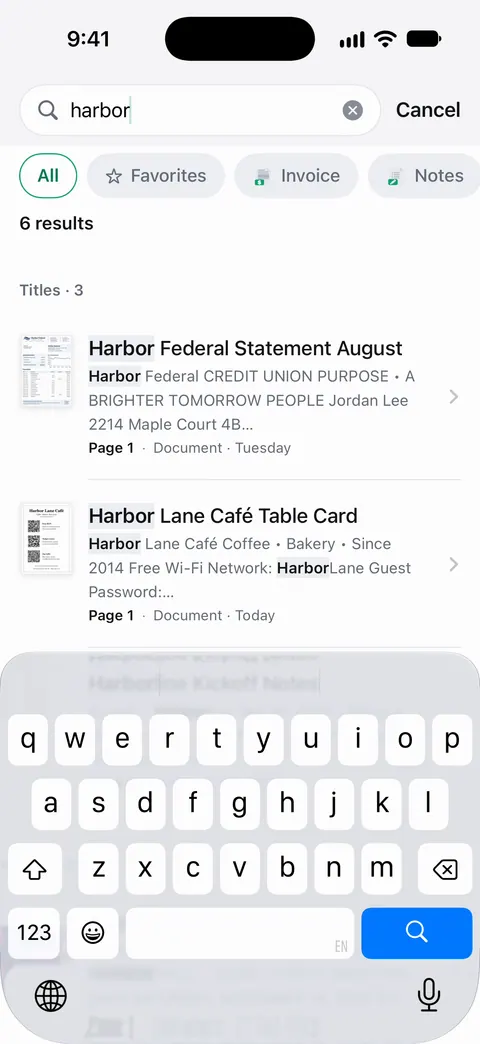
It helps when the office sends a list of documents with a deadline. A scan can have many pages, and you can reorder them. So 4 weeks of pay stubs become one PDF. The To PDF tool turns files and photos into PDFs. A screenshot of a benefits letter or a photo of a utility bill can go up that way. Search looks inside the text of every document and shows the matching line and page. At recertification, searching “electric” finds last year’s bill. Documents stay on your iPhone unless you share them or turn on iCloud Sync.
On a free account, pages you share, print or export carry a small “Scanned with Scanner One” label at the bottom right. Pro removes it. Check your files before you upload them from a free account.
Questions and answers
What documents do I need for a SNAP interview?
Proof of identity, where you live, everyone’s income, and the costs you reported: rent or mortgage, utilities, child care, child support, and medical bills for members 60 or older or disabled. Non-citizens also need proof of immigration status. Your state’s notice lists exactly what it still needs.
What counts as ID for SNAP?
Federal rules give examples: a driver’s license, a work or school ID, an ID for health benefits or another assistance program, a voter registration card, pay stubs, or a birth certificate. The state must accept any document that reasonably proves who you are.
How long does a SNAP application take?
USDA says most states decide within 30 days. Households with very little money may get benefits within 7 days, and approved benefits are counted from the date you applied.
Can I send SNAP documents by phone or email?
Federal rules say households can submit verification in person, by mail, by fax or other electronic means, or through an authorized representative, and states can’t require you to bring it to the office in person. Your state’s notice says which options it offers.
Sources
What this page says about Scanner One was checked against the app on .
- USDA Food and Nutrition Service, SNAP eligibility — apply in your state, the interview and verification within 30 days, benefits within 7 days for some households, authorized representatives, who is in a household, the deductions; figures for 2026-10-01 to 2027-09-30 (not repeated here)
- 7 CFR 273.2, Office operations and application processing (Cornell LII) — mandatory verification (income, alien status, utility and medical expenses, SSNs, residency, identity, disability, child support), examples of identity documents, the household’s responsibility and the state’s duty to help; read 2026-11-13
- Scanner One on the App Store — the app’s own listing
Get Scanner One
Scanner One is free, with generous limits: scanning, clean PDFs and text search never stop.

Scanner OneScan, sign and ask anything
Scanner One is free, with generous limits: scanning, clean PDFs and text search never stop.