
Checklist
Documents for an Australian visitor visa
For an Australian Visitor visa (subclass 600, Tourist stream), you apply online through ImmiAccount and upload color scans of: your passport’s photo and details pages, a national ID card if you have one, proof of money such as 3 months of bank statements or pay slips, and proof you’ll go home, like an employer letter or proof of study. An invitation letter helps if you’re visiting family. Under 18s add a birth certificate and Form 1229 consent from any parent not traveling. Some passports can use an ETA or eVisitor instead.

This page is the document list for Australia’s Visitor visa (subclass 600), Tourist stream, applied for from outside Australia. It sits with the other visitor visa lists: if you’re heading to Europe instead, documents for a Schengen visa covers that. Everything here is from the Department of Home Affairs pages, read on 13 November 2026.
This is general information, not legal or immigration advice. Australian visa rules change, and Home Affairs may ask for more documents after you apply. The visa price is on the Home Affairs site (use its Visa Pricing Estimator) and is not repeated here.
First, check whether you need this visa
- ETA (subclass 601): for eligible passports, applied for in the Australian ETA app. Stays of up to 3 months at a time.
- eVisitor (subclass 651): for passports from particular countries, applied for online. Stays of up to 3 months at a time.
- Visitor visa (subclass 600): everyone else, and anyone who wants a longer stay. It covers tourism, cruises and visiting family or friends. Business visits and medical treatment use other streams.
You can’t work on any of them. Each family member applies separately, including children listed in a parent’s passport.
What Home Affairs looks for
To be granted the visa you must:
- Be a genuine visitor, intending only to stay temporarily and follow the visa’s conditions.
- Have enough money to support yourself in Australia.
- Meet the health and character requirements.
- Have paid back any debt to the Australian government.
- Be outside Australia when you apply and when the decision is made.
Your documents are how you show each of these. Home Affairs says it may decide your application without asking for more, so upload as much as you can at the start.
Identity documents
- Your current passport: the pages with your photo, personal details, and issue and expiry dates.
- Your national identity card, if your country issues one.
- Proof of a change of name, if it applies: a marriage or divorce certificate, change of name documents, or papers showing other names you’ve used.
Proof you have enough money
Home Affairs lists examples:
- Itemized personal bank statements for a 3-month period.
- Pay slips.
- Tax records.
- Audited accounts, if you run a business.
- Term deposits.
- Credit card statements.
If a relative or friend in Australia is paying for your stay, add proof of their funds.
Proof you’re visiting, then going home
- An invitation letter from family or friends in Australia, saying how they know you, why you’re visiting, how long, and whether you’ll stay with them.
- Your plans while you’re there.
- Reasons to return, such as:
- a letter from your employer saying you’ll return to your job,
- proof you’re studying at a school, college or university at home,
- proof of immediate family at home,
- proof you own a house or other major assets at home,
- proof you can return home.
Character documents
- Military service records or discharge papers, if you’ve served.
- A police certificate, only if Home Affairs asks.
Extra documents for children under 18
- A birth certificate showing both parents’ names. If you don’t have one, the identification pages of a family book, a government ID, a court document or a family census register.
- Proof of legal guardianship or adoption papers, if someone other than the biological parents has custody.
- Form 1229, the consent form, or a statutory declaration, from anyone with a legal right to decide where the child lives who is not traveling with them. Include a copy of their passport or driver’s license showing their signature and photo.
- Form 1257, the undertaking declaration, signed by the person the child stays with, if that person isn’t a relative or legal guardian.
Preparing the files
- Translate every document that isn’t in English, and upload the original and the translation. Translators in Australia must be accredited by NAATI. Translators outside Australia don’t need to be, but each translation must show their full name, address, phone number, and their qualifications and experience in the language, in English.
- No certified copies unless Home Affairs asks.
- Scan or photograph every document in color, clear and legible.
- Keep multi-page documents as one file.
Applying
- Log in to ImmiAccount or create an account.
- Fill in the application and attach your documents.
- Pay the fee. Home Affairs won’t process the application until you do.
- Add more documents in ImmiAccount if you missed any or are asked.
- Wait for the written decision before you book travel. Your visa is linked to your passport digitally, with no label.
Mistakes that slow applications down
- Bank statements that aren’t itemized, or cover less than the period you’re showing.
- Black and white scans, or a multi-page statement split into separate files.
- Translations without the translator’s details.
- Missing consent from a parent who isn’t traveling with a child.
- Booking flights before the visa is granted.
Scanning and sending
How to scan a passport photo page for a visa covers the passport pages, and the travel consent letter template helps you think through what a non-traveling parent signs (Australia has its own Form 1229, so use that). More visa lists are on the checklists hub.
Where Scanner One helps, and where it doesn’t
Scanner One doesn’t fill in the ImmiAccount application or decide which visa fits. Home Affairs does.
It makes the color scans Home Affairs asks for and keeps them in one place. ID cards and passports are scanned with both sides on one printable page. A scan can have many pages, and you can reorder them. That matches the rule that a multi-page document goes up as one file. Search looks inside the text of every document and shows the matching line and page. Documents stay on your iPhone unless you share them or turn on iCloud Sync.
On a free account, pages you share, print or export carry a small “Scanned with Scanner One” label at the bottom right. Pro removes it. Check your files before you upload them from a free account.
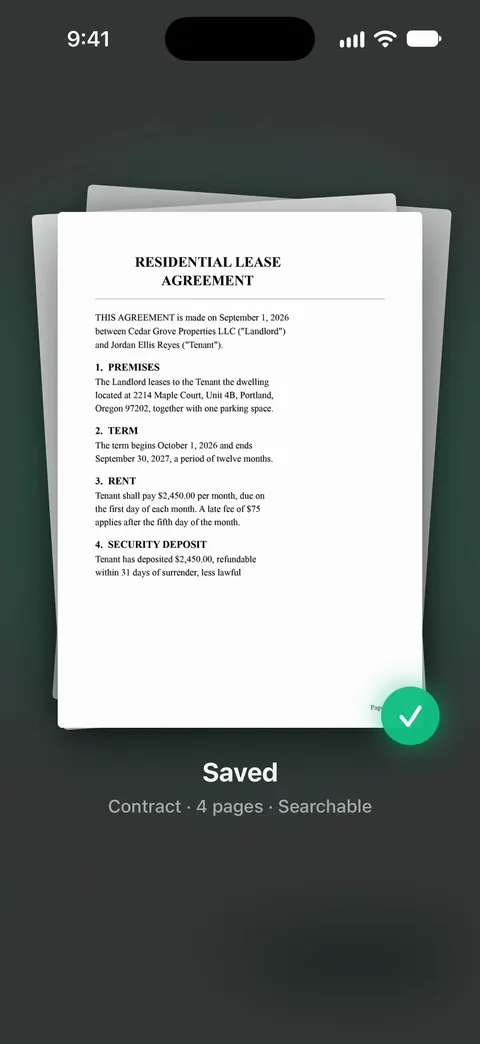
Coming in 1.0.1. Packs: say what you’re applying for, like a visa, a lease or your taxes, and see which papers you have and what’s missing. See Packs.
Questions and answers
Do I need a visitor visa or an ETA for Australia?
It depends on your passport. Home Affairs offers the Electronic Travel Authority (subclass 601) through the Australian ETA app and the eVisitor (subclass 651) for passports from particular countries, both for stays of up to 3 months. Everyone else, or anyone wanting longer, applies for the subclass 600 visitor visa.
How many months of bank statements do I need for an Australian visitor visa?
Home Affairs gives itemized personal bank statements for a 3-month period as one example of proof you have enough money. Pay slips, tax records, term deposits and credit card statements are listed too.
Do my documents need to be certified?
No, not unless Home Affairs asks. You upload color scans or photos, clear and legible, with English translations of anything in another language.
How long can I stay on a subclass 600 visa?
Home Affairs says it usually grants 3 months, and may grant up to 12 months in some circumstances. Parents of Australian citizens or permanent residents may get a longer visa, but no more than 12 months in any 18-month period.
Sources
What this page says about Scanner One was checked against the app on .
- Australian Department of Home Affairs, Visitor visa (subclass 600) Tourist stream (apply outside Australia) — eligibility, the step-by-step document list, under 18 forms 1229 and 1257, translations, scanning in color, applying in ImmiAccount, stay periods; last updated 2026-11-05
- Australian Department of Home Affairs, Visitor visa (subclass 600) — the visa’s purpose and stay lengths of 3, 6 or 12 months; last updated 2024-09-23
- Australian Department of Home Affairs, Electronic Travel Authority (subclass 601) — the ETA for eligible passports through the Australian ETA app, stays of up to 3 months; read 2026-11-13
- Australian Department of Home Affairs, eVisitor (subclass 651) — the eVisitor for passports from particular countries, stays of up to 3 months; read 2026-11-13
- Scanner One on the App Store — the app’s own listing
Get Scanner One
Scanner One is free, with generous limits: scanning, clean PDFs and text search never stop.

Scanner OneScan, sign and ask anything
Scanner One is free, with generous limits: scanning, clean PDFs and text search never stop.