
Checklist
Documents for US citizenship (Form N-400)
Every N-400 applicant sends a copy of both sides of their green card (or of the Form I-90 receipt if the card is lost). Applicants living outside the US add 2 passport-style photos. Then add what fits your case: proof of your spouse’s citizenship and your marriage if you apply after 3 years of marriage, proof prior marriages ended, name change papers, court records for any arrest, IRS letters for unpaid taxes, and Form N-426 for military service. Send copies and bring the originals to the interview.

This page is the paper side of naturalization: what goes in with Form N-400 and what to carry to the interview. If you’re moving to another country instead, documents to move abroad covers that. Everything here comes from the USCIS N-400 page, the form instructions (edition 01/20/25) and the M-477 Document Checklist, read on 13 November 2026.
This is general information, not legal or immigration advice. USCIS rules, fees and form editions change, and your situation may call for more evidence. Check uscis.gov before you file, and talk to an immigration attorney or accredited representative if anything in your history is unusual. Fees are on the USCIS fee schedule and are not repeated here.
Who files, and when
- 5 years as a permanent resident, or 3 years if you’re married to and living with a US citizen. USCIS lets you file up to 90 days before you reach that mark.
- Online or on paper. Online needs a USCIS online account. A fee waiver or reduced fee request means filing on paper.
- Use the current edition. The N-400 page lists the edition date. An old edition can be rejected.
What every applicant sends
- A copy of both sides of your green card (Permanent Resident Card). If it’s lost, send a copy of your Form I-90 receipt instead.
- The filing fee, paid as the USCIS page explains for online or paper filing.
- 2 identical color passport-style photos, only if you live outside the US. The M-477 says to write your name and A-Number lightly in pencil on the back.
Papers that depend on your situation
Send copies of these with the application, unless USCIS asks for an original.
Your name and representation
- Name change documents, if your legal name differs from your green card: marriage certificate, divorce decree or court order.
- Form G-28, if an attorney or accredited representative is acting for you.
Marriage to a US citizen (the 3-year route)
- Proof your spouse has been a citizen for the last 3 years: a US birth certificate, Certificate of Naturalization, Certificate of Citizenship, Form FS-240, or the inside cover and signature page of their current passport.
- Your current marriage certificate.
- Proof that all of your spouse’s earlier marriages ended: divorce decrees, annulments or death certificates.
- Papers that show your life together: joint tax returns, bank accounts, leases, mortgages, children’s birth certificates, or IRS tax return transcripts for the last 3 years.
Earlier marriages
- Proof each of your own earlier marriages ended: divorce decree, annulment or death certificate.
Trips of 6 months or more
- Proof you kept your life in the US: an IRS tax return transcript for the last 5 years (3 on the marriage route), rent or mortgage payments, and pay stubs. A trip of a year or more breaks continuous residence unless USCIS approved it in advance.
Children who don’t live with you
- Any court or agency support order, and proof you paid: cancelled checks, receipts, a court printout of payments, wage garnishment records, or a letter from the child’s caregiver.
Arrests, charges and convictions
- Arrested with no charges filed: an official statement from the arresting agency or court saying so.
- Charged: the complete arrest record and the final disposition for each incident.
- Convicted or placed in a program: the sentencing record and proof you completed the sentence, probation, parole or program.
- Record sealed or expunged: the court order, or a statement from the court that no record exists.
The instructions say photocopies can go with the application, but you must bring originals or court-certified copies to the interview. Traffic incidents only need papers if they involved alcohol or drugs, led to an arrest, or seriously injured someone.
Taxes
- You didn’t file a return you owed: all your letters with the IRS about it.
- You owe back taxes: the signed payment agreement and a current statement of the repayment plan.
Military, disability and Selective Service
- Form N-426 if you’re applying based on US military service. Veterans use a DD-214 or discharge orders.
- Form N-648, completed by a licensed doctor or clinical psychologist less than 6 months earlier, if you’re asking for a disability exception to the test.
- A Selective Service Status Information Letter, if you’re a man who didn’t register and lived in the US between 18 and 26 in a status that required it.
Documents in another language
- A full English translation of each one, with the translator’s signed certification that it is complete and accurate and that they are competent to translate.
What to bring to the interview
The interview notice from USCIS is the final word. Based on the instructions, plan to bring:
- Your green card, passports and travel documents, current and expired, for the trips you listed.
- The originals of every copy you sent, plus court-certified criminal records if they apply.
- IRS tax transcripts, especially after long trips.
- Anything new since you filed: a marriage, divorce, new child, arrest or move.
At the interview, an officer goes through your application and gives the English and civics test. Which civics test you take depends on whether you filed before or after 20 October 2025. You get 2 attempts at each part.
Getting the papers you’re missing
- Tax transcripts: free from the IRS, online or by mail.
- Court records: from the court clerk in the county where the case was heard. Ask for a certified copy (what a certified copy is).
- Marriage, divorce and birth records: from the vital records office or court that issued them.
Mistakes that slow cases down
- Sending originals when copies were asked for. USCIS may destroy them.
- Leaving out an arrest because the case was dismissed or sealed. It still needs papers.
- A green card copy with only one side.
- Translations without the translator’s certification.
- An outdated form edition.
Scanning and sending
Online filing means uploading every document as a file. Scanning documents for USCIS online filing covers file types and size limits, and the checklists hub has the other immigration lists. Keep a full copy of everything you send, page for page.
Where Scanner One helps, and where it doesn’t
Scanner One doesn’t fill in the N-400, check your eligibility or replace legal advice. USCIS decides what counts as evidence.
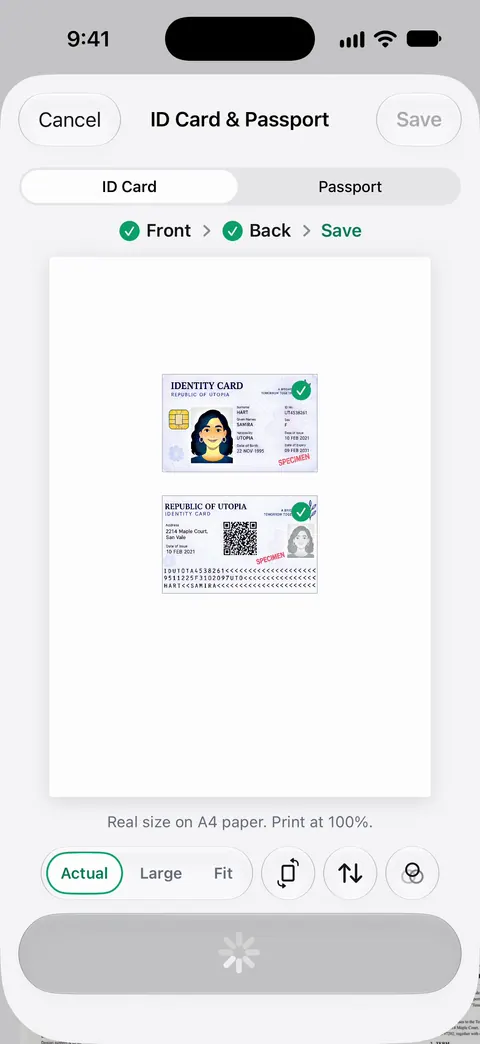
It does help you build the packet and keep a copy. ID cards and passports are scanned with both sides on one printable page. That fits the “both sides of your green card” rule. A scan can have many pages, and you can reorder them. A long court record or a 3-year stack of tax transcripts becomes one PDF, and The PDF tools merge, split, compress, password-protect, add page numbers and watermarks, and extract text. Search looks inside the text of every document and shows the matching line and page. Documents stay on your iPhone unless you share them or turn on iCloud Sync.
On a free account, PDF tools run 3 a week. On a free account, pages you share, print or export carry a small “Scanned with Scanner One” label at the bottom right. Pro removes it. A label on an evidence page you upload to USCIS is worth avoiding, so check your copies before you file.
Coming in 1.0.1. Packs: say what you’re applying for, like a visa, a lease or your taxes, and see which papers you have and what’s missing. See Packs.
Questions and answers
Do I send original documents with Form N-400?
No. The N-400 instructions say to send legible photocopies unless the instructions ask for an original, and that USCIS may destroy originals sent when they were not requested. Bring the originals, or court-certified copies for criminal records, to your interview.
Do I need passport photos for the N-400?
Only if you live outside the United States. Then the instructions ask for 2 identical recent color passport-style photos. Applicants in the US have their photo taken at the biometrics appointment.
My green card is lost. Can I still apply for citizenship?
Yes. The M-477 checklist says to send a copy of the receipt for your Form I-90, the application to replace the card, in place of the card copy.
Should I bring tax transcripts to the interview?
The N-400 instructions say you should bring your IRS tax transcripts, especially if you traveled outside the US for more than 6 months. Spouses of US citizens use them to show joint life too.
Sources
What this page says about Scanner One was checked against the app on .
- USCIS, N-400, Application for Naturalization — who can file and when, online and paper filing, the checklist of required initial evidence, translations, biometrics; last updated 2026-06-16, form edition 01/20/25
- USCIS, Form N-400 Instructions (edition 01/20/25) — copies versus originals, photos for applicants abroad, translations, tax transcripts and crime records to bring to the interview; read 2026-11-13
- USCIS, M-477 Document Checklist — the documents for each situation (marriage, trips, child support, arrests, taxes, N-648, Selective Service); revision dated 11/21/2016, so the fee and photo lines are older than the current N-400 page
- USCIS, The Naturalization Interview and Test — what happens at the interview, the English and civics test versions by filing date, retests; last updated 2025-10-31
- Scanner One on the App Store — the app’s own listing
Get Scanner One
Scanner One is free, with generous limits: scanning, clean PDFs and text search never stop.

Scanner OneScan, sign and ask anything
Scanner One is free, with generous limits: scanning, clean PDFs and text search never stop.