
Checklist
Documents to apply for unemployment
File for unemployment with the state where you worked, as soon as you lose your job. Most states ask for your Social Security number, driver’s license or state ID number, and the name, address, phone, dates and reason you left for every employer in the last 18 months. Have pay stubs or W-2s handy, your bank routing and account numbers for direct deposit, and pension details. Non-citizens need their alien registration number, veterans their DD-214 Member 4 copy, and federal workers their SF-8 or SF-50.

This page is for the day you lose a job: the information and papers your state asks for when you file for unemployment. Starting a new job has its own list in new job paperwork. Unemployment is run by each state, so this is a national overview built from the Department of Labor, USAGov and three state labor departments (Illinois, New Jersey and Tennessee), read on 13 November 2026. Your state’s own page has the final word.
This is general information, not legal or tax advice. Each state sets its own eligibility rules, benefit amounts and filing steps, and they change. Find your state’s unemployment office through the Department of Labor or USAGov, and follow its instructions.
Before you start
- File as soon as you’re out of work. The Department of Labor says to contact your state’s program as soon as possible.
- File with the state where you worked. If you worked in more than one state, or remotely for an employer in another state, ask your home state’s office how to file.
- Online, by phone or in person, depending on the state.
- Use only the official state site. USAGov warns about scammers filing claims in other people’s names.
About you
- Social Security number, and your name exactly as it appears on the card.
- Driver’s license or state ID number.
- Address, phone number and email.
- Dependents, if your state adds an allowance for them: each one’s name, date of birth and Social Security number.
- Bank routing and account number, if you want direct deposit. Some states also offer a debit card.
Your work history
States usually ask about every employer in the last 18 months:
- Employer’s name, address and phone number, including employers in other states.
- Your job title or occupation.
- Start and end dates.
- Why you left: laid off, lack of work, fired, quit.
- Your last day worked.
Pay records
- Pay stubs and W-2s. Illinois says wage records may be needed. They also settle disputes if the state’s record of your wages is missing something.
- Earnings this week, if you worked part of the week you file. Illinois asks for gross pay, the amount before deductions.
Money you’re still receiving
- Separation or severance pay: the amount and how long it lasts.
- Pension or 401(k) payments, other than Social Security.
- A recall date, if your employer expects to bring you back.
Situations with extra papers
- Not a US citizen: your alien registration number, and the card itself if your state asks.
- Left the military in the last 18 months: your DD Form 214, Member 4 copy. Illinois accepts other copies too.
- Former federal civilian employee: Standard Form 8 and your Personnel Action Form SF-50.
- Work through a union hiring hall: the local number and address.
After you file
- Expect a wait. The Department of Labor says the first payment usually comes about 2 to 3 weeks after you file.
- Watch your mail and your state account. States send notices that ask for more information or set a deadline.
- Follow your state’s schedule for requesting payments and reporting your job search. Each state sets its own.
Getting the papers you’re missing
- A lost W-2: ask your former employer for a copy, or request a wage and income transcript from the IRS. Scan W-2 and 1099 forms helps you keep them.
- A lost DD-214: request it from the National Archives.
- Pay stubs: download them from your employer’s payroll site while you still have access. How long to keep pay stubs explains why it’s worth it.
Mistakes that delay claims
- Leaving out an employer from the last 18 months, even a short or out-of-state job.
- A reason for leaving that doesn’t match what the employer reports.
- Filing in the state where you live when you worked in another.
- Missing a payment request or a notice deadline.
- A typo in your Social Security number or bank details.
Uploading documents
When your state asks for proof, it usually wants an upload through its portal. Uploading a scanned document to a website covers file types and sizes. More lists are on the checklists hub.
Where Scanner One helps, and where it doesn’t
Scanner One doesn’t file your claim, certify your weeks or work out what you’re owed. Your state does that.
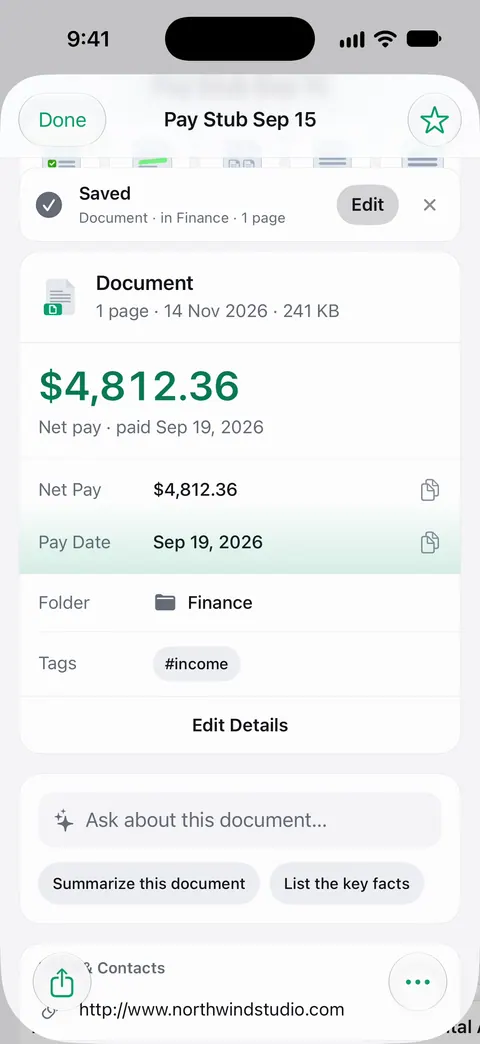
It helps when the state asks for papers. ID cards and passports are scanned with both sides on one printable page. The To PDF tool turns files and photos into PDFs. So a screenshot of a pay stub or a photo of a separation letter can go up as a PDF. A scan can have many pages, and you can reorder them. Search looks inside the text of every document and shows the matching line and page. Documents stay on your iPhone unless you share them or turn on iCloud Sync.
On a free account, pages you share, print or export carry a small “Scanned with Scanner One” label at the bottom right. Pro removes it. Check your files before you upload them from a free account.
Questions and answers
What do I need to file for unemployment?
State lists overlap: your Social Security number, driver’s license or state ID, and for each employer in the last 18 months the name, address, phone number, your dates of work and the reason you left. Add bank details for direct deposit and any pension or severance information.
Which state do I file unemployment in?
Usually the state where you worked, not where you live. The Department of Labor says that if you worked in several states, or in a state other than your home state, your home state’s office can explain how to file.
How long does it take to get unemployment after filing?
The Department of Labor says the first payment generally comes about 2 to 3 weeks after you file. Filing as soon as you’re out of work helps.
Do I need my W-2 to file for unemployment?
Not always at the start, but keep it close. Illinois says wage records such as W-2s or pay stubs may be needed, especially if the state’s record of your earnings is wrong or incomplete.
Sources
What this page says about Scanner One was checked against the app on .
- U.S. Department of Labor, Unemployment insurance — a joint state-federal program run by each state, filing with the state where you worked, the base period, first payment about 2 to 3 weeks after filing; no page date shown
- USAGov, How to get unemployment benefits — each state runs its own program, filing in the state where you worked, scammers filing in others' names; last updated 2025-03-28
- Illinois Department of Employment Security, Information needed to file online — SSN, ID, dependents, 18 months of employers, this week’s gross earnings, pensions, alien registration, DD-214 Member 4, SF-8 and SF-50; read 2026-11-13
- New Jersey Department of Labor, Information needed to apply — separation pay, recall dates, union hiring hall details, DD-214, SF-8 or SF-50, employer details for 18 months; read 2026-11-13
- Tennessee Department of Labor, Information we need from you — driver’s license number, email, bank routing and account number for direct deposit, reason for separation; read 2026-11-13
- Scanner One on the App Store — the app’s own listing
Get Scanner One
Scanner One is free, with generous limits: scanning, clean PDFs and text search never stop.

Scanner OneScan, sign and ask anything
Scanner One is free, with generous limits: scanning, clean PDFs and text search never stop.