
Checklist
Documents you need to open a bank account, in person or online
Bring a government photo ID (a driver’s license, state ID, US passport or military ID), your Social Security number or ITIN, proof of your address if it differs from your ID, such as a recent bill or your lease, and money for the first deposit. Federal rules require every bank to collect your name, date of birth, address and an identification number and to verify them. Many banks also ask for a second ID. Some accept foreign passports and consular IDs, so ask before you go.

Opening an account takes minutes when you walk in with the right papers. Every bank has to identify you under federal rules, and each bank decides which documents it accepts, so check its website or call before you go.
What every bank must collect
Under the customer identification rules, a bank must get 4 things from you before it opens the account, then verify them:
- Your name
- Your date of birth
- Your address
- An identification number: for a US citizen, a Social Security number. Non-citizens may give an ITIN, a passport number with the issuing country, an alien identification card number, or a number from another government ID with a photo.
Banks verify with documents, and also by other means, such as checking a credit reporting agency.
Proof of identity
- Photo ID: a driver’s license, a state ID card, a US passport or a military ID. The FDIC adds that some banks accept foreign passports and consular IDs.
- A second ID: the CFPB says most banks and credit unions want 2 forms. Common second forms are a Social Security card, a birth certificate, or a bill with your name and address.
- If you don’t have what they ask for: ask how else you can verify your identity. Banks often have another way.
Proof of address
- A recent bill: utility, phone or internet, in your name.
- Your lease: or a mortgage statement.
- You need this mainly when your address isn’t the one printed on your ID. If you’ve just moved, bring it anyway.
Money and details
- The first deposit: the FDIC gives 25 to 100 dollars as typical, and some accounts need less or none. Ask the amount and how you can pay it.
- Direct deposit details: your employer’s form, if you want your pay to go straight in.
- Joint account: the other owner comes with their own ID and number, or applies online at the same time.
Opening online or in an app
Online, you type the same 4 things, and you may be asked questions drawn from public records, like an earlier address. If you recently moved, or the bank can’t confirm your address electronically, you may have to call or visit a branch. Some banks ask you to photograph your ID in the app.
Questions to ask before you sign
The CFPB’s checklist suggests asking:
- Is there a monthly fee, and can it be waived?
- Do I pay for checks, or for each transaction?
- Are there free ATMs near where I live and work?
- What happens if I spend more than I have (overdraft)?
- Are there low-balance alerts?
- Does it pay interest?
Banks may also review your credit or banking history when you apply. Read the account disclosures you’re given, and ask for help with anything unclear.
Mistakes that send you home
- An expired ID.
- A bill in someone else’s name as proof of address.
- An ID address that doesn’t match the application, with no proof of the new one.
- Forgetting the opening deposit.
- Assuming a foreign ID is accepted without asking first.
Scan and send them safely
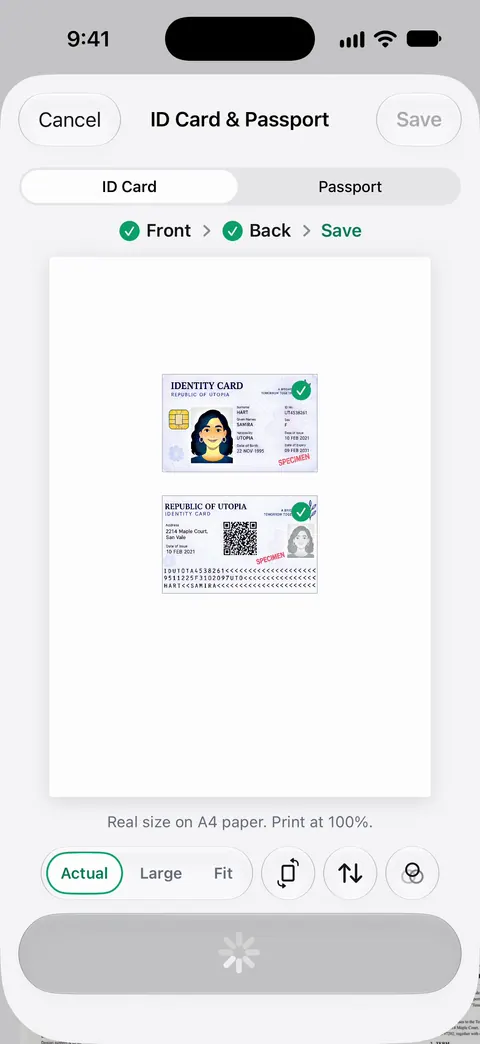
Some banks ask you to upload papers. Scan the front and back of your ID onto one page with scan an ID card front and back, and put a lease or bill into a single PDF with scan several pages into one PDF. Upload only through the bank’s own app or site, never through a link someone sent you.
If you have to prove your address for something else later, proving your address lists what usually counts. Opening one for a company is a different list: see business bank account documents.
Where Scanner One helps, and where it doesn’t
For one bank visit you need the originals, not scans. For an online application, the camera in the bank’s app usually does the job.
Scanner One helps for the copies banks and others ask for again and again. ID cards and passports are scanned with both sides on one printable page. From Home you can bring in pictures from Photos and files from the Files app, or scan an ID card. You can lock the app with Face ID. Documents stay on your iPhone unless you share them or turn on iCloud Sync.
On a free account, pages you share, print or export carry a small “Scanned with Scanner One” label at the bottom right. Pro removes it.
Scanner One doesn’t open accounts, verify your identity for a bank or store your bank logins.
Questions and answers
Can I open a bank account without a Social Security number?
Often, yes. An ITIN works at many banks, and for non-citizens federal rules also allow a passport number with its country, an alien identification card number or another government ID number. The CFPB notes that without an SSN or ITIN you may be offered only a no-interest account.
What counts as proof of address?
The FDIC gives a recent bill or a copy of your lease as examples, for when your current address isn’t the one on your ID. Banks set their own lists, so ask which papers they take.
How old do you have to be to open a bank account?
In most of the US, 18 to open one on your own, according to the FDIC. Younger people can usually open an account with a parent or guardian. Ask the bank what the adult needs to bring.
Why was my online application sent to a branch?
Online, the bank checks your identity electronically, sometimes with questions from public records such as a past address. If you moved recently or it can’t verify your address, the FDIC says you may have to call or visit a branch to finish.
Sources
What this page says about Scanner One was checked against the app on .
- FDIC, How to open a checking or savings account at an FDIC-insured bank — accepted IDs, proof of address, online identity checks, first deposit, minimum age; PDF modified 2023-06-22
- CFPB, Opening a checking or savings account (Your Money, Your Goals tool) — the two-ID checklist, second forms of ID, SSN or ITIN, questions to ask; dated August 2021
- OCC HelpWithMyBank, Identification required to open an account — the four items every bank must collect and verify, ID numbers for non-citizens; last reviewed April 2021
- Apple Support, Scan documents on your iPhone or iPad (108963) — scanning several pages in Notes and Files; published 2026-02-13
- Scanner One on the App Store — the app’s own listing
Get Scanner One
Scanner One is free, with generous limits: scanning, clean PDFs and text search never stop.

Scanner OneScan, sign and ask anything
Scanner One is free, with generous limits: scanning, clean PDFs and text search never stop.