
Template
Proof of residence letter: a template, and when it’s accepted
A proof of residence letter is a signed statement, usually from your landlord or the person whose home you live in, confirming your name, your address and since when you have lived there. Schools often accept one; banks and DMVs usually want bills or statements instead, or their own form. Use the template below, attach a copy of the signer’s ID and a bill or lease in their name, sign it, and notarize it if the office asks. Check the office’s list first.

This page is the letter itself. The broader question, which documents count as proof of address and what to do when nothing is in your name, is answered in you need to prove your address.
This is general information, not legal advice. Every school district, DMV, bank and agency sets its own list, and rules change. Check the office’s current list before you rely on a letter, and never sign a statement that isn’t true: many residency forms warn that a false statement can be punished.
When a letter is accepted, and when it isn’t
A letter is a second-best proof. Offices prefer documents from a company or agency, such as a utility bill, a bank statement or a signed lease. A letter helps when those aren’t in your name.
- Schools: the Department of Justice and the Department of Education say school districts typically accept a variety of documents, such as phone and water bills, lease agreements, affidavits or other documents, and must apply their rules the same way for every child. Many districts have their own residency affidavit for families who live with relatives.
- DMVs and REAL ID: TSA says you need two proofs of address, and states may add requirements. California’s list includes a rental agreement signed by the owner and tenant, and letters from a shelter, nonprofit, employer or government agency. If your name is on no bills, California lets you show a birth or marriage certificate that links you to the person whose name is on them. A plain letter from a friend is usually not on the list.
- Banks: usually want a document with your name and address, and may take a letter only alongside other ID.
So ask first: “Do you accept a letter from my landlord or the homeowner? Is there a form?”
What the letter must say
- Your full name, exactly as on your ID.
- The full address, including the unit number.
- Since when you have lived there, and that it is your main home.
- Who the signer is: landlord, owner or leaseholder, with their phone number.
- A signature and date, and a statement that it is true.
- Attachments: a copy of the signer’s ID, and a bill, deed or lease in their name at that address.
Template 1: from a landlord or property manager
[Landlord’s or company’s name]
[Landlord’s address], [Phone number], [Email]
Date: [Date]
To whom it may concern,
I confirm that [Tenant’s full name] has rented and lived at [Full address with unit number] since [Move-in date]. [He / She / They] [pays / pay] rent of [Monthly rent] under a lease that runs until [Lease end date, or “month to month”].
I am the [owner / property manager] of this property. You can contact me at [Phone number] to confirm this information.
I declare that the information in this letter is true and correct.
Signature: [Signature]
Printed name: [Full name and title]
Template 2: from the person you live with
Use this when you live with a parent, relative or friend and the bills are in their name.
Date: [Date]
To whom it may concern,
I, [Homeowner’s or leaseholder’s full name], [own / rent] the home at [Full address with unit number]. I confirm that [Resident’s full name], my [relationship, for example “daughter” or “friend”], has lived with me at this address as [his / her / their] main home since [Date].
Attached are a copy of my [ID type] and a recent [utility bill / mortgage statement / lease] in my name at this address.
You can contact me at [Phone number] or [Email].
I declare that the information in this letter is true and correct.
Signature: [Signature]
Printed name: [Full name]
[Space for notary, if required]
Sign, notarize and send it
- Get the office’s own form first. If there is one, use it instead of these templates.
- Fill it in on paper or as a PDF. To sign without printing, see how to sign a PDF on iPhone.
- Notarize only if asked, and then sign in front of the notary or the office’s staff, not before.
- Attach the signer’s ID and their bill or lease. Scan them onto as few pages as you can.
- Bring printed copies if the office wants paper. California’s DMV, for example, asks for printed residency documents.
For school enrollment, the rest of the papers are in the school enrollment checklist; for a REAL ID, see the REAL ID documents checklist. Asking someone to collect a document for you is a different letter: see the authorization letter.
Where Scanner One helps, and where it doesn’t
Scanner One doesn’t write the letter, notarize it or tell you what an office accepts.
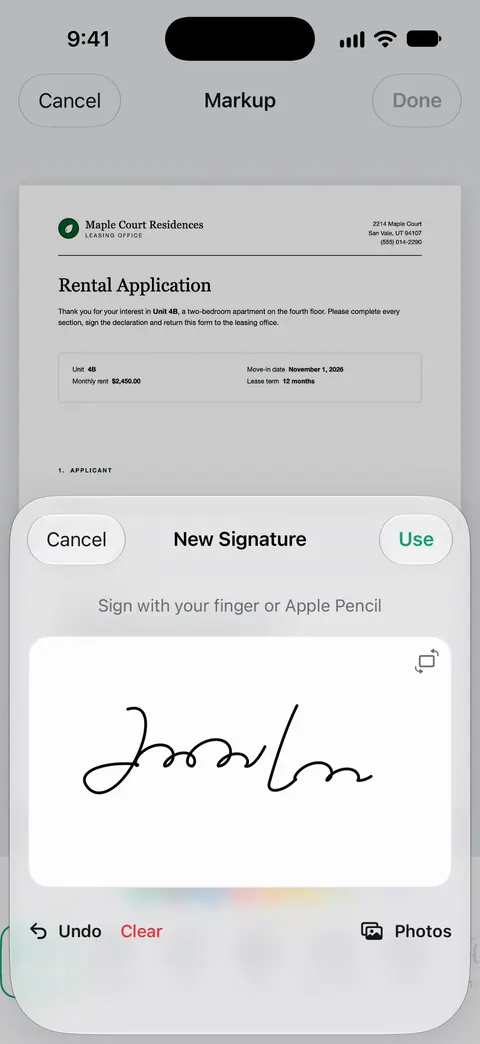
It helps with the signing and the copies. You can sign and annotate documents. The signer can sign the PDF on their own iPhone, and you can scan their ID and the bill into one file: A scan can have many pages, and you can reorder them. ID cards and passports are scanned with both sides on one printable page.
The limits, plainly:
- Free accounts can sign and mark up 3 documents a month. Pro removes every limit.
- On a free account, pages you share, print or export carry a small “Scanned with Scanner One” label at the bottom right. Pro removes it.
- Where the office wants a notarized original or printed papers, a PDF on your phone is a backup, not the proof.
More letters and lists are in templates.
Questions and answers
Who can write a proof of residence letter?
Usually your landlord or property manager, or the owner or leaseholder of the home you live in, such as a parent or a friend. Some offices also accept letters from an employer, a shelter or a government agency. The office decides whose letter counts.
Does a proof of residence letter need to be notarized?
It depends on the office. Many schools use their own residency affidavit, and some ask for it to be notarized or signed in front of staff. Ask before you go, and don’t sign in advance if it must be witnessed.
Will the DMV accept a letter from my landlord?
Often not on its own. California’s DMV, for example, lists a rental agreement signed by the owner and tenant, and letters from shelters, employers or agencies, rather than a general landlord letter. Each state sets its own list.
What if I just moved and have no bills yet?
A signed lease is usually the strongest proof. Add a letter from your landlord, mail from a government agency at the new address, or a bank statement once you’ve updated your address.
Sources
What this page says about Scanner One was checked against the app on .
- U.S. Department of Justice and Department of Education, Fact sheet on the rights of all children to enroll in school (ERIC copy) — school districts typically accept bills, leases, affidavits or other documents as proof of residency, applied the same way for all children; undated PDF, read 2026-11-13
- California DMV, REAL ID checklist — two printed residency documents, a rental agreement signed by owner and tenant, tracing documents when your name isn’t on a bill, and letters from shelters, employers or agencies; no date shown, read 2026-11-13
- TSA, REAL ID frequently asked questions — two proofs of address of principal residence, and states may add requirements; no date shown, read 2026-11-13
- Scanner One on the App Store — the app’s own listing: signing and scanning
Get Scanner One
Scanner One is free, with generous limits: scanning, clean PDFs and text search never stop.

Scanner OneScan, sign and ask anything
Scanner One is free, with generous limits: scanning, clean PDFs and text search never stop.