
Template
A home inventory spreadsheet you can set up in 5 minutes
Make one row per item and these columns: room, item, brand, model, serial number, purchase date, where bought, price paid, quantity, condition, photo, receipt and notes. Copy the header line below into a new sheet or a CSV file, then walk your home room by room, photographing each item and its receipt. The NAIC suggests recording brand, price paid, purchase date, make, model and serial number, and keeping a copy away from your home.

This page is the spreadsheet itself: the columns, a header line to paste, and example rows. For the wider list of what to photograph and which papers your insurer will ask for after a loss, see the home inventory checklist for insurance.
Why a spreadsheet beats memory
After a fire or a burglary, few people can list what was in a room, let alone what it cost. The NAIC’s advice is to include as much information about your belongings as possible, take photos of each item, include any receipts, and keep a copy away from your home. A spreadsheet holds all of that in one place you can sort, total and send to an adjuster.
The columns
One row per item. Group small things (“12 dinner plates”) into one row with a quantity.
| Column | What to write | Why it matters |
|---|---|---|
| Room | Living room, kitchen, garage | Lets you work, and claim, room by room |
| Item | “Sofa, 3-seat, gray fabric” | A plain description |
| Brand | The maker | Sets the replacement price |
| Model | Model name or number | Proves the exact item |
| Serial number | From the label or box | Identifies stolen goods |
| Purchase date | Month and year is fine | Age affects value |
| Where bought | Store or website | Helps find a receipt later |
| Price paid | The amount, no currency sign needed | Your starting value |
| Quantity | 1, 4, 12 | For sets and multiples |
| Condition | New, good, worn | Honest value |
| Photo | File name or “yes” | Evidence it existed |
| Receipt | File name, “email” or “none” | Proof of price and date |
| Notes | Engraving, upgrades, appraisal | Anything that adds value |
Copy this header line
For a CSV file, copy this line exactly into a plain text file and save it as inventory.csv. For Excel, Numbers or Google Sheets, type the same headings into row 1.
Room,Item,Brand,Model,Serial number,Purchase date,Where bought,Price paid,Quantity,Condition,Photo,Receipt,Notes
A few example rows, to show the level of detail:
Living room,“TV, 55 inch”,[Brand],[Model],[Serial number],2024-11,[Store],[Price],1,Good,IMG_0412,receipt-tv.pdf,Wall mount included
Kitchen,Stand mixer,[Brand],[Model],[Serial number],2022-05,[Store],[Price],1,Good,IMG_0420,email,Red
Bedroom,Wedding ring,[Jeweler],,,2015-06,[Store],[Price],1,Good,IMG_0431,appraisal-ring.pdf,Ask agent about a rider
Garage,Cordless drill set,[Brand],[Model],[Serial number],2023-03,[Store],[Price],1,Worn,IMG_0440,none,
Put quotes around any cell that itself contains a comma, as in the TV row, so the CSV doesn’t split it.
Fill it in, room by room
- Do a quick video first. The NAIC suggests that, if you are short on time, you quickly video or photograph every room. Open closets and drawers as you go.
- Then one room per sitting. Start with the rooms that hold the most value: living room, bedrooms, office, kitchen.
- Photograph each valuable item and its label or serial plate. Name the photo in the Photo column.
- Find receipts in your email and online store accounts. Scan paper ones before they fade: scan receipts on iPhone.
- Ask your agent about high-value items. Triple-I suggests asking whether jewelry and art need a separate rider, or “floater”, on your policy.
- Add a total at the bottom of the Price paid column, and compare it with the personal property limit on your policy.
Receipts and manuals you already keep for warranties do double duty here; see keep warranties in one place.
Store a copy away from home
An inventory that burns with the house is no help. The NAIC suggests keeping it with your insurance information and somewhere besides your home, such as with a family member or your insurance agent. Triple-I suggests a friend or a safe deposit box. A copy in cloud storage, shared with one trusted person, covers both. Add new purchases while the details are still fresh, and look over the whole sheet when your policy renews.
If the worst has already happened, start with after a house fire or flood and the insurance claim checklist.
Where Scanner One helps, and where it doesn’t
Scanner One is not an inventory app and doesn’t build this spreadsheet for you. Numbers, Excel or Google Sheets do that for free, and the iPhone’s Camera takes the photos.
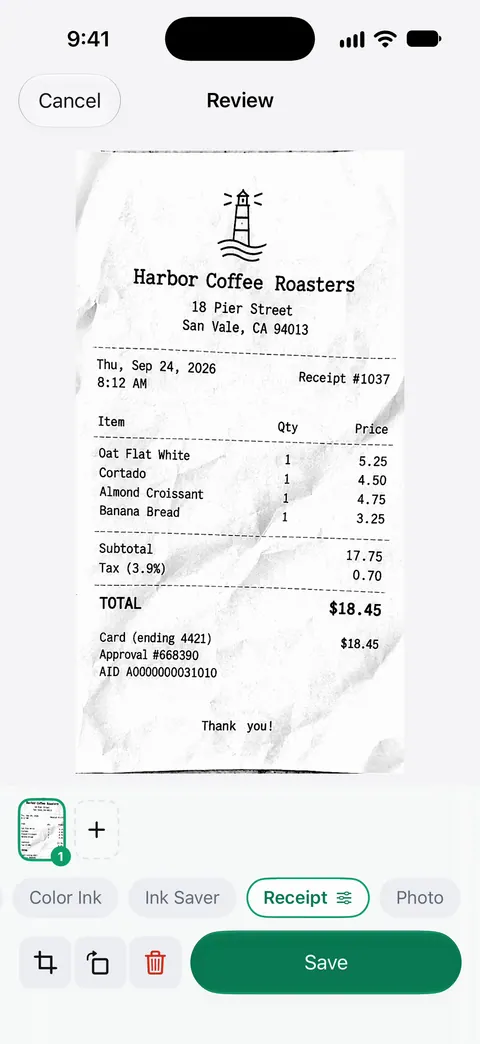
It helps with the paper behind the rows: receipts, manuals and appraisals. Scans come with Auto Clean, Color, Grayscale and Receipt filters. Search looks inside the text of every document and shows the matching line and page. So “the receipt for the TV” is a search away when the adjuster asks.
If a receipt or an old typed list already has a table on it, Scanner One exports to Word, keeping headings, lists and tables, and to Excel and CSV. That can save retyping rows into your sheet.
The limits, plainly:
- Free accounts can run the PDF tools and the Word, Excel and CSV exports 3 times a week, from one shared allowance. Pro removes every limit.
- On a free account, pages you share, print or export carry a small “Scanned with Scanner One” label at the bottom right. Pro removes it.
- An export is only as accurate as the paper it was read from: check the numbers before you rely on them.
More lists like this one are in templates.
Questions and answers
What should a home inventory include?
Every item you would need to replace after a fire, flood or theft: furniture, electronics, appliances, clothing, jewelry, tools and collectibles. For each, the NAIC suggests brand, price paid, purchase date, make and model, serial number, a photo and any receipt.
Is a video walk-through enough?
It is a good start, and the NAIC suggests it if you are short on time. A spreadsheet adds what a video can’t show well: serial numbers, prices and dates. Do the video today and fill in the sheet room by room.
Where should I keep my home inventory?
Somewhere other than your home. The NAIC suggests keeping a copy with your insurance information and somewhere else, such as with a family member or your insurance agent. A copy in cloud storage also works.
How often should I update it?
Add big purchases while the details are fresh, as Triple-I advises, and review the whole sheet once a year, for example when your homeowners or renters policy renews.
Sources
What this page says about Scanner One was checked against the app on .
- NAIC, Disaster preparedness (consumer insight) — what to record for each item, photos and receipts, walking every room, and keeping a copy away from home; modified 2024-01-16
- Triple-I, Brochure: Home inventory — organizing by room or category, description, make and model, cost, photos and walk-through video, keeping a copy outside the home, adding new purchases; undated, read 2026-11-13
- Scanner One on the App Store — the app’s own listing: receipts, Excel and CSV export
Get Scanner One
Scanner One is free, with generous limits: scanning, clean PDFs and text search never stop.

Scanner OneScan, sign and ask anything
Scanner One is free, with generous limits: scanning, clean PDFs and text search never stop.