
Checklist
Documents for a US student visa (F-1)
For an F-1 student visa, your school issues Form I-20, you pay the I-901 SEVIS fee, fill in the DS-160 and book an interview. Bring your passport, the original I-20 signed in ink by you and your school official, the DS-160 confirmation page, the visa fee receipt if you paid in advance, the SEVIS fee confirmation and a photo. Officers may also ask for transcripts and test scores, proof you can pay for school and living costs, and proof you plan to leave the US after your program.

This page covers the F-1 student visa: what the school gives you, what you pay, and what to carry to the embassy and to the US border. For a short trip as a tourist or on business, documents for a US visitor visa (B-1/B-2) is the right list. Sources: the Department of Homeland Security’s Study in the States pages and ICE’s SEVIS fee page, read on 13 November 2026. The State Department’s student visa page could not be opened when this was written, so check it and your embassy’s page too.
This is general information, not legal or immigration advice. Visa rules change, and each US embassy or consulate publishes its own instructions and the final document list. Fees are on the State Department and ICE sites and are not repeated here.
The order things happen
- Get accepted by a school certified by the Student and Exchange Visitor Program (SEVP).
- Receive your Form I-20 from the school’s designated school official (DSO). The school collects proof of your funds before it issues the form.
- Pay the I-901 SEVIS fee on fmjfee.com, using details from the I-20, and print the confirmation.
- Fill in Form DS-160 online and print the confirmation page.
- Pay the visa fee and book your interview with the embassy or consulate.
- Go to the interview with the documents below.
Required at the interview
- Your passport, valid for travel to the United States.
- The original Form I-20, signed in ink by you and your DSO. If you’re under 18, your parents sign it too. Its type (F-1) must match the visa you’re applying for.
- The DS-160 confirmation page.
- The visa application fee receipt, if your embassy has you pay before the interview.
- A photo that meets US visa photo rules, if your embassy asks for a printed one.
- The SEVIS fee payment confirmation printed from fmjfee.com.
What the officer may ask for
DHS says the officer may request more. Bring it organized so you can hand it over quickly:
Your studies
- Transcripts, diplomas and certificates from schools you attended.
- Standardized test scores your school required.
Money
- Bank statements in your name or your family’s.
- A sponsor’s documents: their bank statements and a letter saying they’ll pay.
- Scholarship or financial aid letters from your school.
- An employer letter showing a parent’s or sponsor’s annual salary.
The total should match the costs on your I-20. DHS notes that international students can’t get US government student aid, so the money has to come from you, your family, a sponsor or the school.
Ties at home
- Proof you plan to leave the US after your program: family, a job offer or career plans at home, property, a family business.
Bring originals, with English translations of anything in another language.
At the US border
Study in the States lists three documents to carry in your hand luggage, not in checked bags:
- Passport.
- F-1 visa.
- Signed Form I-20.
DHS also suggests keeping your proof of funds handy, in case a Customs and Border Protection officer asks. You can arrive up to 30 days before the program start date on your I-20. If you’ll be late, tell your DSO right away so they can update your SEVIS record.
Bringing family
- Each dependent (F-2) needs their own I-20 from your school.
- Expect to show the relationship, for example with a marriage or birth certificate. Your embassy’s page lists what it wants for dependents.
Mistakes that cost students their appointment
- An I-20 that isn’t signed by you, or a photocopy when the embassy wants the original.
- Paying the SEVIS fee too late to print the confirmation.
- Proof of funds that doesn’t cover the I-20 amount, or that you can’t explain.
- Booking flights more than 30 days before your program start date.
- Packing the I-20 in checked luggage.
Keep copies
DHS recommends making at least 2 sets of copies of your passport, visa and I-20: one for your family at home and one for your school. A scan on your phone means a third copy you can reach anywhere. How to scan a passport photo page for a visa covers the picture page, and scanning on iPhone for students abroad covers the papers you’ll handle after you land. If your interview is days away, your visa appointment is next week helps you get ready. More lists live on the checklists hub.
Where Scanner One helps, and where it doesn’t
Scanner One doesn’t fill in the DS-160, pay the SEVIS fee or book appointments. Embassies want originals at the window.
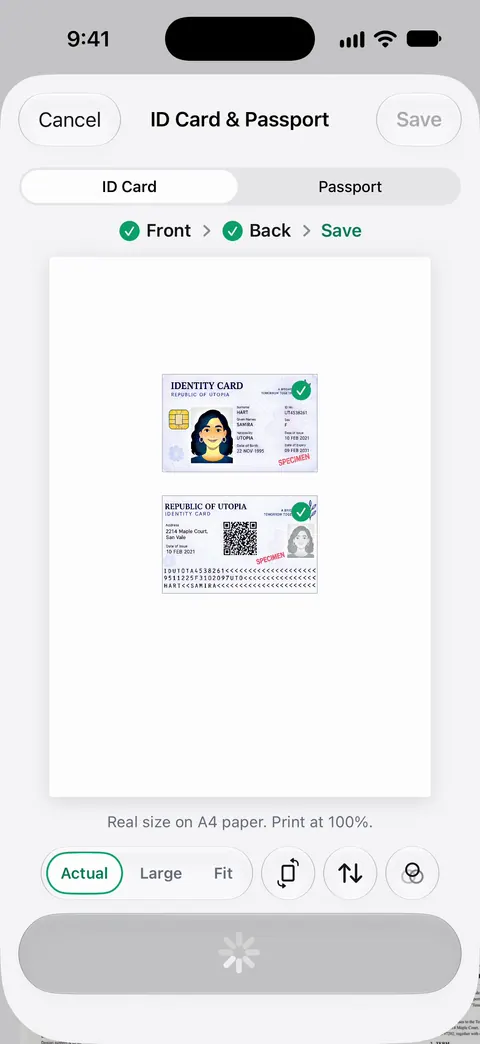
It keeps the folder that goes with you, and a copy of it. ID cards and passports are scanned with both sides on one printable page. A scan can have many pages, and you can reorder them. A 6-page bank statement or a set of transcripts becomes one PDF. Text recognition runs on the device, in 29 languages. So a transcript in your own language is searchable, and Search looks inside the text of every document and shows the matching line and page. Documents stay on your iPhone unless you share them or turn on iCloud Sync.
On a free account, pages you share, print or export carry a small “Scanned with Scanner One” label at the bottom right. Pro removes it. If you print or email copies from a free account, they carry that label.
Coming in 1.0.1. Packs: say what you’re applying for, like a visa, a lease or your taxes, and see which papers you have and what’s missing. See Packs.
Questions and answers
When can I apply for an F-1 visa?
Study in the States says F-1 visas can be issued up to 365 days before your program start date, and you may enter the US up to 30 days before it. You need your I-20 and the SEVIS fee receipt first.
Do I need the original I-20 at the interview?
Yes. DHS says to bring the original Form I-20, signed in ink by you and your designated school official. A consular officer may accept a copy only in limited cases.
What counts as proof of funds for an F-1 visa?
DHS lists family bank statements, sponsor documentation, financial aid and scholarship letters, and an employer letter showing salary. Schools may have their own rules, so ask the international student office.
How do I prove I paid the SEVIS fee?
ICE says it no longer mails receipts. Print the payment confirmation from fmjfee.com using your SEVIS ID, last name and date of birth, and bring it to the interview.
Sources
What this page says about Scanner One was checked against the app on .
- Study in the States (DHS), Students and the Form I-20 — who issues the I-20, signatures, the original at the interview, visas issued up to 365 days before the program, arrival up to 30 days before, dependents; last updated 2025-04-29
- Study in the States (DHS), Financial ability — what counts as proof of funds, when you need it (I-20, visa, port of entry); last updated 2023-05-25
- Study in the States (DHS), Students: prepare for your visa interview — the documents to bring and the evidence an officer may ask for; dated 2018-08-08, so check your embassy’s current list
- U.S. Immigration and Customs Enforcement, I-901 SEVIS fee — who pays the SEVIS fee, paying on fmjfee.com, printing the payment confirmation; read 2026-11-13
- Study in the States (DHS), Getting to the United States — documents to carry at the port of entry, copies for family and school, the 30-day entry window; last updated 2023-05-25
- Scanner One on the App Store — the app’s own listing
Get Scanner One
Scanner One is free, with generous limits: scanning, clean PDFs and text search never stop.

Scanner OneScan, sign and ask anything
Scanner One is free, with generous limits: scanning, clean PDFs and text search never stop.