
Checklist
Documents for a UK student visa
A UK Student visa application needs a current passport and the Confirmation of Acceptance for Studies (CAS) reference from your course provider. Depending on your situation, add proof of money for your course fees and living costs (held for 28 days in a row, ending within 31 days of applying), an ATAS certificate, tuberculosis test results, and written consent from a financial sponsor. Under 18s add consent from both parents, proof of relationship and a birth certificate.

This page is the UK Student visa list: the papers for studying a degree or other course in the UK. A short trip for tourism or a short course is a different visa, covered in documents for a UK visitor visa. Everything here comes from GOV.UK’s Student visa pages, read on 13 November 2026.
This is general information, not legal or immigration advice. UK visa rules and amounts change, and your circumstances may call for more documents. GOV.UK has the current money amounts, fees and the healthcare surcharge, which are not repeated here. Your university’s international office can check your documents before you apply.
Before you start
- You need a place on a course with a licensed student sponsor, and you must be 16 or over.
- Apply from outside the UK up to 6 months before your course starts. From inside the UK, up to 3 months before, and before your current visa runs out.
- The application is online. If it’s approved, you get an eVisa: an online record of your status linked to the passport you travel on, through a UKVI account.
Required for everyone
- A current passport or other valid travel document. Use the same one you’ll travel on, since your eVisa is linked to it.
- Your Confirmation of Acceptance for Studies (CAS) reference number from your course provider. Check that your name, date of birth, course and fee on it are right before you apply.
Proof of money
Unless you’re exempt, you show that you can pay:
- Course fees for the first academic year (up to 9 months), at the amount shown on your CAS.
- Living costs, at one rate for study in London and another outside it. Boarders at independent schools show boarding fees instead.
- Extra funds for each family member coming with you, if they’re allowed to.
The rules on the evidence:
- Held for 28 days in a row. The money must sit in the account for the whole period.
- Recent. The end of the 28 days must fall within 31 days of the date you apply.
- The right kind of evidence. GOV.UK’s finance guidance sets out what bank evidence it accepts. A student loan company’s letter, or evidence from a financial sponsor, also counts.
Who doesn’t need to show money
- People who have held a valid UK visa for at least 12 months before applying.
- Nationals on the differential evidence list, and British National (Overseas) applicants, for living costs, though UKVI may still ask.
- Students’ union sabbatical officers, for living costs.
Documents you may need
- An ATAS certificate (Academic Technology Approval Scheme) depending on your course and nationality, mainly for master’s degrees and above.
- Tuberculosis test results, if GOV.UK’s TB test guidance says you need them. It depends on where you’re applying from.
- Written consent from your financial sponsor, if you’ve had sponsorship for your course fees or living costs in the last 12 months.
Extra documents for under 18s
- Written consent from both parents or legal guardians, or from one parent who has sole responsibility. It must agree to the visa application, your living and care arrangements in the UK, and your travel.
- Proof of your relationship to that parent or guardian.
- Your birth certificate or another government document showing your parents’ names.
Documents in another language
GOV.UK’s documents page says you may need more documents depending on your circumstances, and points to the full student route guidance. That guidance sets the rules for translations, so read it before you upload anything that isn’t in English.
After you apply
- Prove your identity the way your application tells you to.
- Pay the immigration health surcharge during the application. The amount depends on how long your visa lasts.
- Wait for the decision, usually about 3 weeks from outside the UK and 8 weeks from inside. Faster decisions may be offered for a fee.
Mistakes that get applications refused
- Money that dropped below the required amount on any day of the 28.
- A statement whose last date is more than 31 days before you apply.
- Applying with a passport you then replace without updating your UKVI account.
- An under-18 consent letter that doesn’t cover all three: the application, care in the UK and travel.
- Skipping the TB test when the guidance says you need one.
Scanning and sending
You upload most documents as files, so a clear scan matters: how to scan a passport photo page for a visa covers the picture page. Keep your bank statements after the decision too: how long to keep bank statements explains why. Once you arrive, scanning on iPhone for students abroad covers the papers that follow. More lists are on the checklists hub.
Where Scanner One helps, and where it doesn’t
Scanner One doesn’t fill in the UKVI application or check your eligibility. Your university and UKVI do that.
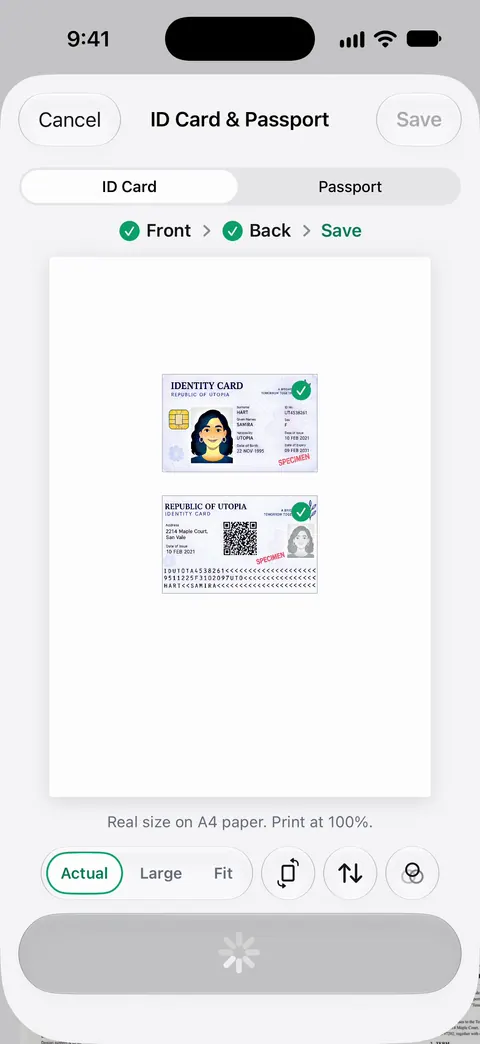
It gets your papers ready to upload and keeps a copy. ID cards and passports are scanned with both sides on one printable page. A scan can have many pages, and you can reorder them. So a 28-day run of statements becomes one PDF in order. Search looks inside the text of every document and shows the matching line and page. Documents stay on your iPhone unless you share them or turn on iCloud Sync.
On a free account, pages you share, print or export carry a small “Scanned with Scanner One” label at the bottom right. Pro removes it. A label on a bank statement you upload is worth avoiding, so check the files before you send them.
Coming in 1.0.1. Packs: say what you’re applying for, like a visa, a lease or your taxes, and see which papers you have and what’s missing. See Packs.
Questions and answers
What is a CAS for a UK student visa?
A Confirmation of Acceptance for Studies. Your course provider, a licensed student sponsor, sends you a reference number once it has offered you a place. You enter it on your visa application, and it also shows the course fee you need to cover.
How long does money have to be in my account for a UK student visa?
GOV.UK says the money must be held for 28 days in a row, and the end of that 28-day period must be within 31 days of the date you apply. The amounts are on GOV.UK’s money page.
When can I apply for a UK student visa?
From outside the UK, up to 6 months before your course starts. From inside the UK, up to 3 months before, and before your current visa expires. GOV.UK says decisions usually take about 3 weeks from outside the UK.
Do I have to show bank statements if I’m from a low-risk country?
Nationals of countries on the differential evidence list don’t have to submit proof of living costs with the application, but GOV.UK says UK Visas and Immigration may still ask for it after you apply. Have it ready anyway.
Sources
What this page says about Scanner One was checked against the app on .
- GOV.UK, Student visa — eligibility, applying up to 6 months before the course from outside the UK, decision times, the healthcare surcharge, eVisas; read 2026-11-13
- GOV.UK, Student visa: documents you’ll need to apply — passport, CAS, proof of money, ATAS, TB test results, sponsor consent, the extra documents for under 18s; no date shown, read 2026-11-13
- GOV.UK, Student visa: money you need — course fees from the CAS, living costs in and outside London, the 28-day and 31-day rules, who is exempt, sponsor evidence; read 2026-11-13 (amounts not repeated here)
- Scanner One on the App Store — the app’s own listing
Get Scanner One
Scanner One is free, with generous limits: scanning, clean PDFs and text search never stop.

Scanner OneScan, sign and ask anything
Scanner One is free, with generous limits: scanning, clean PDFs and text search never stop.