
Checklist
Home inventory for insurance: what to record and keep
A home inventory lists what you own so an insurance claim can be proved and paid faster. For each item, record a description, brand, model or serial number, purchase date and price, and keep receipts for expensive things. Photograph or film every room, including closets, drawers, the attic and garage, and date the pictures. Keep the inventory, photos, your policy and any appraisals somewhere outside the house, and update it once a year and after big purchases.

A home inventory is a record of what you own, made before anything goes wrong. This page is the checklist: what to record, room by room, and how to keep it. Policy papers for renters are a separate list in renters insurance documents, and the claim itself is covered in insurance claim documents. The advice here comes from the Ohio Department of Insurance’s workbook, the NAIC and Ready.gov, read on 13 November 2026.
Why it’s worth an afternoon
- Your insurer will ask for a detailed list of personal property before paying a claim. The Ohio workbook says a good inventory can speed that up.
- It shows whether your coverage is enough. Ohio suggests comparing your inventory with your policy’s personal property limit once a year.
- It can help prove tax deductible or uninsured losses.
- After a fire or flood, memory is unreliable. The NAIC says to make the inventory before a disaster.
What to record for each item
- Description: what it is, in a few words.
- Brand and model.
- Serial number, for electronics, appliances and tools.
- Purchase date.
- Price or value.
- Receipt, for anything expensive.
- A photo, with the date it was taken.
You don’t need all of this for a stack of towels. Spend the detail on the expensive things.
Room by room
Work through one room at a time. The Ohio workbook’s lists give a good start:
- Living room: sofas and chairs, tables, lamps, rugs, curtains and blinds, decorations, TV and speakers.
- Home office: computers and office equipment, personal electronics, desk, bookcases, books.
- Dining room: table and chairs, cabinets, china and tableware, glassware, silverware.
- Kitchen and laundry: appliances big and small, cookware, dishes, washer and dryer.
- Bedrooms: furniture, bedding, clothing and accessories, jewelry.
- Bathrooms: cabinets, linens, electronics.
- Garage, basement and storage: tools, bikes, sports gear, lawn equipment, holiday decorations.
The places people forget
- Closets and drawers. Ohio says to open drawers and photograph what’s inside.
- The attic and garage.
- Storage buildings and sheds.
- Clothing. Ohio suggests a detailed list: it adds up fast.
Papers to keep with the inventory
- Receipts for big purchases, and for repairs and replacements after a loss.
- Appraisals for jewelry, art, antiques and collectibles.
- Your insurance policy, the full copy with declarations page.
- Warranties and manuals, which often carry the model and serial number. Keep warranties in one place shows how.
High-value items
- Check your limits. Ohio notes homeowners policies usually offer limited coverage on things like jewelry and furs.
- Ask about extra coverage. You may be able to add more for an extra premium. Tell your agent about special items.
- Photograph them closely, including hallmarks, signatures or serial numbers, and keep the appraisal.
Where to keep it
- Away from your house. Ohio suggests a safe deposit box, your workplace, or a friend’s or relative’s house.
- A digital copy too. Ohio suggests saving photos and documents on a computer and emailing them to yourself so you can reach them anywhere. Ready.gov suggests a safe deposit box, an external drive or the cloud.
- Update it. The NAIC says once a year and whenever you buy something new.
If you need to claim and have no inventory
The NAIC suggests:
- Write down what you remember, room by room.
- Look through photos on your phone and ask family and friends for theirs.
- Use online retailers to estimate what things cost to replace.
- Photograph the damage and list damaged items to go over with the adjuster.
A house fire or flood took your documents covers replacing the papers themselves.
Mistakes that weaken a claim
- An inventory stored only in the house that burned.
- Photos with no dates, or no serial numbers for electronics.
- Receipts on thermal paper that have faded to blank.
- An inventory last updated years ago.
- Assuming jewelry is fully covered without checking the limit.
A template to start from
If you’d like a ready-made layout, the home inventory spreadsheet template has the columns above. The rest of the lists are on the checklists hub.
Where Scanner One helps, and where it doesn’t
Scanner One doesn’t value your belongings, file a claim or replace a video walk-through of your rooms. The Camera app is the right tool for that, and photos alone are a fine start.
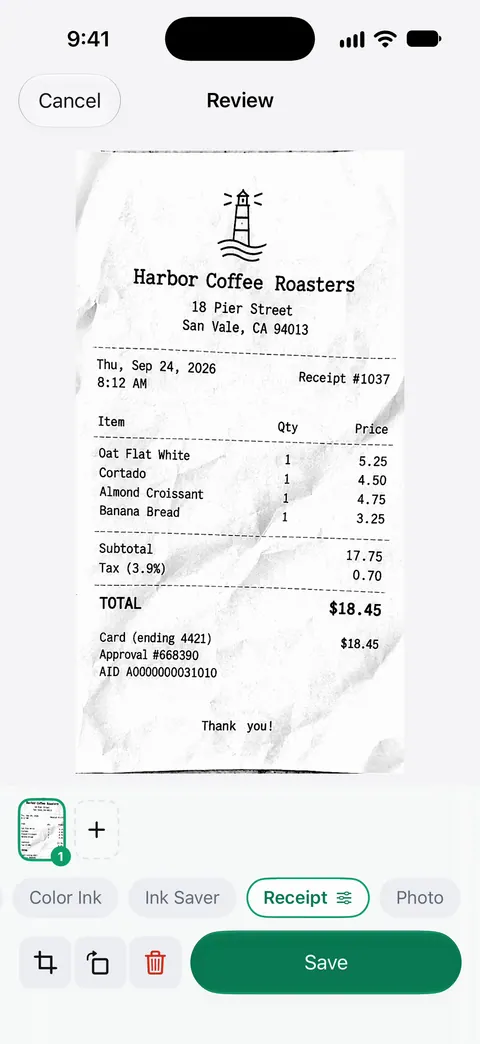
Where it helps is the paper behind the inventory. Scans come with Auto Clean, Color, Grayscale and Receipt filters. The Receipt filter turns a receipt into crisp black text on white, as in the screenshot below. A scan can have many pages, and you can reorder them. So a policy or an appraisal stays one document. Search looks inside the text of every document and shows the matching line and page. So a serial number or “warranty” finds the page. Documents stay on your iPhone unless you share them or turn on iCloud Sync. For a copy away from home, Share & Export saves a document as a PDF, Word, Excel, PowerPoint, JPG, PNG, a long image, plain text, Markdown, Rich Text, a web page or CSV.
On a free account, pages you share, print or export carry a small “Scanned with Scanner One” label at the bottom right. Pro removes it. That matters if you send copies to an insurer from a free account.
Questions and answers
What should a home inventory include?
The Ohio Department of Insurance says to list purchase dates, values, serial numbers and brand names, keep receipts for expensive items, and take dated photos or video of every room, including closets, storage buildings, the attic and the garage.
Where should I keep my home inventory?
Away from the house. Ohio suggests a safe deposit box, work, or a friend’s or relative’s home, plus a saved digital copy. The NAIC also says to store a copy somewhere other than your home.
How often should I update a home inventory?
The NAIC says to review and update it every year and whenever you buy something new.
What if I never made an inventory and need to file a claim?
The NAIC suggests rebuilding the list from memory, checking photos on your phone or from family and friends, and using online retailers to estimate replacement costs.
Sources
What this page says about Scanner One was checked against the app on .
- Ohio Department of Insurance, Home Inventory Checklist (workbook) — the 7 tips (detail, purchase dates and serial numbers, receipts, photos of every room, storing copies away from home, reviewing coverage limits, extra coverage for jewelry) and the room-by-room lists; file dated 2026-08
- NAIC, What you need to know when filing a homeowners claim — making an inventory before a disaster, storing a copy away from home, updating it yearly, receipts for repairs, rebuilding a list if you have none; dated 2022-04-20, modified 2024-06-11
- Ready.gov, Financial preparedness — insurance policies among the documents to keep, storing copies in a safe deposit box, on an external drive or in the cloud; last updated 2026-03-13
- Scanner One on the App Store — the app’s own listing
Get Scanner One
Scanner One is free, with generous limits: scanning, clean PDFs and text search never stop.

Scanner OneScan, sign and ask anything
Scanner One is free, with generous limits: scanning, clean PDFs and text search never stop.