
Checklist
Documents to keep for renters insurance, before you ever need to claim
Keep your full policy and its declarations page, any endorsements for valuables, and proof that you paid. Then build a home inventory: each item’s brand, model, serial number, purchase date and price, with receipts and photos, updated once a year. Store a copy away from your apartment, since a fire or theft can take the paper too. If you ever claim, add a police report for theft, photos of the damage, receipts for temporary living costs and a log of every call with the insurer.

A renters policy covers your belongings, your liability to others and, after a covered loss, the extra cost of living somewhere else for a while. It doesn’t cover the building; that’s the landlord’s insurance. Whether a claim pays quickly depends on the papers you kept before anything happened.
The policy itself
- The declarations page: policy number, dates, address, each coverage and limit, deductible and premium. Check the names and address are right.
- The full policy: the insuring agreement, the exclusions and the conditions, which say what to do after a loss.
- Endorsements or riders: extra coverage for jewelry, art, collections or other valuables. Basic policies cap these.
- Proof of payment: the latest bill or autopay record, so you can show the policy was active.
- Renewal notices: each year’s, to see what changed. See what to check before you renew.
- Proof for your landlord: the certificate or declarations page you gave them, if your lease requires coverage.
Your home inventory
Insurance regulators recommend a complete list of your belongings with their values, updated every year. For each item worth tracking, record:
- What it is: brand and model.
- Serial number: for electronics, appliances, bikes and tools.
- When you bought it and what you paid.
- The receipt: or the order confirmation email.
- A photo or video: the NAIC says the inventory should be backed by photos.
Go room by room, including closets, the storage unit and the car trunk. A slow video walk-through with drawers open counts too.
Valuables
- Appraisals: for jewelry, art, antiques and collections.
- Proof of purchase: certificates, auction or gallery receipts.
- The rider or schedule: listing each valuable your policy covers separately.
Documents that tell you what you’ll be paid
- Actual cash value or replacement cost: your declarations page or policy says which you have. Actual cash value subtracts depreciation; replacement cost pays today’s price to replace or repair, for a higher premium.
- Limits by category: guns, cash, jewelry, and stamp and coin collections often have lower limits unless you add coverage.
If you need to make a claim
- Police report: for a theft, reported promptly, with the report number.
- Photos of the damage: before you clean up or throw anything out.
- Your inventory and receipts: for what was lost or damaged.
- Receipts for temporary living costs: hotel, meals and laundry, if you had to leave.
- Repair or replacement estimates.
- A claim log: date, name and what was said for every call, plus copies of every letter and email.
- The claim number and the adjuster’s contact.
The full claim list is in documents you need for an insurance claim.
Lease papers worth keeping with the policy
- The lease clause that requires insurance: with the minimum coverage.
- The move-in condition report and photos: they help show what was already damaged.
- Your landlord’s or property manager’s contact: for a claim that involves the building.
Mistakes that shrink a claim
- No proof you owned the expensive things.
- An inventory stored only in the apartment that burned.
- Thinking the landlord’s policy covers your belongings.
- Expecting the policy to cover a flood. It usually doesn’t.
- Not reporting a theft to the police.
Scan and keep them safely
Scan the declarations page and the policy into one PDF each time it renews: scan several pages into one PDF. Scan receipts for big purchases the day you buy, before thermal paper fades: scan receipts on iPhone. Keep a copy off-site or in the cloud: back up scanned documents. How long to keep old insurance policies says when to let them go.
Where Scanner One helps, and where it doesn’t
The Notes app or the Files app is enough to scan a policy. For the inventory itself, the photos you take with the Camera are the record; a spreadsheet or a dedicated inventory app does the listing.
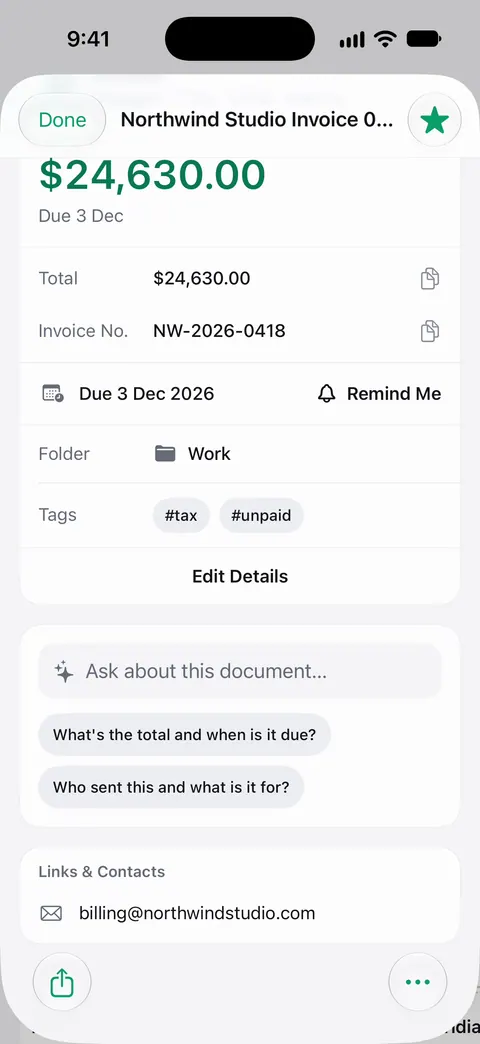
Scanner One helps with the paper behind the inventory: the receipts, warranties and the policy. Scans come with Auto Clean, Color, Grayscale and Receipt filters. QR codes and barcodes are found on every page. Search looks inside the text of every document and shows the matching line and page. Search for a serial number and the receipt comes up. Ask your documents anything. When does the lease end? What did I spend at the shop? The answer comes back with the page it came from. Free accounts can ask 3 questions a day.
Documents stay on your iPhone unless you share them or turn on iCloud Sync. If your phone is lost in the same fire, a backup is what saves the inventory, so set one up.
On a free account, pages you share, print or export carry a small “Scanned with Scanner One” label at the bottom right. Pro removes it.
Scanner One doesn’t value your belongings, file a claim or talk to your insurer.
Questions and answers
What is a declarations page?
The summary page of your policy. It shows the policy number, the dates it runs, the address insured, each coverage and its limit, the deductible, the premium and any endorsements. Check that the names and address are right, since mistakes can cause problems at claim time.
Do I need receipts for everything I own?
No, but the more proof you have, the easier a claim is. Photos or a video of each room, serial numbers for valuable items and receipts for big purchases cover most of it. Bank and card statements can stand in for lost receipts.
Does renters insurance cover flood damage?
Typically not. The NAIC notes that flood and earthquake are usually excluded from homeowners and renters policies. Ask your agent about separate flood coverage if you live where flooding happens.
My landlord needs proof of renters insurance. What do I send?
Usually the declarations page, or a certificate your insurer issues that names the landlord. Some landlords ask to be listed as an interested party so they are told if the policy lapses.
Sources
What this page says about Scanner One was checked against the app on .
- NAIC, Understanding your homeowners or renters policy — declarations page, exclusions such as flood and earthquake, limits on valuables, what a home inventory should record; last modified 2024-01-16
- Wisconsin Office of the Commissioner of Insurance, A brief guide to renter’s insurance — what the HO4 renters policy covers, actual cash value vs replacement cost, yearly inventory, reporting theft to police; updated 2026-09-03
- Apple Support, Scan documents on your iPhone or iPad (108963) — scanning several pages in Notes and Files; published 2026-02-13
- Scanner One on the App Store — the app’s own listing
Get Scanner One
Scanner One is free, with generous limits: scanning, clean PDFs and text search never stop.

Scanner OneScan, sign and ask anything
Scanner One is free, with generous limits: scanning, clean PDFs and text search never stop.