
Guide
Insurance renewal: what to check before you renew
When the renewal notice arrives, check before the renewal date: the premium and why it changed; the details the insurer prices on, such as your home’s age, size and roof, or your drivers and cars; your deductibles; your coverages and limits; and any new endorsements or exclusions at the back. Ask about discounts, get other quotes if the price jumped, and don’t cancel the old policy until the new one is in force.

This page is general information from state insurance regulators and the NAIC, not insurance or legal advice. Rules on notices and coverage differ by state; your state’s department of insurance has the ones that apply to you.
When the renewal arrives
Home and auto policies renew on their own dates, and the renewal packet is the moment to check them. The California Department of Insurance puts it simply: there is no substitute for reading your policy and your renewal declarations carefully.
Set a reminder a month before each renewal date, so you are never reading it the night before. If your insurer decides not to renew you, your state’s rules set how much notice you get, and the period varies: the Texas Department of Insurance says 60 days in Texas, and California’s guide says at least 75 days there.
Home insurance: the five checks
The Texas Department of Insurance lists five things to look at when your home policy comes up for renewal:
- Roof coverage. Check whether the insurer is changing how it covers your roof. As a roof ages, some policies move it from replacement cost to actual cash value, which pays less, or drop roof coverage if it is in poor condition.
- House details. Check the home’s listed age, square footage, construction type and roof age. Insurers use these to set your price, so an error can cost you money.
- Deductibles. If your deductible is a percentage of the insured value, work out the amount in dollars. A higher deductible generally lowers the premium, but choose one you could afford to pay.
- Coverages. Know what the policy includes. Backup of sewer or drain, for example, covers water that overflows from inside the home, not flooding from outside, and most home policies don’t cover floods.
- Added or removed coverage. Read the final pages of the renewal for new endorsements or exclusions, and ask your agent or company to explain anything you don’t understand.
Auto insurance: the five questions
For an auto renewal, the Texas Department of Insurance’s list is:
- Did your premium go up? Ask your agent to explain why, check your claims history report for errors, and compare quotes from other companies.
- What are your deductibles? A higher deductible lowers the premium but costs more after a claim.
- Are you getting every discount? Ask about new ones, such as for driving fewer miles or joining a driving monitoring program.
- Do you have a new driver or a new car? Add them, and remove any car you sold.
- Do you have the right coverage? Is your liability limit enough? Do you still need collision on a paid-off older car, or gap insurance?
The NAIC notes that discounts are usually listed on the declarations page, and that if you think you qualify for one you are not getting, you should raise it with your agent or insurer.
Check the limits still fit your life
The renewal often just repeats last year’s limits. Life may have moved on.
- Dwelling limit. California’s guide says to review it initially and upon renewal, and that it should be the cost to replace your home, not its market value. Building costs change.
- Belongings. Keep a home inventory: what you own, when you bought it and the price, with photos or video, updated from time to time. It shows whether your personal property limit is enough, and it is what you will need after a loss.
- Liability. If you have more to protect than when you bought the policy, ask whether your limit still fits.
Check the declarations page for errors
The declarations page lists who is covered, the property or cars, the coverages and limits, the deductibles, discounts and the premium. The NAIC warns that if the page is wrong, it could cause problems if you file a claim. Check names, addresses, vehicles, drivers and any lender listed.
If you want to see exactly what changed from last year, put the old and new declarations pages side by side. How to spot what changed in your renewed policy shows a method.
If the price went up
- Ask the insurer or agent for the reason, in writing if you can.
- Fix any error in the details they price on.
- Ask about discounts and about a different deductible.
- Get quotes from other insurers for the same coverage. Texas’s shopping guide suggests contacting your top choices for actual quotes and comparing policies side by side.
If you switch
Texas’s guide gives one firm rule: don’t cancel your current policy until you get your new policy or a written statement that proves you have coverage. A gap, even a day, can leave you uninsured.
If you are told your policy won’t be renewed, shop before it ends, and contact your state’s department of insurance if you think the decision is unfair.
Keep the renewal
File the new declarations page and policy, and keep the old one at least until any claim from its period is closed. How long to keep old insurance policies has the reasoning by policy type. If you ever need to claim, the insurance claim checklist lists what to gather.
Where Scanner One helps, and where it doesn’t
Scanner One doesn’t know what your policy should cover, and it isn’t an insurance advisor. Your agent and your state’s department of insurance are.
It does make a 40-page renewal easier to read and to question. Point your camera at any piece of paper. Scanner One finds the edges, straightens the page, cleans it up and saves a real PDF. A scan can have many pages, and you can reorder them. Search looks inside the text of every document and shows the matching line and page. So you can search the new policy for “roof” or “flood” and jump to the page.
Ask your documents anything. When does the lease end? What did I spend at the shop? The answer comes back with the page it came from. You can ask what the wind deductible is, or when the policy renews, and see the page the answer came from. On a free account you can ask 3 questions a day.
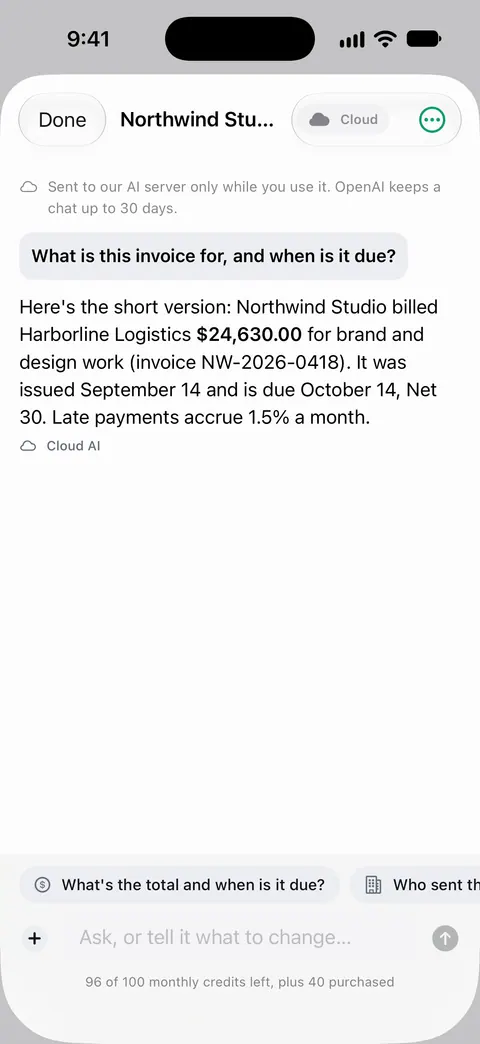
What changed compares the new version of a lease or policy with the one you signed. Pro adds What changed, filling forms from your documents, Pack checks and folder sharing.
Documents stay on your iPhone unless you share them or turn on iCloud Sync. Cloud AI is off until you switch it on, and page images are a separate permission.
If your renewal is two pages and you read them, that may be all you need.
Questions and answers
How early should I review my insurance renewal?
As soon as the renewal notice arrives, and at least a few weeks before the renewal date, so there is time to ask questions or get other quotes. Set a reminder a month before each policy’s renewal date.
Why did my home insurance go up at renewal?
Ask your agent or insurer to explain the increase. Check that the details they price on are right, such as the home’s age, size, construction and roof age, since the Texas Department of Insurance notes that errors can cost you money. For auto, also check your claims history report for errors.
Should I raise my deductible to lower the premium?
A higher deductible generally lowers the premium, but you pay more out of pocket after a claim. The Texas Department of Insurance’s advice is to choose an amount you could afford to pay and talk to your agent before changing it.
Can I switch insurers at renewal?
Yes. Get quotes before the renewal date, and don’t cancel your current policy until your new policy has started or you have written proof of coverage.
Sources
What this page says about Scanner One was checked against the app on .
- Texas Department of Insurance, Is your home policy up for renewal? Here’s what to look for — roof coverage, house details, deductibles, coverages, and endorsements or exclusions on the last pages; last updated 18 December 2025
- Texas Department of Insurance, Is your auto policy up for renewal? — premium increases, the CLUE claims report, deductibles, discounts, drivers and cars, and coverages; last updated 14 October 2024
- California Department of Insurance, Residential Insurance: Homeowners and Renters (Form 401) — review your dwelling limit on renewal, read renewal declarations carefully, keep an inventory, deductibles, and California’s 75-day nonrenewal notice; revised January 2026
- Texas Department of Insurance, Home insurance nonrenewal options — Texas insurers must give 60 days' notice of nonrenewal; shop before the policy ends; posted 9 May 2025
- Texas Department of Insurance, Home insurance shopping guide — replacement cost and actual cash value, deductibles, and not cancelling your current policy until you have the new one; read 2026-11-13
- NAIC, Declarations of Saving — what the declarations page lists, errors that can cause claim problems, and discounts; published 1 August 2011, page modified 16 January 2024
- Scanner One on the App Store — the app’s own listing
Get Scanner One
Scanner One is free, with generous limits: scanning, clean PDFs and text search never stop.

Scanner OneScan, sign and ask anything
Scanner One is free, with generous limits: scanning, clean PDFs and text search never stop.