
Situation
After a car accident: the documents to collect
First make sure everyone is safe, and call 911 if anyone is hurt. Then collect the other driver’s name, address, license and plate numbers, insurer and policy number; witnesses' names and contacts; the officer’s name, badge number and how to get the report; and photos of the cars and the scene. Report the accident to your insurer soon, file any crash report your state requires, and keep a dated log of every call.

At the scene: safety first, then information
- Check on everyone. Call 911 if anyone is hurt. Don’t move an injured person unless there is a danger such as fire.
- Stop and stay. New York, for one, says you must stop after any crash, however small the damage.
- Make the scene safe. If your car can be driven and it is safe to do so, move it out of traffic. Turn on your hazard lights.
- Call the police if anyone is hurt, if a driver leaves, or if you are unsure. For a hit-and-run, call promptly.
Then, calmly, start collecting. Your phone’s notes and camera are enough.
What to write down and photograph
Use this as a checklist. A photo of a document, such as the other driver’s insurance card, is quicker than copying it, if they agree.
The other driver and car
- Name and address
- Insurer’s name and phone number, and the policy number (on their proof-of-insurance card)
- Driver’s license number and license plate number, if you can’t get the rest
- Make, model and year of the car
Witnesses
- Names and phone numbers or email addresses. People leave quickly; ask early.
The police
- The officer’s name, badge number and contact details
- When and where you can get the accident report, and its report number
The scene
- Time, date and exact location
- Photos of both cars from all sides, the damage up close, the plates, the road, any skid marks, signs and signals, the weather and the light
- A rough sketch of where each car was and which way it was going
Give your own name, insurance and license details to the other driver too.
The papers that come later
The scene is only the start. Over the next weeks, these papers arrive, and each one belongs in the same claim file:
- The police or accident report. Order your copy as soon as it is available.
- Your state’s crash report, if your state requires one. New York, for example, wants a report to the DMV within 10 days for crashes with an injury, a death or damage above a set amount, and a report to your insurer doesn’t replace it. Your state’s rules are on its motor vehicle agency site.
- The claim number and your adjuster’s name and contact details.
- Repair estimates and the final repair invoice.
- Towing, storage and rental car receipts.
- Medical records and bills, if anyone was hurt.
- Proof of time off work, if you claim lost pay.
- Every letter and email from either insurer.
- Your own policy’s declarations page, so you know your coverage and deductibles.
The insurance claim documents checklist has the full list for other kinds of claims too.
Report it to your insurer
Call the number on your proof-of-insurance card as soon as you can. Many insurers also take claims in their app. An adjuster will be assigned and may want to see the car.
While the claim is open:
- Keep a log. For every call, write the date, the person’s name and what was said.
- Ask for decisions in writing. If the adjuster decides something about your claim, ask for a written explanation.
- Don’t rush. You don’t have to agree to anything you are uncomfortable with, or accept a payment you think is unfair.
- Know where to turn. If you disagree about the value, check your policy for an appraisal clause. If the dispute goes on, contact consumer services at your state insurance department.
Keep one claim file
Put everything in one place: the report, the photos, the estimates, the receipts and your call log. Scan paper as it arrives, so you can send a copy the moment an adjuster asks. Combine related pages into one PDF, such as all the repair invoices, and name the files clearly. Our guides to scanning several pages into one PDF and sending a PDF from your iPhone cover the how.
Keep the file until the claim is closed, and longer if anyone was injured. Ask your insurer or a lawyer how long matters in your case.
Be ready for next time
Keep your registration and insurance card in the car, and a copy on your phone. Our guide to keeping car documents on your iPhone shows how. A note on your phone with the checklist above means you won’t forget anything when your hands are shaking.
This page is general information, not legal advice. Reporting rules differ by state, and your policy decides what is covered. If someone was injured, or fault is disputed, talk to your insurer and consider a lawyer.
Where Scanner One helps, and where it doesn’t
At the scene, use your phone’s camera for photos of the cars and the road; that is what the camera is for. Scanner One helps with the paper that follows.
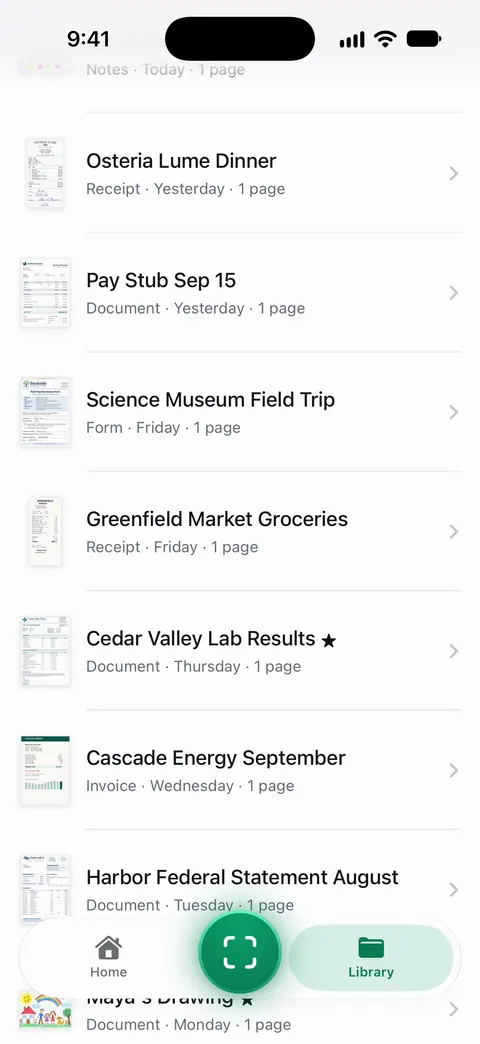
Point your camera at any piece of paper. Scanner One finds the edges, straightens the page, cleans it up and saves a real PDF. A scan can have many pages, and you can reorder them. So the police report, the estimates and the receipts each become one clean PDF instead of a pile of photos. Search looks inside the text of every document and shows the matching line and page. When the adjuster asks for “the towing receipt”, you search for it instead of digging.
On a free account, pages you share, print or export carry a small “Scanned with Scanner One” label at the bottom right. Pro removes it. If you send scans to an insurer from a free account, the label will be on them. Documents stay on your iPhone unless you share them or turn on iCloud Sync.
It does not file the claim, talk to your insurer or know your state’s rules.
Questions and answers
What information should I exchange after a car accident?
Names and addresses, driver’s license numbers, license plate numbers, vehicle make, model and year, and each insurer’s name, phone number and policy number. New York, for example, also requires the registration and the policy’s effective date. Take the witnesses' names and contacts too.
Do I have to report a minor accident?
It depends on your state. New York, for example, requires a report to the DMV within 10 days for any crash with an injury, a death or property damage above a set amount, and telling your insurer does not count. Check your state’s motor vehicle agency.
How do I get a copy of the police report?
Ask the officer at the scene when and where the report will be available, and write down the report number. If police did not come, ask your local police how to file a report yourself.
What if I don’t agree with the insurance company’s offer?
You don’t have to accept a payment you think is unfair. Ask the adjuster to explain the decision in writing, check your policy for an appraisal clause if the dispute is about value, and contact your state insurance department if it isn’t resolved.
Sources
What this page says about Scanner One was checked against the app on .
- NAIC, What you should know about filing an auto claim — what to collect at the scene, reporting to your insurer, the adjuster, notes of conversations, written explanations, the state insurance department and the appraisal clause; dated 2022-03-28, modified 2024-04-26
- New York DMV, Driver’s Manual chapter 12: If you are in a traffic crash — an example of state rules: stop, exchange name, address, license, registration and insurance details, and report to the DMV within 10 days when required; reporting to the insurer does not count; no date shown, read 2026-11-13
- USAGov, State motor vehicle services — a link to every state’s motor vehicle agency; no date shown, read 2026-11-13
- Scanner One on the App Store — the app’s own listing: scanning, multi-page scans, search
Get Scanner One
Scanner One is free, with generous limits: scanning, clean PDFs and text search never stop.

Scanner OneScan, sign and ask anything
Scanner One is free, with generous limits: scanning, clean PDFs and text search never stop.