
Situation
You just started freelancing: the papers to keep from day one
Open a separate account for business money, then keep four kinds of records from the first invoice: income (invoices, 1099s, payment app and bank statements), expenses (receipts and bills that show who you paid, how much, when and what for), mileage and travel logs, and your estimated tax payments. Keep each tax year’s papers together with that year’s return, generally for at least 3 years, and longer for anything about equipment or property.

Why records matter more now
As an employee, your employer kept the records that mattered and took tax out of every paycheck. Now that is your job. The IRS puts it simply: self-employed people generally pay self-employment tax (Social Security and Medicare) as well as income tax, usually through estimated payments during the year, and report their business on Schedule C with Schedule SE. Every number on those forms comes from the records you keep from today.
Set up on day one
Thirty minutes now saves a weekend next spring:
- A separate bank account for business income and spending. The IRS notes that for most small businesses, the business checking account is the main source of entries in the books. A separate account keeps that record clean.
- A W-9 ready to send. Clients who must report what they pay you will ask for one with your taxpayer identification number.
- One folder per tax year with four sections: Income, Expenses, Mileage and travel, Taxes paid.
- A simple invoice template with a number on each invoice.
- A place for contracts and statements of work.
The business bank account documents checklist shows what the bank will ask for.
What to keep: income
- Every invoice you send, numbered.
- 1099 forms from clients and from payment platforms (1099-NEC, 1099-K, 1099-MISC).
- Payment app and marketplace statements.
- Bank deposit records, for cash and card income.
- Copies of checks paid to you.
Track every payment, whether or not a 1099 arrives for it. The form is the payer’s paperwork; the income is yours to report.
What to keep: expenses
The IRS asks that your expense records show who you paid, how much, proof of payment, the date, and what it was for. One document rarely shows all five, so keep a combination:
- Receipts and invoices from suppliers.
- Card statements and bank transfer records.
- Canceled checks.
- Bills for things like software, phone and internet you use for work.
Then the special cases:
- Car and travel. Keep a mileage log as you go: date, where, why, miles. For travel, keep receipts that show the amount, date, place and business purpose.
- Equipment. For a laptop, camera or anything you’ll use for years, keep the purchase invoice and note when you started using it for work. You need these records until after you sell or get rid of it.
Our guide to scanning receipts for taxes shows how to keep receipts readable, and the freelancer tax documents checklist is the list to work from at year end.
Estimated taxes
Because no one withholds tax from your pay, the IRS expects you to pay during the year. The year is divided into four payment periods, each with its own due date. Form 1040-ES has a worksheet to work out the amount, and you need your prior-year return to fill it in. You can pay online, by phone or in the IRS app, and your IRS online account shows your payment history.
Keep every payment confirmation in the “Taxes paid” section of your folder. You will need the total when you file.
How long to keep it
From the IRS:
- 3 years in most cases.
- 4 years for employment tax records, if you hire anyone.
- 6 years if you did not report income that you should have, and it was more than 25% of the gross income on your return.
- 7 years for a claim for a loss from worthless securities or a bad debt deduction.
- Property and equipment records until the period ends for the year you dispose of it.
The guide on how long to keep business records puts this in a table, and the small business records checklist covers the rest once you grow.
A 15-minute weekly habit
Pick a time each week, and do the same four things:
- Scan the week’s receipts into the Expenses section.
- Log any work mileage.
- Send any invoices that are due, and mark paid ones.
- Glance at the business account for anything you don’t recognize.
Fifteen minutes a week is about 13 hours a year, and it replaces a panicked weekend in April.
This page is general information, not tax advice. Tax rules and thresholds change; check the IRS pages linked here, or ask a tax professional about your own business.
Where Scanner One helps, and where it doesn’t
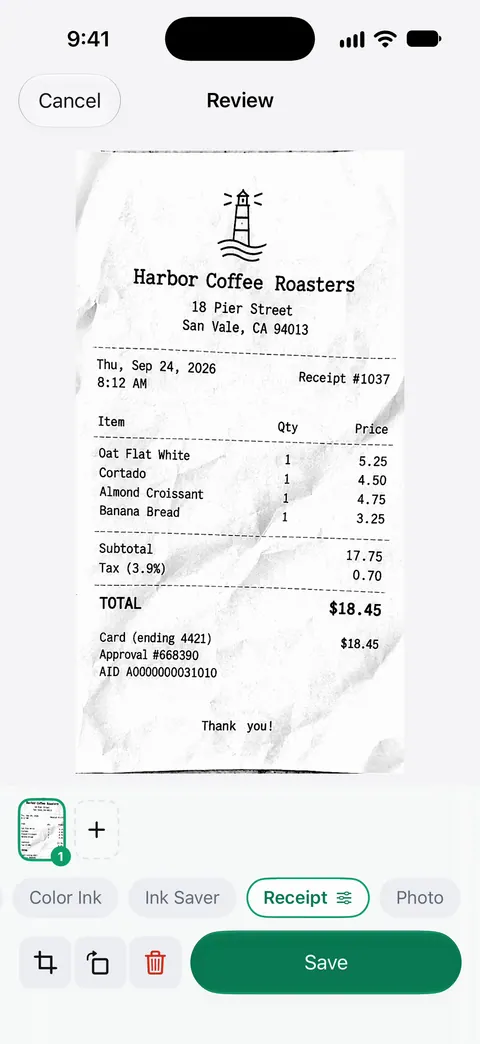
A freelancer’s paperwork is mostly receipts, invoices and statements, scanned every week. Point your camera at any piece of paper. Scanner One finds the edges, straightens the page, cleans it up and saves a real PDF. Scans come with Auto Clean, Color, Grayscale and Receipt filters. Then it reads the text, names the document, tags it and puts it in the right folder.
Search looks inside the text of every document and shows the matching line and page. Scanner One exports to Word, keeping headings, lists and tables, and to Excel and CSV. That is useful for checking a month’s expenses in a spreadsheet. Free accounts can run the PDF tools and the Word, Excel and CSV exports 3 times a week, from one shared allowance.
What to know before you rely on it for a business:
- Free accounts get smart filing for 10 documents a month. A busy month goes past that.
- On a free account, pages you share, print or export carry a small “Scanned with Scanner One” label at the bottom right. Pro removes it. That label appears on invoices or receipts you send from a free account.
- Pro removes every limit. Pro comes monthly, yearly with a free week, or once for life.
It is not bookkeeping software: it doesn’t track income against expenses or work out your estimated tax. Use it alongside an accounting tool or a spreadsheet, not instead of one.
Questions and answers
What records should a freelancer keep?
Records of all your income (invoices, 1099s, payment app and bank statements, deposit records), your business expenses (receipts, bills, card statements, canceled checks), mileage and travel logs, records of anything you buy to use for years, such as a computer, and the estimated tax payments you make.
Do I have to pay estimated taxes as a freelancer?
Generally yes, if you are in business for yourself and no employer withholds tax from your pay. The IRS divides the year into four payment periods, each with its own due date, and Form 1040-ES helps you work out the amount.
Are scanned receipts good enough for the IRS?
The IRS says all requirements that apply to paper books and records also apply to electronic ones. What matters is that the record is complete and readable: who you paid, how much, the date and what it was for.
How long should a freelancer keep records?
Generally 3 years from filing, 6 years if you left out more than 25% of the income on your return, 7 years for a bad debt or worthless securities claim, and at least 4 years for employment tax records if you hire. Keep records for equipment and property until the period ends for the year you sell or dispose of it.
What is a W-9 and why is a client asking for one?
It is how you give your taxpayer identification number to someone who has to report payments to you to the IRS. Clients ask for it so they can send you, and the IRS, an information return for what they paid you.
Sources
What this page says about Scanner One was checked against the app on .
- IRS, Self-employed individuals tax center — self-employment tax, filing a return, estimated tax with Form 1040-ES, Schedule C and Schedule SE; page last reviewed 2026-09-27
- IRS, Estimated taxes — who pays, the four payment periods, Form 1040-ES and paying online, with payment history in the IRS online account; page last reviewed 2026-09-25
- IRS, What kind of records should I keep — supporting documents for income, purchases, expenses, travel and assets, keeping them in order, and electronic records; page last reviewed 2026-08-03
- IRS, How long should I keep records? — the 3, 4, 6 and 7 year periods and property records; page last reviewed 2026-06-30
- IRS, About Form W-9 — giving your taxpayer identification number to someone who must file an information return; page last reviewed 2026-06-27
- Scanner One on the App Store — the app’s own listing: Receipt filter, Excel and CSV export, smart filing
Get Scanner One
Scanner One is free, with generous limits: scanning, clean PDFs and text search never stop.

Scanner OneScan, sign and ask anything
Scanner One is free, with generous limits: scanning, clean PDFs and text search never stop.