
Checklist
Tax documents a freelancer should keep, all year
Keep a record of every payment you receive, not only the 1099-NEC and 1099-K forms: invoices, bank and payment app statements, and checks. For expenses, keep receipts or invoices plus proof of payment, a mileage log for business driving, and purchase records for equipment. Keep your estimated tax payment records, last year’s return, and records for health insurance and retirement contributions. You must report all business income even when no form arrives, so your own records are what count.

This is general information, not tax advice. Rules, forms and thresholds change. Check IRS.gov or ask a tax professional about your situation.
As a freelancer, independent contractor or gig worker, nobody withholds tax for you and nobody keeps your records but you. The IRS treats you as self-employed if you’re in business for yourself, even part time. These are the records that let you fill in Schedule C, work out self-employment tax and back up every number if asked.
Income records
- Form 1099-NEC: from clients who paid you for contract work.
- Form 1099-K: from payment apps, card processors and online marketplaces.
- Form 1099-MISC: for other payments, such as rents or prizes.
- Your invoices: numbered, with the client, date, amount and what the work was.
- Bank and payment app statements: every account where business money lands.
- Checks you received: scan them before you deposit.
- A simple income log: date, client, amount, how paid.
You must report all business income, whether or not a form arrives. The 1099s are the IRS’s copy; your log is yours, and the two should match.
Expense records
For each business expense, keep what you bought and proof that you paid:
- Receipts and invoices: software, supplies, equipment, phone and internet, coworking, ads, courses.
- Proof of payment: card statements, bank transfers or canceled checks.
- Subscriptions: the annual invoice or a monthly receipt.
Car and travel
- Mileage log: date, start and end, miles and business purpose for every business trip, written at the time.
- Car expenses: fuel, repairs, insurance and parking receipts, if you track actual costs.
- Travel receipts: lodging, fares and meals, with a note of the business purpose.
IRS Publication 463 explains what each of these records needs to show.
Home office
- Measurements: of your work space and of the whole home.
- Rent or mortgage interest, utilities and insurance: the bills for the year.
- Photos of the space: dated, if you ever need to show it.
Equipment and other assets
- Purchase invoices: for computers, cameras and other gear, with the date and price.
- How you use it: business, personal or both.
- Sale or disposal records: when you sell or retire it.
Estimated taxes and other payments
- Form 1040-ES worksheet: the one you used to work out each payment. You need last year’s return to fill it in.
- Each payment’s date, amount and confirmation: your IRS online account shows your payment history.
- State estimated tax payments: if your state has income tax.
Other year-end records
- Health insurance: premium statements, and Form 1095-A if you bought through the Marketplace.
- Retirement contributions: SEP, SIMPLE, solo 401(k) or IRA statements.
- Last year’s return: federal and state.
- Letters from the IRS or your state.
If you pay others
If your business paid contractors or others, you may have to file information returns of your own. Keep the W-9 each one gave you and records of what you paid.
Mistakes freelancers make
- Paying business costs from a personal account with no way to separate them.
- Keeping card statements but no receipts, or the reverse.
- A mileage log rebuilt from memory in April.
- Ignoring a 1099-K that includes personal payments instead of keeping the records that explain it.
- Losing the confirmation for an estimated payment.
Scan and keep them safely
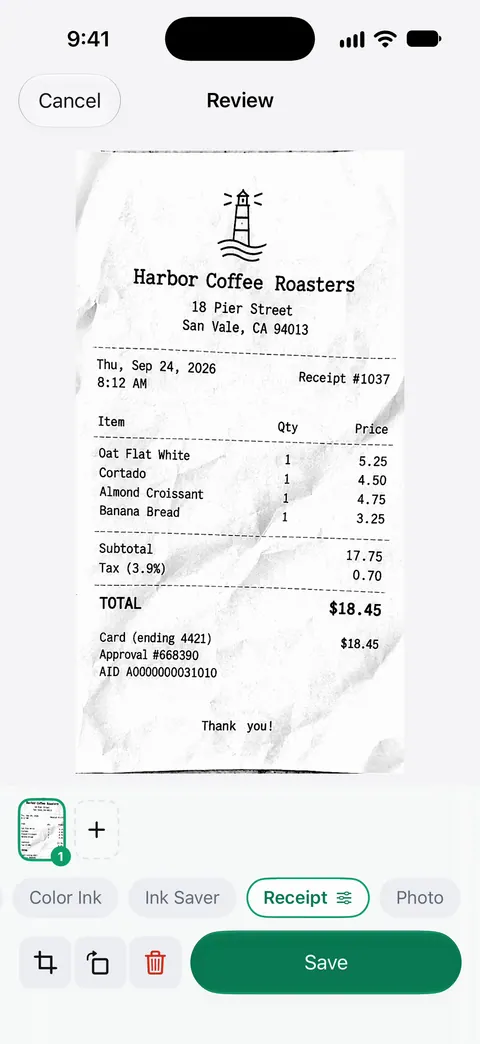
Scan receipts weekly before thermal paper fades: scan receipts for taxes. Keep one folder per tax year and one PDF per month of statements. When it’s time to file, the documents to file your taxes list covers the rest, and how long to keep tax records says when you can let them go. Just starting out? Read the papers to keep from day one.
Where Scanner One helps, and where it doesn’t
The Notes app or the Files app can scan a receipt, and a folder per year in Files is a workable system.
Scanner One helps with the weekly pile. Scans come with Auto Clean, Color, Grayscale and Receipt filters. Then it reads the text, names the document, tags it and puts it in the right folder. Free accounts get smart filing for 10 documents a month. Search looks inside the text of every document and shows the matching line and page. Scanner One exports to Word, keeping headings, lists and tables, and to Excel and CSV. Free accounts can run the exports 3 a week.
On a free account, pages you share, print or export carry a small “Scanned with Scanner One” label at the bottom right. Pro removes it. Documents stay on your iPhone unless you share them or turn on iCloud Sync.
Scanner One isn’t accounting or tax software: it doesn’t track mileage, total your income or tell you what’s deductible.
Questions and answers
Do I have to report freelance income if I didn’t get a 1099?
Yes. The IRS says you must report all income from selling goods or services whether or not you receive a form. That’s why your own invoices and deposit records matter more than the forms.
What if a 1099-K includes money friends sent me?
Gifts, repaid shared costs and similar personal payments aren’t taxable. Keep records that show what those payments were, and mark them as personal in the payment app when you can.
Do freelancers have to pay estimated taxes?
Often, yes, since no employer withholds tax for you. Form 1040-ES has a worksheet to tell whether you must pay and vouchers to pay with. Keep a record of each payment’s date and amount; your IRS online account shows your payment history too.
Is a bank statement enough proof of a business expense?
It proves you paid, but not what you bought. The IRS lists receipts and invoices alongside card and bank statements, and notes a combination may be needed. Keep both.
Sources
What this page says about Scanner One was checked against the app on .
- IRS, Self-employed individuals tax center — who is self-employed, self-employment tax, estimated tax, Schedule C and SE; last reviewed 2026-09-27
- IRS, Understanding your Form 1099-K — payment card and app payments, personal payments that aren’t income, report all income with or without a form; last reviewed 2026-10-28
- IRS, Estimated taxes — who pays, Form 1040-ES, ways to pay, payment history in your online account; last reviewed 2026-09-25
- IRS, What kind of records should I keep — supporting documents for income, expenses and assets; last reviewed 2026-08-03
- IRS, Gather your documents — the side job and self-employment records to gather at filing time; last reviewed 2026-10-26
- Apple Support, Scan documents on your iPhone or iPad (108963) — scanning several pages in Notes and Files; published 2026-02-13
- Scanner One on the App Store — the app’s own listing
Get Scanner One
Scanner One is free, with generous limits: scanning, clean PDFs and text search never stop.

Scanner OneScan, sign and ask anything
Scanner One is free, with generous limits: scanning, clean PDFs and text search never stop.