
Checklist
Records a small business should keep
Keep records that prove your income and expenses: deposit records, invoices, receipt books and 1099 forms for gross receipts; receipts, invoices, card statements and proof of payment for purchases and expenses; purchase and sale records for assets you depreciate; and payroll records such as W-4s, wage payments and tax deposits if you have employees. Add copies of every tax return, your formation papers, licenses, leases and contracts. The IRS says any system works if it clearly shows income and expenses.

This is general information, not tax or legal advice. Rules depend on your business, your state and your industry. Check IRS.gov or ask your accountant.
The IRS doesn’t require a particular system, except in a few cases. It asks that your records clearly show your income and expenses, and that you can back up every figure on your return with a document. This is the list of those documents, grouped the way the IRS groups them.
Income (gross receipts)
- Deposit records: for cash and card sales.
- Invoices: every one you send, numbered.
- Cash register tapes or sales reports: from your point-of-sale system.
- Receipt books: if you write receipts by hand.
- Forms 1099: the 1099-NEC, 1099-MISC or 1099-K forms you receive from clients and payment platforms.
Purchases for resale
Items you buy to resell, and raw materials or parts for what you make:
- Invoices from suppliers.
- Proof of payment: canceled checks, electronic transfers, card receipts and statements.
- Cash register receipts: for small purchases.
Business expenses
Everything else it costs to run the business:
- Receipts and invoices: for rent, supplies, software, phone, ads, repairs.
- Account statements and card statements.
- Proof of payment: a canceled check or transfer record for each larger bill.
The IRS notes that you may need more than one paper to support a purchase or expense. A receipt shows what you bought; a statement shows that you paid.
Travel, meals, gifts and car use
- Receipts: with the date, place and amount.
- A note of the business purpose: who you met and why.
- Mileage log: dates, destinations, miles and purpose for each business trip.
IRS Publication 463 sets out what each of these needs to show.
Assets
Equipment, furniture, vehicles and property you use in the business. Keep records of:
- When and how you got it: the purchase invoice or closing statement.
- What you paid: and what improvements cost.
- How you used it: business or personal use.
- Depreciation and section 179 deductions you took.
- When and how you disposed of it: the sale invoice and price.
Payroll, if you have employees
The IRS lists these employment tax records:
- Your EIN.
- Each employee’s name, address, Social Security number and job.
- Dates of employment.
- Dates and amounts of wages, and tips reported.
- Forms W-4 and the other withholding certificates.
- Dates and amounts of tax deposits, with EFTPS acknowledgment numbers.
- Copies of returns you filed, with confirmation numbers.
- Fringe benefits and expense reimbursements, with their substantiation.
- Records for any credits you claimed.
- W-2s returned to you as undeliverable.
Taxes
- Every tax return you filed: federal, state and local, with all schedules.
- Estimated tax payment records.
- Sales tax returns and payments: if your state collects them.
- Letters from the IRS and your state.
Legal and company papers
- Formation papers: articles of organization or incorporation, your EIN confirmation letter, an operating or partnership agreement.
- Licenses and permits: with their renewal dates.
- Leases and contracts: with landlords, clients and suppliers.
- Insurance policies: and certificates you give or receive.
- Loan papers: notes, security agreements and statements.
- Bank and card statements: for every business account.
How long to keep them
It depends on what each record supports. The IRS bases it on the period during which it can examine a return: usually 3 years, longer in some cases. Payroll records stay at least 4 years. Asset records stay until the period ends for the year you sell or dispose of the asset. Insurers and lenders may want some records longer. How long a small business should keep its records goes through each type.
Mistakes that hurt at tax time
- Mixing personal and business spending on one card.
- Keeping receipts but no proof of payment, or the reverse.
- Thermal receipts that fade to blank before anyone needs them.
- A mileage log written from memory at year end.
- No copy of the asset purchase invoice when you sell the asset.
Scan and keep them safely
Scan receipts the week you get them, before thermal paper fades: scan receipts for taxes. Put each month’s statements into one PDF with scan several pages into one PDF. Keep a second copy away from the office: back up scanned documents. Read which papers you can shred before you throw out originals.
Where Scanner One helps, and where it doesn’t
The Notes app and the Files app can scan receipts and statements, and for a few a month that may be enough.
Scanner One is built for the steady flow of a business. Then it reads the text, names the document, tags it and puts it in the right folder. Free accounts get smart filing for 10 documents a month. Pro removes every limit. Scans come with Auto Clean, Color, Grayscale and Receipt filters. Search looks inside the text of every document and shows the matching line and page. Scanner One exports to Word, keeping headings, lists and tables, and to Excel and CSV.
On a free account, pages you share, print or export carry a small “Scanned with Scanner One” label at the bottom right. Pro removes it. Documents stay on your iPhone unless you share them or turn on iCloud Sync.
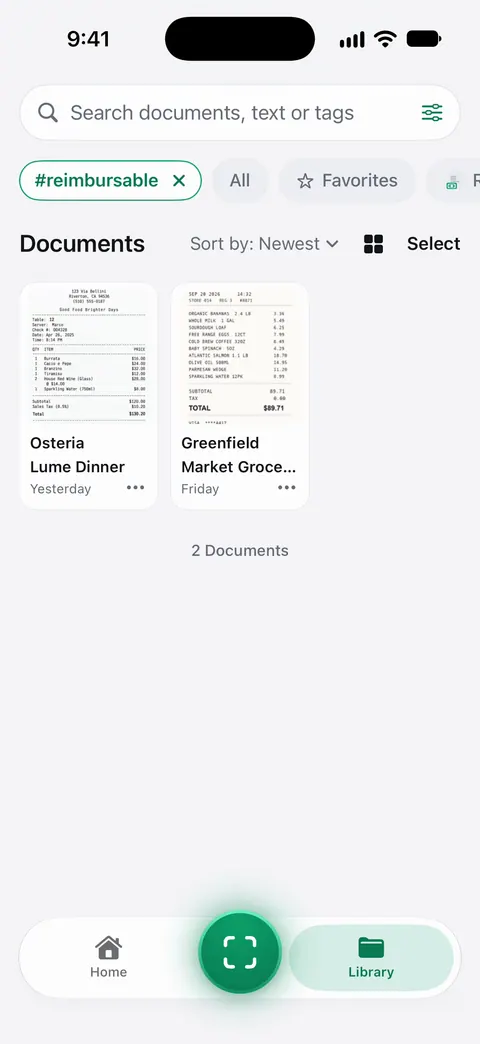
Scanner One is not accounting software. It doesn’t keep books, run payroll or file returns, and it won’t tell you which expenses you can deduct. The scanner apps for a small business, compared has the alternatives.
Questions and answers
Can I keep business receipts as scans instead of paper?
Many businesses do. What matters to the IRS is that your records clearly show income and expenses and that you can produce them if asked. Keep scans complete and readable, keep a backup, and read our guide on throwing away originals before you shred anything.
How long should a small business keep records?
Generally as long as the IRS can examine the return they support, which is usually 3 years and longer in some cases. Payroll records are kept at least 4 years, and asset records until the period ends for the year you sell the asset.
What counts as proof of a business expense?
A receipt or invoice that shows what was bought, plus proof you paid, such as a canceled check, an electronic transfer or a card statement. The IRS notes a combination of documents may be needed.
Do I need to keep bank statements if I have receipts?
Yes. Statements show deposits for your income records and proof of payment for expenses. They work together with the receipts and invoices.
Sources
What this page says about Scanner One was checked against the app on .
- IRS, What kind of records should I keep — gross receipts, purchases, expenses, assets and their supporting documents; last reviewed 2026-08-03
- IRS, Employment tax recordkeeping — the payroll records to keep and for how long; last reviewed 2026-06-12
- IRS, How long should I keep records? — periods of limitations, property records, non-tax reasons to keep longer; last reviewed 2026-06-30
- IRS, Recordkeeping — why records matter, any system that clearly shows income and expenses; last reviewed 2026-05-01
- Apple Support, Scan documents on your iPhone or iPad (108963) — scanning several pages in Notes and Files; published 2026-02-13
- Scanner One on the App Store — the app’s own listing
Get Scanner One
Scanner One is free, with generous limits: scanning, clean PDFs and text search never stop.

Scanner OneScan, sign and ask anything
Scanner One is free, with generous limits: scanning, clean PDFs and text search never stop.