
Guide
Your policy renewed: how to spot what changed
Put last year’s declarations page next to this year’s and compare them line by line: who is insured, the address, the property or vehicles, every coverage limit, every deductible, the discounts and the premium. Then read the last pages of the renewal for new endorsements or exclusions, as the Texas Department of Insurance advises, and ask the insurer in writing to explain anything that changed. Keep both versions until you are sure.

This page is general information from state insurance regulators and the NAIC, not insurance or legal advice. What insurers must disclose at renewal is set by each state. Your state’s department of insurance can tell you what applies to your policy.
Why a renewal deserves a second look
A renewal is not always the same policy again. Coverage can narrow, a deductible can change from a fixed amount to a percentage, a roof can move from replacement cost to actual cash value, and a new exclusion can arrive as a page at the back. The premium may change too, or stay the same while the coverage shifts. The California Department of Insurance’s advice is blunt: there is no substitute for reading your policy and your renewal declarations carefully.
You don’t need to reread every page. You need to find what is different.
Step 1: put the two declarations pages side by side
The declarations page is the summary at the front: the NAIC describes it as listing the policy number, the effective dates, what is covered, the coverages and limits, the premium, the discounts and the company’s details. Find last year’s and this year’s, and go line by line.
A simple way is to copy this table and fill in both columns:
| Line | Last year | This year | Changed? |
|---|---|---|---|
| Named insured and address | |||
| Policy period | |||
| Property details or vehicles and drivers | |||
| Dwelling or vehicle coverage and limit | |||
| Other structures, belongings, loss of use | |||
| Liability limit | |||
| Deductibles, including any percentage deductibles | |||
| Roof: replacement cost or actual cash value | |||
| Discounts listed | |||
| Lender or lienholder | |||
| Premium | |||
| Forms and endorsements listed |
Mark every line where the two columns differ. Those are your questions.
Step 2: check the details they price on
The Texas Department of Insurance points out that insurers use your home’s age, square footage, construction type and roof age to set your price, so an error can cost you money. For a car policy, the drivers, the cars and how they are used play the same role. If any of these changed on the declarations page and you didn’t tell them about a change, ask why.
The NAIC adds a second reason to check: if your declarations page is wrong, it could cause problems if you file a claim.
Step 3: read the back of the renewal
Changes to coverage are often not on the summary page at all. They arrive as endorsements, the pages that add to, remove from or change the standard policy. The Texas Department of Insurance’s advice is to check the final pages of your renewal for new endorsements or exclusions, and to ask your agent or company to explain anything you don’t understand.
What to look for:
- New exclusions: something that was covered and now isn’t.
- Deductible changes: especially a deductible that is now a percentage of the insured value. Work it out in dollars.
- Roof terms: a change from replacement cost, which pays current prices, to actual cash value, which takes off depreciation for wear and age.
- Limits and sublimits: lower caps on items like jewelry, water damage or mold.
- Named perils instead of all-risk: the Texas shopping guide explains that all-risk policies cover events the policy doesn’t specifically exclude, while named perils policies cover only the events listed.
If the policy lists its forms and endorsements by name or number on the declarations page, compare that list too. A form that is new this year is worth a question.
Step 4: ask, in writing
Send your insurer or agent a short email: “My policy renews on [date]. I compared it with last year’s. Please explain these changes: …” and list them. Keep the reply with the policy. A written answer is easier to rely on later than a phone call.
If the changes don’t suit you, you have until the renewal date to change the policy or move to another insurer. The renewal checklist covers the rest of the decision, including quotes and discounts.
Step 5: keep both versions
Keep last year’s policy and declarations page with the new one, at least until any claim from last year’s period is closed. Next year, you will compare again, and you’ll want this year’s copy. How long to keep old insurance policies has the reasoning by policy type.
If your insurer sent the renewal as a PDF, you can compare two PDFs on your phone too; see how to compare two PDFs on iPhone.
Where Scanner One helps, and where it doesn’t
Scanner One is not an insurance advisor and does not judge whether a change is good or bad for you. Your agent, your insurer and your state’s department of insurance can explain what a change means.
It makes the comparison easier to do. Point your camera at any piece of paper. Scanner One finds the edges, straightens the page, cleans it up and saves a real PDF. A scan can have many pages, and you can reorder them. Search looks inside the text of every document and shows the matching line and page. Search both years for “roof”, “deductible” or “exclusion” and jump straight to those pages.
Ask your documents anything. When does the lease end? What did I spend at the shop? The answer comes back with the page it came from. In the screenshot below, two documents are compared side by side in a table.
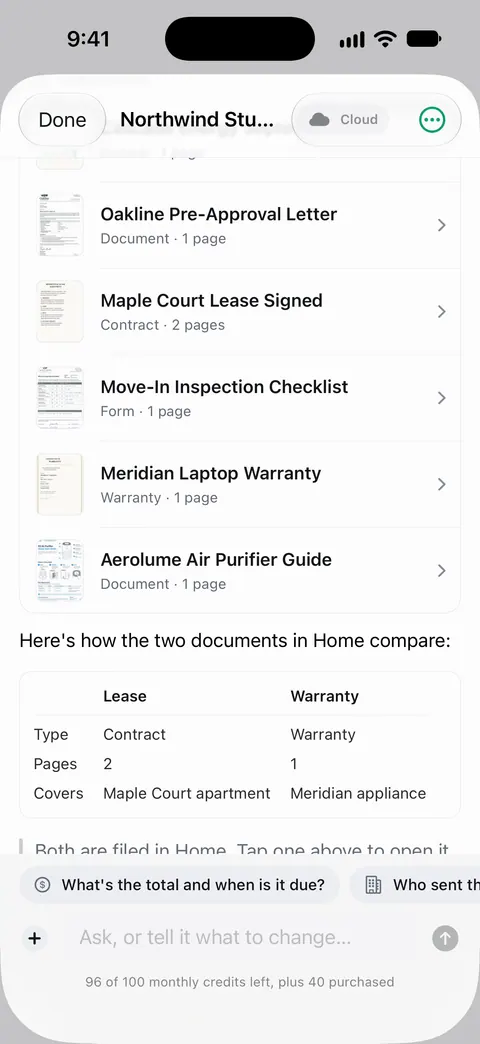
On a free account you can ask 3 questions a day. Check any answer against the page it came from before you act on it.
What changed compares the new version of a lease or policy with the one you signed. Pro adds What changed, filling forms from your documents, Pack checks and folder sharing.
Documents stay on your iPhone unless you share them or turn on iCloud Sync. Cloud AI is off until you switch it on, and page images are a separate permission.
If your renewal is short and the declarations pages are clear, a pen and the table above are enough.
Questions and answers
Do insurers have to tell me when they change my policy?
The rules are set by each state, and they differ for nonrenewals, cancellations and changes in coverage. Read every page of the renewal, and contact your state’s department of insurance if you think a change wasn’t disclosed properly.
What is an endorsement?
A page that changes the standard policy: it can add coverage, remove it, or change how something is paid. The Texas Department of Insurance advises checking the final pages of your renewal for new endorsements or exclusions.
What does it mean if my roof moved to actual cash value?
Replacement cost pays to repair or replace at current prices. Actual cash value pays that minus depreciation for wear and age, so an older roof would be paid out at less. The Texas Department of Insurance notes some policies make this change as a roof ages.
My premium is the same. Do I still need to check?
Yes. Coverage can change while the price stays the same, for example a new exclusion or a higher percentage deductible. The declarations page and the final pages are where that shows.
Sources
What this page says about Scanner One was checked against the app on .
- Texas Department of Insurance, Is your home policy up for renewal? Here’s what to look for — changes to roof coverage, house details, percentage deductibles, coverages, and new endorsements or exclusions in the final pages; last updated 18 December 2025
- California Department of Insurance, Residential Insurance: Homeowners and Renters (Form 401) — there is no substitute for reading your policy and renewal declarations carefully; review the dwelling limit on renewal; revised January 2026
- NAIC, Declarations of Saving — what the declarations page lists, and that an error on it could cause problems with a claim; published 1 August 2011, page modified 16 January 2024
- Texas Department of Insurance, Home insurance shopping guide — replacement cost versus actual cash value, all-risk versus named perils, and deductibles; read 2026-11-13
- Texas Department of Insurance, Is your auto policy up for renewal? — premium, deductibles, discounts, drivers, cars and coverages to check; last updated 14 October 2024
- Scanner One on the App Store — the app’s own listing
Get Scanner One
Scanner One is free, with generous limits: scanning, clean PDFs and text search never stop.

Scanner OneScan, sign and ask anything
Scanner One is free, with generous limits: scanning, clean PDFs and text search never stop.