
Situation
Moving out: the papers and photos that get your deposit back
Reread your lease for the move-out and cleaning rules, ask for a walk-through before you leave if your state offers one, fix what you can, then clean and photograph every room the way you did at move-in, with dates. Return the keys in a way you can prove, give your forwarding address in writing, and keep receipts for cleaning and repairs. If the deposit doesn’t come back, or the deductions look wrong, ask for an itemized statement in writing; your state’s rules set the deadline.

This page is about the end of a tenancy: proving the place was left in good shape. The papers you need to rent a new place are on a different page, the checklist of documents to rent an apartment.
This page is general information, not legal advice. Security deposit rules are set by each state, and some cities add more. The examples here are from California’s Attorney General; check your own state’s tenant rules.
Two to four weeks before you leave
Reread the lease
Find the parts about notice, cleaning, carpet, painting, keys and the deposit. Some leases say how clean the place must be or require professional carpet cleaning. USAGov’s first advice for tenants is to read the lease carefully. If your lease is a PDF, search it for “deposit”, “clean” and “move”.
Find your move-in record
This is the most important paper you have. Look for:
- The move-in checklist or inspection report you signed
- Move-in photos and videos, ideally dated
- Any emails or texts where you reported a problem early on, such as a stained carpet or a broken blind
Under California’s rules, for example, a deposit may not be used for damage that was already there when you moved in. Your move-in record is how you show that.
Ask for a pre-move-out inspection
Some states give you this right. In California, the landlord must tell you that you can ask for an initial inspection, held within the two weeks before you move out. The landlord then lists what they plan to charge for, so you have a chance to fix it first. Even where it isn’t required, asking costs nothing.
Moving day: document the place
After cleaning, with the furniture out:
- Walk through room by room with your camera. Start at the door of each room for a wide view, then go close on walls, floors, windows, closets, the inside of cabinets, the oven, the fridge, the bathroom and any spot on your move-in list.
- Shoot a slow video too. Say the date and the room out loud.
- Match the move-in photos. Same angles where you can, so the before and after sit side by side.
- Photograph the meter readings and the keys you return.
- Don’t edit the photos. Keep the originals; their dates are part of the proof.
The papers to keep
- Receipts for cleaning supplies, professional cleaning, carpet cleaning and any repairs you paid for
- Your written notice to leave, and the landlord’s reply
- Proof you returned the keys: a signed note, a text confirming it, or a photo of the drop box
- Your forwarding address, given in writing. Send it by email or letter so there’s a date on it.
- The final utility bills, showing your accounts closed
Scan the paper ones into one folder for this move, with the lease and the move-in checklist. On iPhone, the Notes or Files app can scan them: in Files, tap the More button, then Scan Documents. Our apartment move-out documents checklist has the full list.
When the deposit comes back short
Read the itemized statement
Many states require landlords to explain deductions in writing. In California, the statement must arrive within 21 days after move-out, and if the landlord paid someone for repairs, they must include a copy of the bill. If the landlord did the work themselves, the statement must show the work, the time and the hourly rate.
Check each charge against your photos, your move-in record and your receipts.
Dispute in writing
Write a short letter or email: which charges you dispute, why, and what you’re attaching (photos, the move-in checklist, a cleaning receipt). Ask for the amount back by a date. Keep a copy.
If that doesn’t work
- Your state’s tenant agency or handbook. USAGov links to each state’s.
- Legal aid, if you qualify.
- Small claims court. Deposit disputes are common there. Your photos, receipts and letters become the evidence; our page on organizing small claims court evidence shows how to put them in order.
California’s Attorney General notes that in a court case over deposit deductions, the landlord has to prove the amounts were reasonable.
Next time, at move-in
Take the photos on day one, before you unpack. Send them to the landlord with the signed checklist so there’s a dated record on both sides. Our page on moving house paperwork covers the rest of a move.
Where Scanner One helps, and where it doesn’t
Scanner One won’t get your deposit back and can’t tell you your state’s rules. It helps keep the lease, the checklist and the receipts together and easy to search.
A scan can have many pages, and you can reorder them. Search looks inside the text of every document and shows the matching line and page. So the line in the lease about carpet cleaning is one search away.
Ask your documents anything. When does the lease end? What did I spend at the shop? The answer comes back with the page it came from. Asking “when do I have to give notice?” of your scanned lease, for example, brings back the clause and its page.
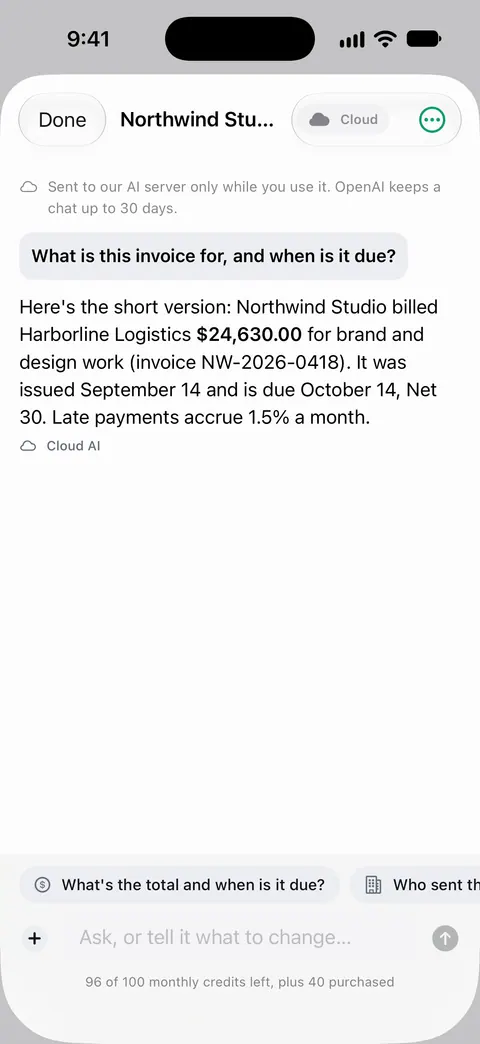
Free accounts can ask the on-device AI 3 questions a day. On a free account, pages you share, print or export carry a small “Scanned with Scanner One” label at the bottom right. Pro removes it. Your photos are best kept as photos, with their original dates, in the Photos app or a shared album.
Questions and answers
How long does a landlord have to return a security deposit?
It depends on your state, and some cities add their own rules. In California, for example, the Attorney General says the landlord must send an itemized statement of any deductions and return the rest within 21 days after you move out. Look up your state’s tenant handbook; USAGov links to each state’s agency.
Can a landlord charge for normal wear and tear?
Generally no. California’s Attorney General lists ordinary wear and tear, and damage that was already there when you moved in, among the things a deposit may not be used for. Faded paint and light scuffs from normal living are the usual examples. Your move-in photos are how you show what was already there.
What photos should I take when I move out?
Every room, from the doorway and then close up: walls, floors, inside the oven and fridge, the bathroom, windows, closets and any spot you noted at move-in. Take them after cleaning, on the day you hand back the keys, and keep the originals with their dates.
What if my landlord won’t return my deposit?
Write to them first, asking for the itemized statement and the balance, and keep a copy. If that doesn’t work, your state’s tenant agency or legal aid can tell you your options; many people take deposit disputes to small claims court.
Sources
What this page says about Scanner One was checked against the app on .
- California Attorney General, Know your rights as a California tenant: security deposits (consumer alert) — allowed deductions, no charges for ordinary wear and tear or damage already there at move-in, the right to an inspection before move-out, the itemized statement within 21 days, bills for repairs; file modified 2024-02-20
- USAGov, Tenant rights — read your lease, find your state’s tenant rights agency or handbook, legal aid; last updated 2026-04-15
- Superior Court of California, County of San Mateo, Go to court (small claims) — bringing copies of evidence such as photos, bills and estimates to a small claims trial; notice on the page dated 2026-11-12
- Scanner One on the App Store — the app’s own listing, for the closing section
Get Scanner One
Scanner One is free, with generous limits: scanning, clean PDFs and text search never stop.

Scanner OneScan, sign and ask anything
Scanner One is free, with generous limits: scanning, clean PDFs and text search never stop.