
Checklist
Documents you need to rent an apartment: the printable list
Most landlords ask for a government photo ID, proof of income (recent pay stubs, an offer letter, or tax returns and bank statements if you are self-employed), your rental history and references, and your permission to run a credit and background check. Have the application fee and deposit ready, and a guarantor’s papers if your income is short. Requirements vary by landlord, city and state, so ask for the written list first, and confirm the listing is real before you send your Social Security number or ID.

Landlords decide fast, and the first complete application often gets the apartment. Gather these papers before you start touring, keep them in one folder, and you can apply the same day you find a place you like.
Every adult who will live in the unit usually fills in an application and is screened, so make one set per person.
Proof of identity
- Government photo ID: a driver’s license, state ID or passport. Scan the front and back of a card, and check that it hasn’t expired.
- Social Security number or ITIN: screening companies use your name, Social Security number and date of birth to find your records. If you don’t have a number, ask the landlord what they accept instead.
- Name change papers: a marriage certificate or court order, if your pay stubs or rental history show another name.
Proof of income
- Recent pay stubs: usually the last 2 or 3, or the last 30 days. Send whole pages, not crops.
- Offer letter: for a new job, signed, with the start date and pay.
- Self-employed: last year’s tax return (some landlords want 2), your 1099 forms and 2 to 3 months of bank statements.
- Other income: benefit award letters (Social Security, disability, veterans’ benefits), a child support or alimony order, or a student aid letter.
- Bank statements: often 2 or 3 months, to show savings or regular deposits.
- Housing voucher papers: if you pay part of the rent with a voucher, the voucher and the agency’s contact.
Rental history and references
- Current and past addresses: with dates and each landlord’s name, phone and email. Screening reports list current and past addresses, so your list should match.
- Current lease: or a letter from your landlord saying you pay on time.
- Proof of rent paid: receipts, a portal’s payment history or bank statements, useful if you have little credit.
- References: an employer or a previous landlord who agreed to take a call.
Credit and background check
- Signed screening authorization: the landlord’s form letting a screening company pull your credit, eviction and criminal records.
- Your own credit reports: free at AnnualCreditReport.com. Read them before you apply, and dispute mistakes early. The FTC notes that most landlords pull credit themselves, so be wary of anyone who asks you for a screenshot of your score or pushes you to a paid site.
- Court papers for an old case: if an eviction case was dismissed or a debt was paid, keep the paper that shows how it ended. The CFPB’s checklist tells renters to look for exactly these errors.
Money and extras
- Application fee, deposit and first month’s rent: by check, money order, card or the landlord’s portal. Anyone who insists on a wire, gift cards or cryptocurrency is running a scam, according to the FTC.
- Guarantor or co-signer papers: their ID, proof of income and the signed guarantee form.
- Renters insurance: some leases require proof before you move in. See the renters insurance papers to keep.
- Pet records: vaccination and license papers, if the building allows pets.
- Car details: plate and registration, if you’ll get a parking spot.
What to get from the landlord, and keep
- The signed lease: every page, every addendum, with both signatures.
- Lead paint disclosure: for housing built before 1978, the landlord must disclose known lead paint and give you the EPA’s pamphlet.
- Move-in condition report: signed and dated, with your own photos.
- Deposit receipt: and where the deposit is held, if your state requires that.
- Any denial or higher-deposit notice: if a screening report was the reason, you can get a free copy of it within 60 days and dispute errors.
Where the rules differ
Cities and states set many of the rules: caps on application fees, limits on credit and criminal history checks, protection for tenants who pay with vouchers, and what goes in a lease. Ask your state or city housing agency, and read what a landlord can and cannot ask for before you hand over anything unusual.
Mistakes that slow an application
- Pay stubs with the dates or the employer cut off.
- A blurry photo of an ID instead of a flat, readable scan.
- Names that don’t match across papers, with no name change document.
- One adult applying when two will live there.
- Sending your ID and pay stubs to a listing you haven’t verified. Check the owner in the county’s property records.
Scan and send them safely
- Scan each group into one PDF: ID, income, history. Several pages into one PDF shows how.
- Name files plainly: “Rivera ID.pdf”, “Rivera pay stubs Oct-Nov.pdf”.
- Shrink big files before you email them: make a PDF smaller to email.
- Use the landlord’s secure portal when there is one. If you must email, password-protect the PDF and send the password by text.
- Cover account numbers the landlord doesn’t need, for real: redact a PDF properly.
If the landlord wants it all tonight, this step-by-step for a same-day request will help.
Where Scanner One helps, and where it doesn’t
Your iPhone can already do the basics. Notes and the Files app scan several pages into one document, and for an application or two that is enough.
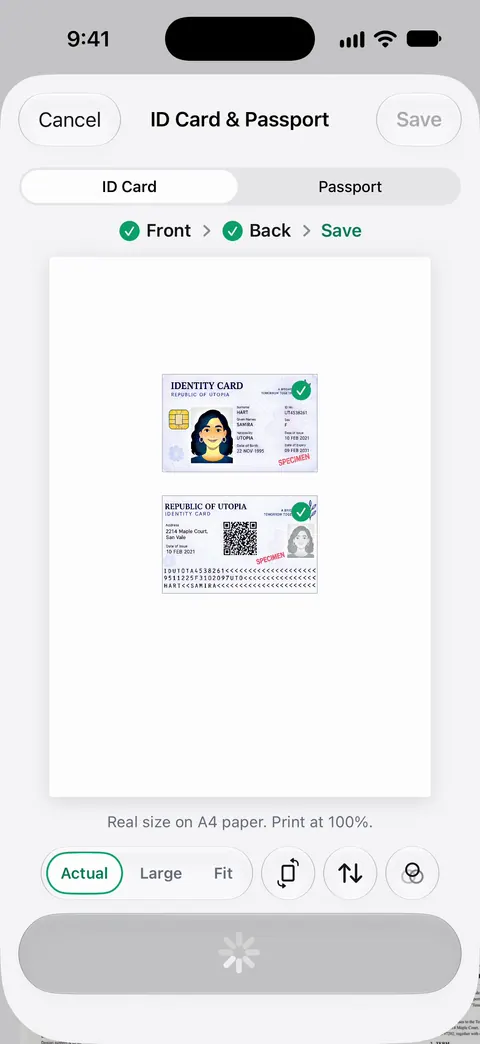
Scanner One helps when the pile grows. ID cards and passports are scanned with both sides on one printable page. A scan can have many pages, and you can reorder them. The PDF tools merge, split, compress, password-protect, add page numbers and watermarks, and extract text. Free accounts can run them 3 a week. Pro adds redaction, the smart eraser, edit text, auto-export and five alternate app icons. Documents stay on your iPhone unless you share them or turn on iCloud Sync.
On a free account, pages you share, print or export carry a small “Scanned with Scanner One” label at the bottom right. Pro removes it. Most landlords won’t mind, but know it’s there.
Packs: say what you’re applying for, like a visa, a lease or your taxes, and see which papers you have and what’s missing.
Scanner One doesn’t fill in a landlord’s portal for you, check whether a listing is real or run a credit check.
Questions and answers
Can a landlord ask for bank statements?
Many do, usually the last 2 or 3 months, to see income or savings. Ask whether they will accept statements with the account number covered except the last 4 digits, and send them through the landlord’s portal rather than plain email.
What can I use as proof of income if I just started a new job?
A signed offer letter on the employer’s letterhead that shows your start date, pay and position. Add your first pay stub as soon as you have it, and bank statements that show savings if the landlord wants more.
Should I send my Social Security number before I see the apartment?
No. The FTC warns that rental scammers ask for Social Security numbers, license photos and pay stubs before you have agreed to rent. See the place, check that the person owns or manages it, then give your number through the screening company or the landlord’s application.
What if I’m self-employed?
Bring your last 1 or 2 years of tax returns with all schedules, your 1099 forms, and 2 to 3 months of bank statements that show regular deposits. A short letter from your accountant can help, but ask the landlord what they accept.
Sources
What this page says about Scanner One was checked against the app on .
- FTC, Tenant background checks and your rights — what screening reports contain, adverse action notices, the free copy and disputes; page dated August 2025
- FTC, Rental listing scams — scammers asking for SSN, license photos and pay stubs, wire and gift card payments; page dated June 2026
- CFPB, Review your rental background check — what to check in eviction and criminal records, how to dispute; last modified 2024-01-30
- EPA, Real estate disclosures about potential lead hazards — landlords of housing built before 1978 must disclose known lead paint and give the EPA pamphlet; updated 2026-05-27
- Apple Support, Scan documents on your iPhone or iPad (108963) — scanning several pages in Notes and Files; published 2026-02-13
- Scanner One on the App Store — the app’s own listing
Get Scanner One
Scanner One is free, with generous limits: scanning, clean PDFs and text search never stop.

Scanner OneScan, sign and ask anything
Scanner One is free, with generous limits: scanning, clean PDFs and text search never stop.