
Situation
Selling your car: the papers to hand over and to keep
Hand the buyer the title, signed in the seller’s section with the odometer and any damage disclosure filled in, and a bill of sale signed by both of you. If there is a loan, the lender has to sign off or release the lien first. Keep copies of everything. Then tell your state DMV the car is sold, as your state requires, deal with the plates by your state’s rules, and only then cancel the insurance.

Before you list the car
A sale goes quickly once there is a buyer. These are easier to sort before:
- Find the title. If it is lost, apply for a duplicate from your state’s motor vehicle agency now. Without it, most buyers will walk away.
- If you have a loan, ask the lender for the payoff amount and how they release the lien. In California, the lienholder signs the title too.
- Gather the car’s records: service history, repair receipts, the owner’s manual, spare keys. They help the sale and the buyer will want them.
- Check your state’s extra steps. California, for example, may require a smog certification for a transfer.
- Clear out personal things, including toll tags, garage door openers and anything in the glove box with your name or address on it.
What the buyer gets
Hand these over at the sale, once you have been paid:
- The title, signed by you in the seller’s section. When you transfer a title, you fill in the odometer and damage disclosure statements on it, and sign where it says “Seller’s Signature”. Write carefully, and ask your DMV what to do if you make a mistake on it.
- A bill of sale, signed by you both. New York’s bill of sale shows the year and make, the vehicle identification number (VIN), the date of sale, the price, and both names and signatures. It should be given even for a gift.
- The lien release or the lender’s signature on the title, if there was a loan.
- Emissions or smog certificates, where your state requires them.
- The records and keys you gathered.
The buyer’s side of the sale is in the checklist of documents you need to buy a car, which is worth a look so you know what they will ask for.
If the car is a gift or sold well below its value, New York also asks the seller to fill in a section of a sales tax form. Other states have their own rules for family sales, so check yours.
What you keep
The title leaves with the buyer, so keep copies of what proves the car is no longer yours:
- Both sides of the signed title, photographed or scanned before you hand it over.
- The bill of sale. New York says both buyer and seller may keep photocopies; the buyer keeps the original for the DMV.
- Your release of liability or notice of sale confirmation from the DMV.
- The plate surrender receipt, if your state takes plates back.
- Proof of payment: a copy of the cashier’s check or the transfer confirmation.
- The insurance cancellation confirmation.
Keep these for a few years. If the buyer gets a parking ticket or toll bill before registering the car, they are your proof of the date the car changed hands.
Tell the DMV and deal with the plates
States handle this differently, so check yours; USAGov links to every state’s motor vehicle agency, and the buyer will need the papers in the car registration checklist. Two examples:
- California: the seller submits a Notice of Transfer and Release of Liability within 5 days of the sale.
- New York: remove the plates and the registration sticker before the car leaves you, and turn the plates in at a motor vehicle office unless you move them to another car you own.
Cancel the insurance last
Cancelling insurance is the final step, not the first. New York warns that if you cancel your liability insurance or let it lapse before you turn in your plates, your registration will be suspended, and your driver license could be too. Once the plates and the DMV notice are done, call your insurer.
Getting paid safely
For a private sale, agree on the payment method before you meet. If the buyer brings a cashier’s check, call the issuing bank yourself, using a number you looked up, to confirm it before you hand over the title. Meeting at the buyer’s bank is simpler still.
This page is general information, not legal advice. Title, plate and reporting rules are set by each state and change. Check your state motor vehicle agency’s page before the sale.
Where Scanner One helps, and where it doesn’t
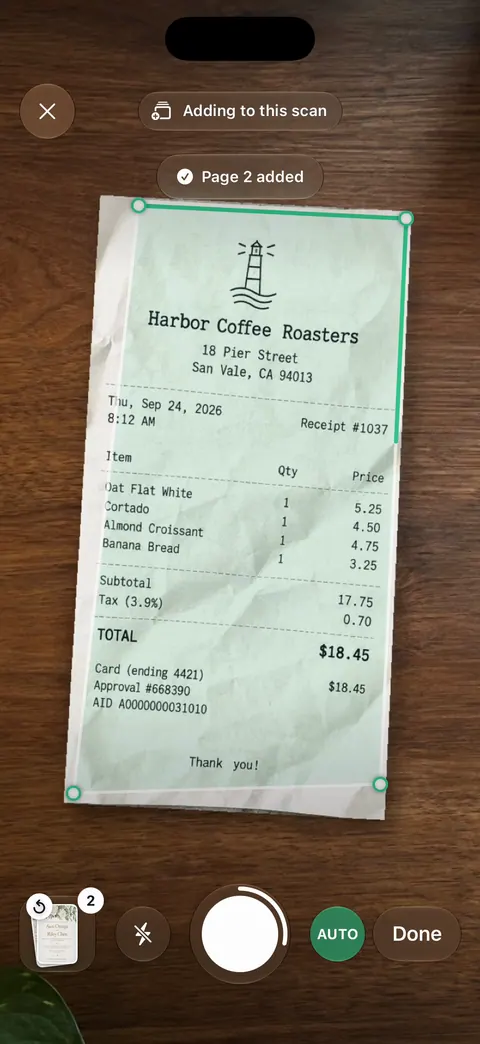
The one moment that matters is just before you hand over the title: that is your last chance to copy it. Point your camera at any piece of paper. Scanner One finds the edges, straightens the page, cleans it up and saves a real PDF. A scan can have many pages, and you can reorder them. So the front and back of the title and the bill of sale can go into one PDF in a few seconds.
Search looks inside the text of every document and shows the matching line and page. A year later, searching for the car’s make or the buyer’s name brings the bill of sale back up. Documents stay on your iPhone unless you share them or turn on iCloud Sync. On a free account, pages you share, print or export carry a small “Scanned with Scanner One” label at the bottom right. Pro removes it.
It doesn’t notify the DMV or your insurer, and it can’t tell you your state’s rules. For a single copy, your iPhone’s Notes scanner is enough; our guide to keeping car documents on your iPhone covers both ways, and scanning several pages into one PDF shows the built-in steps.
Questions and answers
What paperwork do I need to sell my car?
The title, which you sign in the seller’s section with the odometer reading and any damage disclosure, and a bill of sale signed by you and the buyer. If you still owe money on the car, you also need the lender’s sign-off on the title or a lien release. Some states ask for more, such as a smog certificate in California.
Do I need a bill of sale?
In New York the seller should give one even for a gift, showing the year, make, VIN, date, price and both names and signatures. Other states differ, but a signed bill of sale is a good record for both of you anywhere.
Do I keep the license plates when I sell my car?
It depends on the state. New York tells sellers to remove the plates and the registration sticker and turn the plates in, unless they move to another car you own. Check your state’s motor vehicle agency.
When can I cancel my car insurance after selling?
After the plates and ownership are dealt with. New York warns that if you cancel insurance before you turn in the plates, your registration will be suspended and your driver license could be too.
What do I do if I can’t find the title?
Ask your state motor vehicle agency for a duplicate before you list the car, because it can take time. Most buyers, and the DMV, will want the title itself.
Sources
What this page says about Scanner One was checked against the app on .
- New York DMV, Buy, sell, or transfer vehicle ownership — the seller signs the transfer section of the title, a bill of sale even for a gift and what it must show, photocopies for both sides, and the sales tax form for gifts; no date shown, read 2026-11-13
- New York DMV, Let the buyer be aware — remove the plates and registration sticker, turn in plates before cancelling insurance, and odometer and damage disclosure on the title; no date shown, read 2026-11-13
- California DMV, Title transfers and changes — seller and lienholder sign the title, the Notice of Transfer and Release of Liability within 5 days, and forms that may be required such as a smog certification and bill of sale; no date shown, read 2026-11-13
- USAGov, State motor vehicle services — a link to each state’s motor vehicle agency; no date shown, read 2026-11-13
- Scanner One on the App Store — the app’s own listing: scanning, multi-page scans, search
Get Scanner One
Scanner One is free, with generous limits: scanning, clean PDFs and text search never stop.

Scanner OneScan, sign and ask anything
Scanner One is free, with generous limits: scanning, clean PDFs and text search never stop.