
Checklist
Documents you need to buy a car, new or used
Bring your driver’s license, proof of insurance (or your insurer’s details to set it up), how you’ll pay (a loan preapproval, a cashier’s check or proof of funds), and for a loan, recent pay stubs and proof of address. For a trade-in, bring its title or the lender’s payoff details and its registration. Before you drive away, get signed copies of the contract and loan disclosures, the Buyers Guide on a used car, and the title or the dealer’s title paperwork. Registration rules are set by your state.

A car purchase produces a stack of papers in one afternoon, and some of them, like the title and the Buyers Guide, matter for years. Read this before you go, take the first part with you, and use the second part as your check before you sign.
To bring: identity and insurance
- Driver’s license: valid, for the test drive and the paperwork.
- Proof of insurance: your current card, or your insurer’s name and policy number so the new car can be added. Have the VIN ready to call in.
- Proof of address: a recent bill or bank statement, if your license shows an old address.
To bring: how you’ll pay
- Loan preapproval letter: from your bank or credit union, if you have one. It gives you an offer to compare with the dealer’s.
- Down payment: a cashier’s check, or a card or debit limit you’ve confirmed with your bank.
- For a dealer loan: your recent pay stubs, proof of address and references, if the lender asks.
- Your credit reports: read them before you shop and fix mistakes. The CFPB suggests keeping your loan applications within a short window, since several lender checks close together count as one.
To bring: your trade-in
- The title: if you own the car outright.
- The payoff details: if you still owe money, the lender’s name, your account number and a payoff quote.
- The registration: current, in your name.
- Service records: they can help the trade-in value.
- Both keys and the manuals.
To check before you sign at a dealer
- The price and terms in writing: the total price, the down payment, your trade-in value and every fee.
- Loan disclosures: the APR, finance charge, amount financed, total of payments and total sale price, plus the payment amount, number of payments and late fees. The CFPB says you can ask for these early and take them home to compare.
- No blanks: every space filled in. Don’t sign a blank or partly blank form.
- Add-ons: extended warranties, service contracts or other products you didn’t ask for.
- The Buyers Guide, on a used car: whether it’s sold as is or with a warranty. Any warranty change you negotiate must appear on the Buyers Guide and the contract.
- Spoken promises: get them in writing, because the FTC notes spoken promises are hard to enforce.
To get before you drive away
- Copies of everything you signed: the sales contract and the loan contract, signed by you and the dealer. Electronic copies should be in a format you can save or print.
- The Buyers Guide: for a used car.
- Warranty papers: the manufacturer’s or dealer’s, and any service contract you bought.
- Title and registration paperwork: dealers usually apply for the title and registration and give you temporary tags. Ask what you’ll receive and when.
- Inspection report: if you paid an independent mechanic, the written report with the VIN.
Buying from a private seller
- The title, signed over to you: check that the seller’s name matches their ID and that the VIN matches the car.
- A lien release: if the title shows a lender.
- A bill of sale: with the date, price, VIN and both signatures, if your state asks for one.
- A vehicle history report: helpful for accidents and flood damage, but it won’t show mechanical problems, so get an inspection too.
Registering the car
Each state sets its own rules, fees and deadlines. Your state’s motor vehicle agency lists what to bring. Documents to register a car goes through the usual list.
Mistakes buyers regret
- Signing a contract with blank spaces.
- Leaving without copies of the signed papers.
- Agreeing to add-ons without reading what they cost in total.
- Buying privately from someone whose name isn’t on the title.
- Trading in a car without the payoff amount in writing.
Scan and keep them safely
Scan the contract and loan papers as soon as you get home, every page in order: scan several pages into one PDF. Keep the original title somewhere safe and fireproof rather than in the glove box, and keep a scan of it. Keeping car documents on your iPhone covers the registration and insurance cards. When it’s time to sell, the selling paperwork picks up from here.
Where Scanner One helps, and where it doesn’t
For a single contract, the Notes app or the Files app scans the pages into one document, and that’s enough to keep a copy.
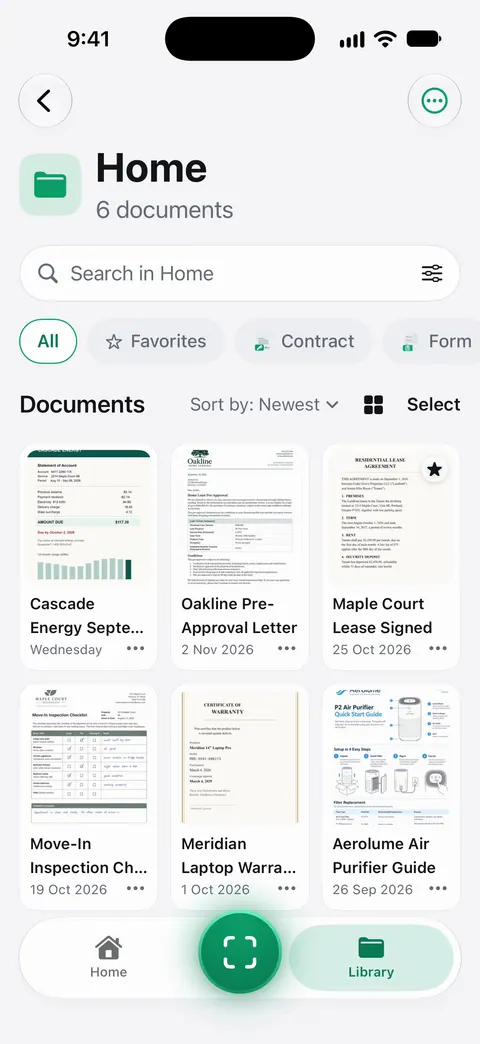
Scanner One helps when you want those papers findable for years. A scan can have many pages, and you can reorder them. Scanner One makes searchable PDFs. Search looks inside the text of every document and shows the matching line and page. Documents stay on your iPhone unless you share them or turn on iCloud Sync.
You can sign and annotate documents. Free accounts can sign and mark up 3 documents a month. On a free account, pages you share, print or export carry a small “Scanned with Scanner One” label at the bottom right. Pro removes it.
Scanner One doesn’t check a car’s history, read a contract for you or register a car with your state.
Questions and answers
Do I need insurance before I buy a car?
Nearly every state requires insurance to drive, and dealers usually ask for proof before you leave. Call your insurer with the car’s VIN, or add it in their app, before you pick it up.
What is the Buyers Guide on a used car?
A sticker dealers must display on used cars that says whether the car is sold as is or with a warranty. You get it after the sale, and the FTC says it overrides anything in your sales contract, so keep it with your papers.
Should I get a loan preapproval before going to the dealer?
It gives you an offer to compare. The CFPB suggests checking your credit reports first and keeping your loan shopping within a short window, since several lender inquiries close together count as one.
What papers do I need from a private seller?
The title signed over to you, with the odometer reading if your state requires it, and a bill of sale if your state asks for one. Make sure no lender is still listed on the title, or get the lender’s release.
Sources
What this page says about Scanner One was checked against the app on .
- FTC, Buying a used car from a dealer — the Buyers Guide, as-is sales, getting promises in writing, independent inspection; page dated April 2024
- CFPB, What should I know before I finalize a car or auto loan? — the loan disclosures, no blank forms, copies of every document; last modified 2023-04-28
- CFPB, What should I know before I shop for an auto loan? — credit reports, keeping rate shopping in a short window, co-signers, trade-in value; last modified 2024-11-20
- USA.gov, Motor vehicle services — links to each state’s motor vehicle agency for registration
- Apple Support, Scan documents on your iPhone or iPad (108963) — scanning several pages in Notes and Files; published 2026-02-13
- Scanner One on the App Store — the app’s own listing
Get Scanner One
Scanner One is free, with generous limits: scanning, clean PDFs and text search never stop.

Scanner OneScan, sign and ask anything
Scanner One is free, with generous limits: scanning, clean PDFs and text search never stop.