
Checklist
Documents you need to apply for a loan
Most lenders ask for a photo ID and your Social Security number, proof of income (recent pay stubs, W-2s or tax returns, or benefit letters), recent bank statements, proof of address, and the details of your current debts, which they use to work out your debt-to-income ratio. Self-employed applicants usually add 2 years of tax returns. A co-signer brings the same set. Lists differ by lender and loan type, so ask for the lender’s own list before you apply.

A loan decision comes down to who you are, what you earn and what you already owe. Each paper below answers one of them. Gather the set once and you can apply with several lenders and compare their offers.
Identity
- Photo ID: a driver’s license, state ID or passport, front and back.
- Social Security number: for the credit check. Some lenders accept an ITIN; ask.
- Proof of address: a recent utility bill, lease or bank statement, especially if your ID shows an old address.
- Name change papers: if your pay stubs and ID show different names.
Income
- Pay stubs: the most recent ones, often covering the last 30 days.
- W-2 forms: last year’s, sometimes the last 2 years.
- Tax returns: the last 2 years with all schedules, if you’re self-employed, paid on commission or have income from rentals or investments.
- 1099 forms: for contract work.
- Benefit letters: Social Security, pension, disability or veterans’ benefits.
- Child support or alimony: the court order and proof the payments arrive, if you want the lender to count it.
- Employer details: name, address, phone and how long you’ve worked there.
Savings and bank accounts
- Bank statements: usually the last 2 or 3 months, every page.
- Savings or investment statements: if you’re showing reserves or a down payment.
Debts
Lenders weigh your new payment against what you already pay each month. Have:
- Statements for each loan: car, student, personal, and the mortgage or rent.
- Credit card statements: balances and minimum payments.
- Child support or alimony you pay: the order and amounts.
Divide your total monthly debt payments by your gross monthly income and you have your debt-to-income ratio, the number lenders use. Knowing it in advance tells you how big a payment is realistic.
Credit
- Your credit reports: free from each nationwide bureau at AnnualCreditReport.com, and weekly. Read all 3 and dispute errors before you apply.
- Letters of explanation: short, signed and dated, for a late payment or a gap the lender asks about.
- Beware of other “free report” sites. The FTC warns that imposter sites copy the name, and that the real site and the bureaus never email you to ask for your Social Security or account numbers.
For the specific loan
- Auto loan: the purchase agreement or buyer’s order with the VIN, and proof of insurance.
- Debt consolidation: statements for the debts you’re paying off.
- Student loan: the school’s cost of attendance and enrollment, and a co-signer’s papers if needed.
- Home or business loans: the lists are longer. See mortgage application documents and SBA loan documents.
If you have a co-signer
A co-signer brings the same identity, income and debt papers you do. The CFPB stresses that a co-signer takes on full responsibility for the loan, so talk through what happens if a payment is missed before you ask.
Mistakes that slow approval
- Pay stubs older than the lender’s window.
- Statements with missing pages.
- An income figure on the application that doesn’t match the pay stubs.
- Applying everywhere over months instead of within a short window.
- Paying an upfront “processing fee” to someone who guarantees approval. Real lenders don’t work that way.
Scan and send them safely
- Scan each group into one PDF, every page in order: scan several pages into one PDF.
- Upload through the lender’s own website or app, typed in yourself, not from a link in a message.
- If you must email, password-protect the PDF and send the password by text.
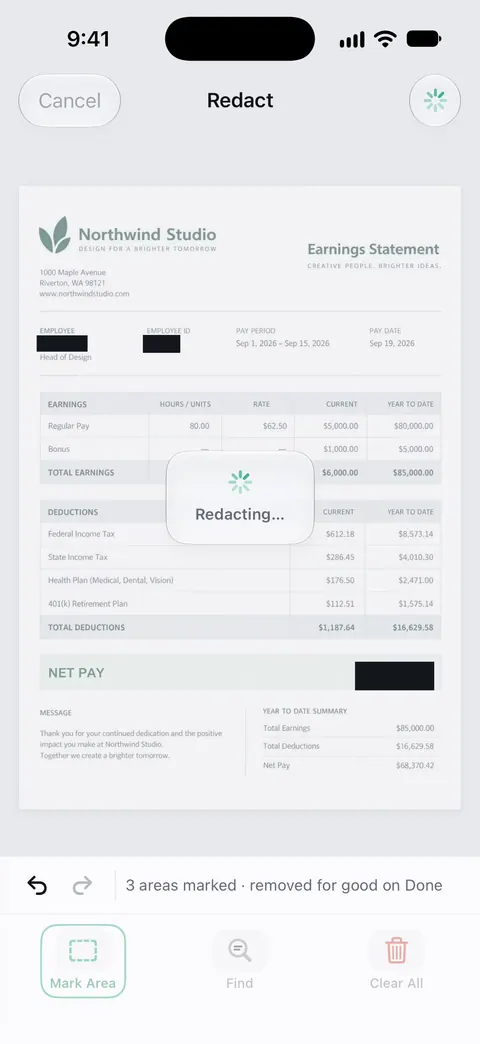
- Lenders need your income and balances. If a paper also shows things they don’t need, ask first, then redact it properly.
Once the loan closes, how long to keep pay stubs and the loan papers is worth a look.
Where Scanner One helps, and where it doesn’t
Notes and the Files app scan pages into one document, and for one application that’s enough.
Scanner One helps when you’re sending the same papers to several lenders. A scan can have many pages, and you can reorder them. The PDF tools merge, split, compress, password-protect, add page numbers and watermarks, and extract text. Free accounts can run them 3 a week. Pro adds redaction, the smart eraser, edit text, auto-export and five alternate app icons. Redaction is permanent.
On a free account, pages you share, print or export carry a small “Scanned with Scanner One” label at the bottom right. Pro removes it. Documents stay on your iPhone unless you share them or turn on iCloud Sync.
Packs: say what you’re applying for, like a visa, a lease or your taxes, and see which papers you have and what’s missing.
Scanner One doesn’t check your credit, compare loan offers or apply for you.
Questions and answers
What is a debt-to-income ratio?
All your monthly debt payments divided by your gross monthly income, before taxes. Lenders use it to judge whether you can take on another payment, and different lenders and loans set different limits.
Do I need tax returns for a personal loan?
Not always. Employees often get by with pay stubs and a W-2. If you’re self-employed or paid in irregular amounts, expect to send 2 years of tax returns and bank statements that show the deposits.
Will applying to several lenders hurt my credit?
Each hard check can lower your score a little. For auto loans, the CFPB suggests keeping your applications within 14 to 45 days of each other so they count as one inquiry.
Is it safe to email my pay stubs and ID to a lender?
Use the lender’s secure upload instead whenever you can. If you must email, send a password-protected PDF with the password by text. Real lenders don’t ask for upfront fees by gift card or wire.
Sources
What this page says about Scanner One was checked against the app on .
- CFPB, Create a loan application packet — the CFPB’s model list of income, asset and identity documents (written for mortgages); last modified 2024-12-12
- CFPB, What is a debt-to-income ratio? — how lenders measure what you can repay, limits differ by lender; last modified 2023-08-30
- FTC, Free credit reports — AnnualCreditReport.com, weekly free reports, imposter sites; page dated June 2026
- CFPB, What should I know before I shop for an auto loan? — checking credit first, rate shopping in a short window, what a co-signer takes on; last modified 2024-11-20
- Apple Support, Scan documents on your iPhone or iPad (108963) — scanning several pages in Notes and Files; published 2026-02-13
- Scanner One on the App Store — the app’s own listing
Get Scanner One
Scanner One is free, with generous limits: scanning, clean PDFs and text search never stop.

Scanner OneScan, sign and ask anything
Scanner One is free, with generous limits: scanning, clean PDFs and text search never stop.