
Checklist
Documents you need to file your taxes: the IRS list, grouped
Gather Social Security numbers or ITINs for everyone on the return, last year’s return, your bank routing and account numbers, and every income form: W-2s, the 1099 forms (NEC, K, INT, DIV, G, R, MISC), SSA-1099 and 1095-A. Then the records for credits and deductions: child care, mortgage interest and property tax, donations, education costs and retirement contributions. Side work adds income statements, receipts and mileage logs. Most forms arrive by early February; if a W-2 is missing, ask your employer first.

This is general information, not tax advice. Tax rules and forms change every year. Check IRS.gov or ask a tax professional about your situation.
Most of these papers arrive between January and mid-February, by mail or in an online account. Make one folder for the tax year, drop each form in as it comes, and tick it off this list. Only gather what applies to you.
You and your family
- Social Security numbers or ITINs: for you, your spouse and every dependent on the return.
- Your name as Social Security has it: if you married or changed your name, the names must match.
- Your current address: and tell the IRS and Social Security if it changed.
- Last year’s return: your adjusted gross income from it, and last year’s self-select PIN if you e-filed.
- Identity Protection PIN: if the IRS issued you one. A new one arrives each year by letter or in your online account.
- Bank routing and account numbers: for a direct deposit refund or a payment.
Income forms
- Form W-2: from each employer, and any corrected W-2.
- Form 1099-NEC: pay for freelance or contract work.
- Form 1099-K: payments through cards, payment apps and online marketplaces.
- Form 1099-INT and 1099-DIV: interest, dividends and distributions.
- Form 1099-G: government payments such as unemployment benefits.
- Form 1099-R: pensions, annuities and retirement plan withdrawals.
- Form SSA-1099: Social Security benefits.
- Form 1099-MISC: other income, such as rents or prizes.
- Form W-2G: gambling and lottery winnings.
- Digital asset records: your own records of sales and trades, even if no form arrived.
Health coverage
- Form 1095-A: if you had a plan from the Health Insurance Marketplace.
Credits and deductions
- Child and dependent care: the provider’s name, address, tax ID and what you paid.
- Mortgage interest and property tax: if you itemize.
- Charitable donations: receipts and acknowledgment letters.
- HSA or FSA contributions: the year-end statements.
- Medical costs: if you itemize.
- Retirement contributions: IRA and other plan records.
- Education costs: receipts for tuition and books, for students and teachers.
Side work and self-employment
- Statements from banks, payment apps and marketplaces: to total what you were paid.
- Checks paid to you.
- Receipts and mileage logs: for travel, gifts and car costs.
- Office expenses: receipts for what you deduct.
- Estimated tax payments: the dates and amounts you paid.
The full list for freelancers is in tax documents a freelancer should keep.
Letters from the IRS
- Any notice or letter: about this year’s return or last year’s, with its notice number.
- The letter with your new IP PIN, if you’re in the program.
If a form is missing or wrong
- Check your online accounts first. Employers, banks and brokers often post forms before the paper arrives.
- Ask the employer or payer for a missing or corrected W-2 or 1099-R.
- Call the IRS after the end of February if it still hasn’t come. Have your employer’s name, address and EIN ready. The IRS contacts the employer and sends you Form 4852.
- File with Form 4852 if you must, using your best estimate. If the real form arrives later with different numbers, you file an amended return on Form 1040-X.
- For a wrong 1099-K, keep records of what the payments were. Personal payments, like a friend paying you back, aren’t income.
Your IRS online account also shows recent return details and lets you download transcripts.
Mistakes that hold up a return
- Filing before every form has arrived, then amending.
- A dependent’s Social Security number typed wrong.
- A name that doesn’t match Social Security’s records.
- A wrong bank routing number on a direct deposit.
- Missing the 1099 from a small side job. The IRS gets a copy.
Scan and keep them safely
Scan each form when it arrives rather than in April. How to scan receipts for taxes covers the small ones, and scan several pages into one PDF covers statements.
If you send papers to a preparer, use their secure portal, or password-protect the PDF and send the password separately. Before you send a copy to anyone else, such as a lender, redact what they don’t need.
When everything is in, the one-evening plan for tax season gets it done, and how long to keep tax records tells you when the folder can go.
Where Scanner One helps, and where it doesn’t
For a handful of forms, the Notes app or the Files app is enough: both scan several pages into one document.
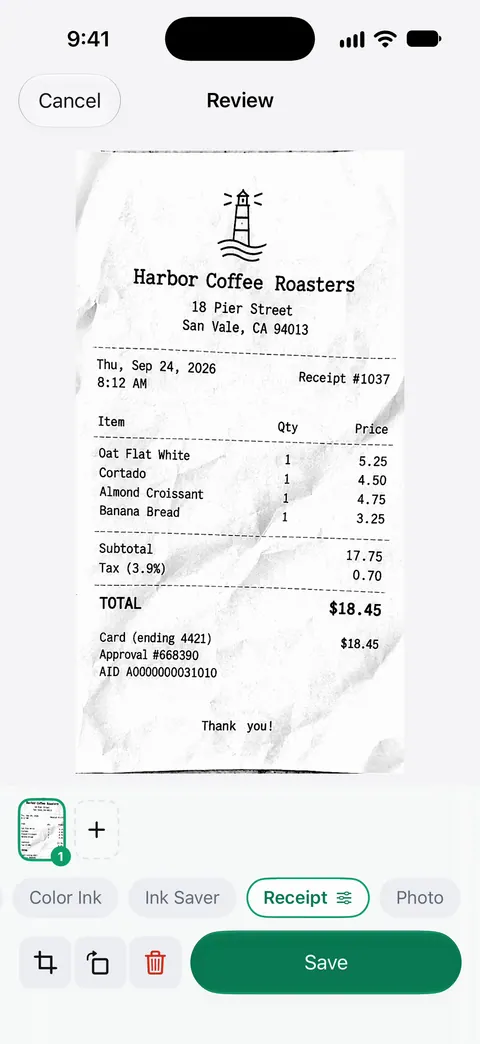
Scanner One helps when the year’s papers add up. Then it reads the text, names the document, tags it and puts it in the right folder. Free accounts get smart filing for 10 documents a month. Search looks inside the text of every document and shows the matching line and page. Scans come with Auto Clean, Color, Grayscale and Receipt filters. The Receipt filter keeps faded print readable.
The PDF tools merge, split, compress, password-protect, add page numbers and watermarks, and extract text. Free accounts can run them 3 a week. On a free account, pages you share, print or export carry a small “Scanned with Scanner One” label at the bottom right. Pro removes it. Documents stay on your iPhone unless you share them or turn on iCloud Sync.
Packs: say what you’re applying for, like a visa, a lease or your taxes, and see which papers you have and what’s missing.
Scanner One doesn’t prepare or file a return, calculate deductions or give tax advice.
Questions and answers
When should my W-2 arrive?
Employers send W-2s at the end of January or the first days of February; the IRS’s Topic 154 gives this season’s date. If yours hasn’t come, ask your employer. If it still hasn’t arrived by the end of February, the IRS can help, and Form 4852 lets you file with your best estimate.
Do I need last year’s tax return?
It helps. The IRS lists last year’s adjusted gross income, and the self-select PIN if you e-filed, among the things to have ready. You can view recent return details and download transcripts in your IRS online account.
What if I get a 1099-K for money friends sent me?
Gifts, repaid shared costs and a roommate’s share of rent aren’t taxable and don’t belong on a 1099-K, according to the IRS. Keep the records that show what the payments were, and see the IRS’s page on what to do with a 1099-K you shouldn’t have received.
Can I keep my tax documents as scans?
Many people do. Keep each form whole and readable, keep a backup, and keep them for as long as the IRS can ask about the return. Our guide on how long to keep tax records explains the periods.
Sources
What this page says about Scanner One was checked against the app on .
- IRS, Gather your documents — the full list of personal information, income forms and deduction records; last reviewed 2026-10-26
- IRS, Get ready to file your taxes — online account, IP PIN, direct deposit, digital assets; last reviewed 2026-11-10
- IRS, Topic 154: Form W-2 and Form 1099-R (what to do if incorrect or not received) — contact the employer, call the IRS after February, Form 4852, Form 1040-X; last reviewed 2026-09-24
- IRS, Understanding your Form 1099-K — what the form reports, personal payments that are not income; last reviewed 2026-10-28
- Apple Support, Scan documents on your iPhone or iPad (108963) — scanning several pages in Notes and Files; published 2026-02-13
- Scanner One on the App Store — the app’s own listing
Get Scanner One
Scanner One is free, with generous limits: scanning, clean PDFs and text search never stop.

Scanner OneScan, sign and ask anything
Scanner One is free, with generous limits: scanning, clean PDFs and text search never stop.