
Checklist
Documents for an SBA small business loan
For an SBA 7(a) loan, expect to give your lender SBA Form 1919 (the borrower information form), a signed personal financial statement for every owner of 20% or more and every guarantor, business financial statements or tax returns for the last 3 years, a current interim income statement and balance sheet, a business debt schedule, and projections if you’re a start-up or buying a business. Add purchase agreements, leases and any lawsuit or bankruptcy papers. Your lender’s list governs, and it varies with the loan’s size and type.

This is general information, not financial or legal advice. SBA loans are made by lenders, and each lender decides its own document list within SBA rules. Smaller loans need less; 504 loans and microloans have their own lists. Ask your lender for its checklist.
The SBA guarantees the loan; a bank, credit union or other approved lender makes it. That means you deal with the lender’s checklist, which is built on what the SBA requires them to collect. The list below follows the SBA’s own 7(a) submission checklist, updated July 2026, grouped the way lenders use it.
Application forms
- SBA Form 1919, Borrower Information Form: completed by the business, and a separate one for each co-borrower, signed by the business’s authorized representative. It must be dated within 120 days of submission to the SBA.
- The lender’s own application: with the loan amount and what it’s for.
Owners and guarantors
- Personal financial statement: for every owner of 20% or more, and every proposed guarantor. It includes the assets of the owner’s spouse and minor children. Signed and dated within 120 days, with the “as of” date filled in. The spouse signs too if they’ll guarantee the loan.
- Personal credit reports: the lender pulls them for owners of 20% or more.
- Résumés: lenders often ask for each owner’s management experience.
- Status papers for non-citizen owners: lawful permanent residents and other non-citizen owners and guarantors are verified with USCIS.
Business financial statements
- Interim income statement and balance sheet: both dated the same day, within 120 days of submission.
- Year-end statements or federal tax returns: income statements and balance sheets, or complete tax returns, for the last 3 years.
- Projections with assumptions: required for start-ups, new businesses, changes of ownership and any loan based on projections.
- Business debt schedule: every business debt on the latest balance sheet, marking any you want to refinance.
- Affiliates’ statements: the same interim and 3-year statements for affiliated businesses.
What the money is for
- Business purchase agreement: when the loan buys a business, plus the seller’s financial statements or tax returns for 3 years and an interim period, and a pro forma balance sheet as of the transfer.
- Real estate purchase agreement: when the loan buys property.
- Cost breakdown: for improvements to real estate.
- Debts being refinanced: copies of the notes, security agreements and leases, and 12 months of payment history showing they’re current.
- Business valuation: for a change of ownership, when required.
Supporting papers
- Business plan: the SBA advises having a plan, an expense sheet and projections, and for an existing business, income statements, balance sheets and cash flow statements for the last 3 to 5 years.
- Formation documents: articles, operating agreement or bylaws, and your EIN.
- Business licenses and the lease for your location.
- Collateral list: what you could pledge.
- Lawsuits, judgments or bankruptcy papers: if any.
Before you apply
- Check your personal credit. The SBA notes a new business’s loan is typically judged on the owner’s personal credit score.
- Use the SBA’s Lender Match tool, or ask your own bank whether it makes SBA loans.
- Ask which program fits: 7(a) is the SBA’s main program, 504 loans give long-term, fixed-rate financing through Certified Development Companies, and microloans cover smaller amounts.
Mistakes that send packages back
- A Form 1919 or financial statement older than 120 days by the time the lender submits it.
- Interim statements and balance sheet dated on different days.
- A personal financial statement with the “as of” date left blank.
- A missing statement from a 20% owner or a guarantor.
- Projections without the assumptions behind them.
Scan and send them safely
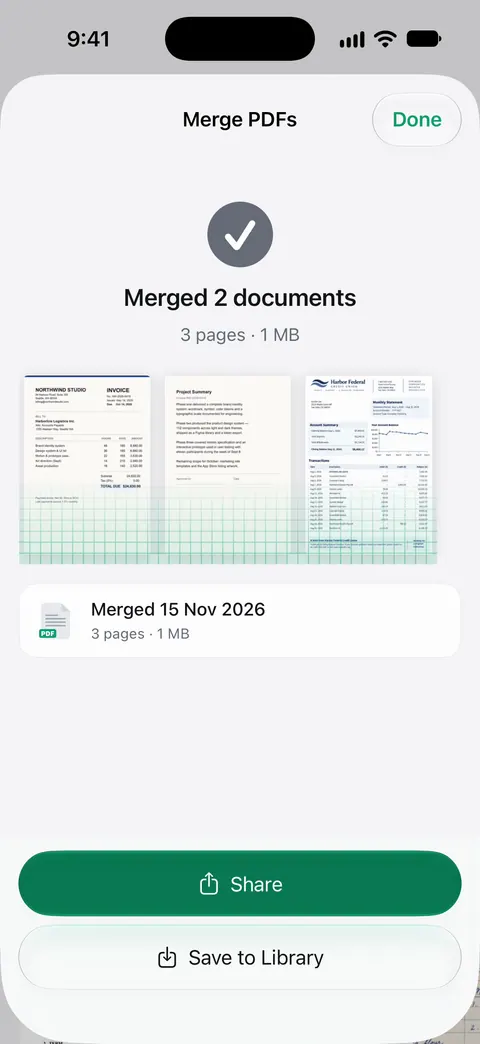
Lenders want a tidy package, one PDF per item, named the way they file it (“Form 1919 Acme LLC.pdf”, “2025 tax return Acme.pdf”). Scan several pages into one PDF, merge PDFs when a document came in parts, and make big files smaller for upload limits. Upload through the lender’s portal. Keep copies of everything with your business records.
Where Scanner One helps, and where it doesn’t
Your accountant produces most of this as PDFs already. What usually needs scanning is the signed forms, the leases and old loan papers, and the Notes app or the Files app can do a few pages.
Scanner One helps with the package. A scan can have many pages, and you can reorder them. The PDF tools merge, split, compress, password-protect, add page numbers and watermarks, and extract text. Free accounts can run them 3 a week, and a full SBA package will likely need more. Pro removes every limit. Scanner One exports to Word, keeping headings, lists and tables, and to Excel and CSV. Fill Form lets you type into the fields of a PDF form.
On a free account, pages you share, print or export carry a small “Scanned with Scanner One” label at the bottom right. Pro removes it. Documents stay on your iPhone unless you share them or turn on iCloud Sync.
Scanner One doesn’t prepare financial statements, check a package against SBA rules or submit anything to a lender.
Questions and answers
What is SBA Form 1919?
The Borrower Information Form for 7(a) loans. The small business applying fills it in and gives it to the lender. Each co-borrower signs a separate one, and the SBA’s checklist says it must be dated within 120 days of submission to the SBA.
Do I need a business plan for an SBA loan?
Usually, yes, especially for a new business. The SBA’s own guidance says to have a business plan, an expense sheet and financial projections, and its checklist asks for detailed projections with assumptions for start-ups, new businesses and changes of ownership.
Who has to give a personal financial statement?
Every owner of 20% or more and every proposed guarantor, per the SBA’s 7(a) checklist. It includes the assets of the owner’s spouse and minor children, and must be signed and dated within 120 days.
How many years of tax returns do I need?
For an existing business, the SBA’s checklist asks for year-end financial statements or federal tax returns for the last 3 years, with a recent interim statement. Lenders often ask for personal returns of the owners too.
Sources
What this page says about Scanner One was checked against the app on .
- SBA, 7(a) loan submission checklist (LGPC) — the documents lenders submit for 7(a) loans, with the 120-day dating rules and the 20% ownership threshold; checklist updated July 2026, page updated 2026-08-24
- SBA, Form 1919: Borrower information form — completed by the small business applying for a 7(a) loan and given to the lender; page updated 2025-03-31
- SBA, Fund your business — business plan, projections, past financial statements, personal credit and collateral
- SBA, 7(a) loans — application contents vary with the loan size and the lender’s processing method
- SBA, Loans — eligibility basics, Lender Match, 7(a), 504 and microloans
- Apple Support, Scan documents on your iPhone or iPad (108963) — scanning several pages in Notes and Files; published 2026-02-13
- Scanner One on the App Store — the app’s own listing
Get Scanner One
Scanner One is free, with generous limits: scanning, clean PDFs and text search never stop.

Scanner OneScan, sign and ask anything
Scanner One is free, with generous limits: scanning, clean PDFs and text search never stop.