
Checklist
Documents and records to start an LLC
You file articles of organization (some states call it a certificate of formation) with your state, naming a registered agent in that state. Once the state approves, you get a free EIN from the IRS, which needs the responsible party’s Social Security number or ITIN. Then write an operating agreement, register any trade name (DBA), get the licenses and permits your work needs, and open a business bank account. Every state has its own forms, fees and annual filings, so start at your Secretary of State’s website.

This is general information, not legal or tax advice. LLCs are created under state law, and every state sets its own forms, fees, names and yearly filings. Check your Secretary of State’s website, and ask a lawyer or accountant about your situation.
Starting an LLC is mostly paperwork in the right order: the state first, then the IRS, then the bank and the licenses. Keep each paper as it comes in, because you’ll be asked for the same set again by banks, lenders, clients and landlords.
Before you file
- The LLC’s name: checked against your state’s business name search, with “LLC” or the ending your state requires.
- A registered agent: a person or service with an address in the state who accepts legal papers for the LLC. You need one before you file.
- The business address: and a mailing address if it’s different.
- The members: names and addresses of the owners.
- How it’s managed: by the members, or by managers.
- The purpose: a short description, if your state’s form asks for one.
The state filing
- Articles of organization: some states call it a certificate of formation. The SBA describes it as a simple document with the basics of your LLC.
- The filing receipt and the approved, stamped copy: your proof the LLC exists. Banks will ask for it.
- The filing fee: it depends on your state; the Secretary of State’s site lists it.
The operating agreement
- Who owns what share.
- How decisions are made and money is shared.
- Who may sign contracts and open accounts.
- What happens if a member leaves or dies.
Some states require one; banks ask for ownership agreements either way. Sign it and keep it with the articles.
The EIN from the IRS
- The responsible party’s Social Security number or ITIN: the person who controls the LLC.
- The approved state filing: form the LLC first. Applying before can delay the EIN.
- One session online: the application expires after 15 minutes of inactivity, and each responsible party can get only one EIN a day.
- The confirmation letter: print or save it on the spot. It’s the paper banks and clients ask for.
The EIN is free. Websites that charge a fee for it are not the IRS.
Tax choices
- Default classification: a single-member LLC is disregarded for income tax; two or more members, a partnership. A single-member LLC is still separate for employment and some excise taxes.
- Form 8832: if you elect to be taxed differently, keep a copy and the IRS’s acceptance letter.
Names, licenses and permits
- DBA certificate: if you’ll trade under a name other than the LLC’s. It doesn’t protect the name by itself.
- Business licenses and permits: federal for some activities, and state, county and city ones depending on what you do and where. Note each renewal date.
- State tax registrations: sales tax and payroll accounts, if you sell taxable goods or hire.
- Trademark filing: optional, with the USPTO, once you’ve formed the business.
If you work in other states
- Foreign qualification: a certificate of authority in each other state where the LLC does business.
- Certificate of good standing: from your home state, which some states ask for.
Records to keep from day one
- The articles, the approval and every later amendment.
- The operating agreement and any amendments.
- The EIN confirmation letter.
- Licenses, permits and renewal notices.
- Each year’s state report or renewal filing, if your state requires one.
- Member decisions put in writing, such as resolutions to open accounts or borrow.
Beneficial ownership reports to FinCEN are no longer required for companies created in the US, under the final rule effective August 14, 2026. Banks still ask who owns the LLC when you open an account: see business bank account documents.
Mistakes new owners make
- Applying for the EIN before the state approved the LLC.
- Paying a website for an EIN.
- Letting the registered agent lapse, so legal papers go nowhere.
- Missing the state’s yearly filing.
- Mixing personal and LLC money from the start. The records a small business should keep shows how to keep them apart.
Scan and keep them safely
The EIN confirmation and many state filings arrive as PDFs. Save each into one folder, and scan anything signed on paper, such as the operating agreement, as one PDF: scan several pages into one PDF. Keep a backup off your phone: back up scanned documents. When a bank or lender asks for the set, merge them into one PDF.
Where Scanner One helps, and where it doesn’t
If everything arrived as a PDF, the Files app with a folder named for the LLC is enough to start.
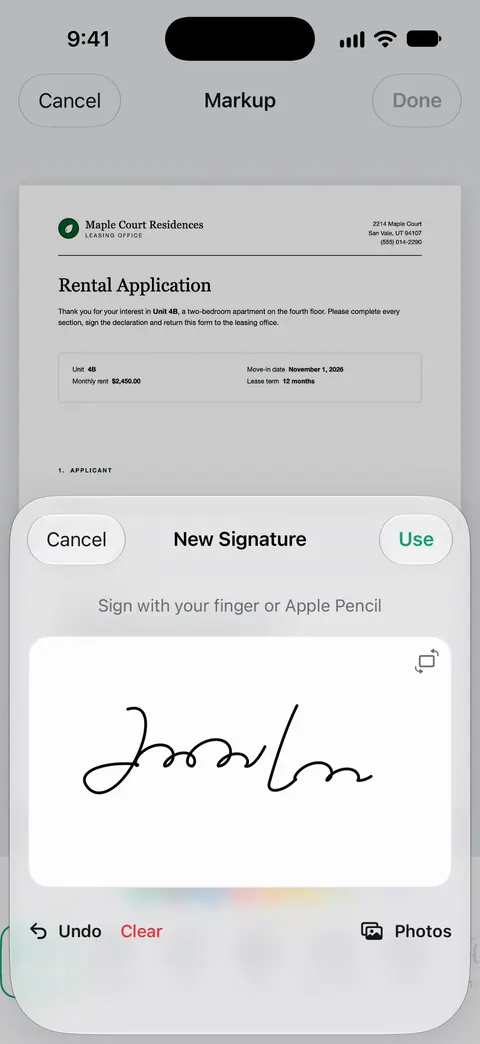
Scanner One helps when the papers grow: signed agreements, licenses, receipts. A scan can have many pages, and you can reorder them. You can sign and annotate documents. Free accounts can sign and mark up 3 documents a month. Search looks inside the text of every document and shows the matching line and page. The PDF tools merge, split, compress, password-protect, add page numbers and watermarks, and extract text. Free accounts can run them 3 a week.
On a free account, pages you share, print or export carry a small “Scanned with Scanner One” label at the bottom right. Pro removes it. Documents stay on your iPhone unless you share them or turn on iCloud Sync.
Scanner One doesn’t form an LLC, apply for an EIN, act as a registered agent or file state reports.
Questions and answers
Do I need an EIN for a single-member LLC?
You need one if your LLC will have employees or certain tax filings, and most banks ask for one to open a business account. Getting one is free on IRS.gov. Form the LLC with your state first, or the IRS says your application may be delayed.
Is an operating agreement required?
It depends on your state. Even where it isn’t required, banks and lenders often ask for it, since it shows who owns the LLC, how decisions are made and who may sign.
Does my LLC need to file a beneficial ownership report?
Not if it was created in the United States. FinCEN’s final rule, effective August 14, 2026, exempts companies created in the US from beneficial ownership reporting. Banks still collect ownership details when you open an account.
How is an LLC taxed?
By default, a single-member LLC is disregarded as separate from its owner for income tax, and an LLC with two or more members is taxed as a partnership. An LLC can choose a different classification with Form 8832. Ask a tax professional which fits.
Sources
What this page says about Scanner One was checked against the app on .
- SBA, Register your business — articles of organization, registered agents, DBAs, foreign qualification in other states, fees vary by state
- IRS, Get an employer identification number — free online EIN, responsible party, form the LLC with the state first, one EIN per day, print the confirmation; last reviewed 2026-10-16
- IRS, Limited liability company (LLC) — LLCs exist under state law, default tax classification, Form 8832; last reviewed 2026-10-10
- SBA, Apply for licenses and permits — federal, state, county and city licenses depend on activity and location; track renewals
- FinCEN, Beneficial ownership information — companies created in the US are exempt from BOI reporting under the final rule effective 2026-08-14
- Scanner One on the App Store — the app’s own listing
Get Scanner One
Scanner One is free, with generous limits: scanning, clean PDFs and text search never stop.

Scanner OneScan, sign and ask anything
Scanner One is free, with generous limits: scanning, clean PDFs and text search never stop.