
Checklist
What documents a landlord can ask for, and what they cannot
In most of the US a landlord can ask for a photo ID, proof of income such as pay stubs or tax returns, rental history and references, and your consent to a credit, eviction and criminal background check. Under the federal Fair Housing Act a landlord cannot treat you differently because of race, color, religion, sex, national origin, familial status or disability, and generally cannot ask whether you have a disability or how severe it is. Many states and cities add protections, so check your local rules too.

This is general information, not legal advice. Housing law differs by state, county and city, and it changes. For your situation, contact your state or local fair housing agency, a legal aid office or a lawyer.
Landlords need to know you’ll pay the rent and look after the place. Federal law lets them ask a lot to find that out, as long as they ask everyone the same way and don’t screen people out for who they are. Here is the line, item by item.
What a landlord can usually ask for
- Photo ID: a driver’s license, state ID or passport.
- Social Security number or ITIN: for the screening report.
- Proof of income: pay stubs, an offer letter, tax returns, bank statements or benefit letters.
- Rental history: past addresses, landlords’ contacts and your current lease.
- References: employers or past landlords.
- Consent to a background check: credit, eviction records and criminal records.
- Who will live there: names of all adults, and the number of people, for the lease.
- An application fee and a security deposit: many states and cities cap or regulate these.
- A guarantor: if your income or credit falls short of the landlord’s written criteria.
- Pet details: if the building allows pets.
What a screening report can include
Tenant screening companies may report your name, Social Security number, date of birth and past addresses, your work and income history, credit accounts, eviction cases, criminal records, missed rent, bankruptcies and lawsuits. Some add a score. Under federal law, most negative information drops off after 7 years and bankruptcies after 10, but there is no federal time limit for criminal convictions.
What federal fair housing law rules out
The Fair Housing Act bars landlords from discriminating because of race, color, religion, sex, national origin, familial status or disability. That means a landlord may not, because of one of these:
- Refuse to rent to you, or make the housing unavailable.
- Set different terms, rent, deposits or screening standards.
- Say a unit is taken when it isn’t, or steer you to certain buildings or areas.
- Keep families with children in one part of a complex, or set unreasonable limits on how many people may live in a unit.
Questions about disability
Federal rules forbid asking an applicant whether they have a disability, or about its nature or severity. A landlord may ask every applicant, disabled or not:
- Whether you can meet the requirements of the tenancy.
- Whether you qualify for housing reserved for people with disabilities, if the unit is.
- Whether you currently use illegal drugs.
- Whether you’ve been convicted of illegally making or selling drugs.
Landlords must also make reasonable accommodations in their rules when a person with a disability needs one to use the home. The regulation’s own examples: allowing a guide dog in a no-pets building, and reserving a parking space near the unit for a tenant with a mobility impairment.
Housing the law treats differently
Some housing is exempt from parts of the Act, including qualifying senior housing and some non-commercial housing run by religious organizations.
What state and local laws may add
Many states and cities protect more than the federal list. Depending on where you live, there may be rules on using a housing voucher or other source of income, on asking about criminal history, on application fee amounts, on credit scores, and more protected groups. Your state’s fair housing or civil rights agency publishes the local rules.
Requests that are red flags
The FTC warns that rental scammers:
- Ask for your Social Security number, a photo of your license or pay stubs before you’ve seen the place or agreed to rent.
- Want the fee or deposit by wire, gift card or cryptocurrency.
- Ask for a screenshot of your credit score, or push a paid credit service.
- Claim to be abroad and rush you.
Check who owns the property in the county’s tax records before you send anything.
If a screening report counts against you
If a landlord denies you, charges a higher deposit or rent, or asks for a co-signer because of a screening report, you’re entitled to an adverse action notice. It names the screening company and explains your rights.
- Request your free copy of the report from that company within 60 days.
- Check it for errors: a dismissed eviction listed as a judgment, the same case twice, sealed records, someone else’s debts.
- Dispute in writing with the screening company, and attach proof, such as the court record showing how a case ended.
- The company must investigate, generally within 30 days, and tell you the result in writing.
- Tell the landlord about the dispute and send the corrected report.
If you think you were treated unfairly
- Write down what happened: dates, names, what was said. Keep texts, emails, the ad and any notices.
- File with HUD online, by phone at 1-800-669-9777, or by mail. Include your contact details, who you’re complaining about, the property, what happened and the dates. There are time limits, so act soon.
- You can also contact your state or local fair housing agency, a legal aid office, or file your own lawsuit.
Where Scanner One helps, and where it doesn’t
Scanner One can’t tell you what your local law allows. Ask a fair housing agency or legal aid office for that.
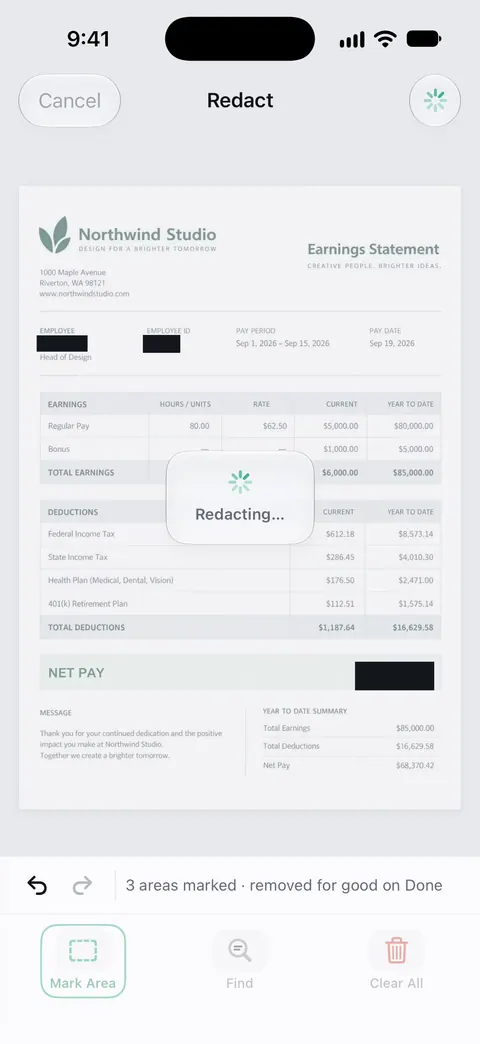
It helps you send only what’s needed and keep a clean record. Pro adds redaction, the smart eraser, edit text, auto-export and five alternate app icons. Redaction is permanent. The PDF tools merge, split, compress, password-protect, add page numbers and watermarks, and extract text. Free accounts can run them 3 a week. Search looks inside the text of every document and shows the matching line and page. Documents stay on your iPhone unless you share them or turn on iCloud Sync.
On a free account, pages you share, print or export carry a small “Scanned with Scanner One” label at the bottom right. Pro removes it. Read how to redact a PDF properly for the built-in options, and the documents to rent an apartment for the full application list.
Questions and answers
Can a landlord ask for my Social Security number?
Many do, because screening companies use it to find your credit and rental records. If you don’t have one, ask what they accept instead, since some landlords take an ITIN or other ID. Give it only after you’ve confirmed the landlord and the listing are real.
Can a landlord ask if I have children?
They can ask who will live in the unit. Under the Fair Housing Act they cannot refuse to rent to a family with children under 18, keep families in one part of a building or set unreasonable limits on the number of occupants. Housing that qualifies as senior housing is an exception.
Can a landlord ask about my disability?
Generally no. Federal rules bar asking whether an applicant has a disability or about its nature or severity. A landlord may ask every applicant whether they can meet the terms of the lease, and a few other narrow questions, such as whether you qualify for housing reserved for people with disabilities.
Can a landlord check my criminal record?
Federal law doesn’t forbid it, and screening reports can include criminal records. The FTC notes there is no federal time limit on reporting convictions. Many states and cities limit when and how landlords may ask about or use criminal history, so check your local rules.
Sources
What this page says about Scanner One was checked against the app on .
- US Department of Justice, The Fair Housing Act — the protected characteristics, families with children, exemptions, filing with HUD or in court; updated 2023-06-22
- 24 CFR 100.202, inquiries about disability (govinfo, 2024 edition) — landlords may not ask whether an applicant has a disability or its nature or severity, and the exceptions; edition of 2024-04-01
- 24 CFR 100.204, reasonable accommodations (govinfo, 2024 edition) — the duty to make reasonable accommodations, with the guide dog and parking examples; edition of 2024-04-01
- FTC, Tenant background checks and your rights — what screening reports contain, time limits, adverse action notices, free copy, disputes; page dated August 2025
- CFPB, Review your rental background check — errors to look for, disputing in writing with documents, complaints; last modified 2024-01-30
- FTC, Rental listing scams — requests for SSN, license photos and pay stubs before you agree to rent; page dated June 2026
- HUD, Report housing discrimination — filing online, by phone or by mail, what to include, time limits
- Scanner One on the App Store — the app’s own listing
Get Scanner One
Scanner One is free, with generous limits: scanning, clean PDFs and text search never stop.

Scanner OneScan, sign and ask anything
Scanner One is free, with generous limits: scanning, clean PDFs and text search never stop.