
Guide
Your lease renewal arrived: what to check
Before you sign a lease renewal, check the new rent and when it starts, the new end date, and every clause that differs from your current lease: fees, utilities, pets, parking, repairs, the security deposit, and the renewal and notice terms. Compare the renewal with the lease you signed, side by side, not from memory. Notice periods and renewal rights depend on your state and city, so check your state’s tenant guide.

This page is general information, not legal advice. Tenant law is set by states and cities, and it differs a lot. The New York rules quoted here are an example, not a rule for everywhere. Your state’s tenant guide, attorney general or a local tenant organization can tell you what applies to you.
Start with the dates
A renewal offer usually has three dates that matter: when your current lease ends, when the new terms start, and the deadline to answer. Put all three in your calendar the day the offer arrives.
How much notice your landlord must give depends on where you live. New York is an example of how specific the rules can be. Its Attorney General’s guide says that for apartments that are not rent-regulated, a landlord must give written notice of a rent increase or of not renewing:
| You have lived there, or your lease is | Notice New York requires |
|---|---|
| Less than 1 year | 30 days |
| More than 1 year, less than 2 | 60 days |
| 2 years or more | 90 days |
The same guide says that for non-regulated apartments the landlord does not have to renew the lease at all. Your state may be quite different. USAGov points you to your state agency for tenant rights, which may have a tenant handbook.
The checklist
Read the renewal with your current lease next to it, and check each line:
| Item | What to check |
|---|---|
| Names and address | Every tenant and the unit are right; anyone moving in or out is reflected |
| Rent | The new amount, the date it starts, how and when it is due |
| Lease dates | The new start and end dates, and the length |
| Fees | Late fees, pet fees, parking, storage, amenity or service fees, new or changed |
| Utilities | Which ones you pay and which the landlord pays |
| Security deposit | Any increase, and what it is held for |
| Renewal and notice terms | Automatic renewal, how much notice you must give to leave, what happens if you stay past the end date |
| Repairs and maintenance | Who fixes what, and how to request repairs |
| Rules | Pets, guests, subletting, smoking, alterations |
| Addenda and riders | New pages attached to the lease, and whether old ones still apply |
Two items deserve extra care.
Automatic renewal. Some leases renew themselves unless you give notice. In New York, the Attorney General’s guide says a landlord must remind the tenant that such a clause exists between 15 and 30 days before the tenant’s notice is due. Many places have no such rule, so read your lease for it.
The deposit. New York’s guide notes that a landlord may collect more at renewal to bring the deposit up to the new monthly rent, where the lease allows. If yours goes up, get a receipt.
Compare it with the lease you signed
The most common miss is a clause that changed quietly: a fee that appeared, a utility that moved to you, a notice period that got longer. Memory won’t catch it; a side-by-side read will.
- Put your current lease and the renewal side by side, on paper or on two screens.
- Go section by section. Mark every difference.
- Check every number twice: rent, fees, dates, notice periods, the deposit.
- Write your questions down next to each difference.
If both are PDFs, how to compare two PDFs on iPhone shows ways to do it, including Word’s Compare on a computer.
A step-by-step comparison. How to compare two versions of a lease walks through the whole process, with What changed.
Rent-regulated apartments
If your apartment is rent-regulated, the rules can be much stronger. New York’s guide says a rent-stabilized tenant is entitled to a one- or two-year renewal lease on the same terms and conditions as the prior lease, offered in New York City not more than 150 and not less than 90 days before the lease ends, and that the tenant then has 60 days to accept. If you think your apartment is regulated, check with your state or city housing agency.
Ask, and get changes in writing
If a clause is new or unclear, ask the landlord or manager before you sign, by email so the answer is in writing. If you agree to change something, the change belongs in the lease itself. New York’s guide notes that any changes to the lease should be initialed by both parties.
If a dispute comes up, USAGov’s first advice is to read your lease carefully and make sure you are following the rules you agreed to, then look to your state’s tenant agency or legal aid. What to check in a contract before you sign it covers the general signing habits.
If you are not renewing
Give notice the way your lease says: in writing, by its deadline. Then plan the move-out and the deposit. In New York, for non-regulated apartments, the guide says the landlord must return the deposit within 14 days of move-out, with an itemized list of any deductions. Other states have other deadlines. Photos of the empty apartment help.
Keep the papers
Keep the signed renewal, your old lease, and every receipt for the deposit and rent you paid outside a bank. The FTC’s keep-or-shred list puts rental agreements and leases in its keep-while-you-own group, which for a lease means while it’s in force. In practice, keep them until you have moved out and the deposit is settled.
Where Scanner One helps, and where it doesn’t
Scanner One doesn’t know tenant law and can’t tell you whether a clause is fair or legal. Your state’s tenant guide and a local tenant organization can.
It does keep both leases readable and searchable. Point your camera at any piece of paper. Scanner One finds the edges, straightens the page, cleans it up and saves a real PDF. A scan can have many pages, and you can reorder them. Search looks inside the text of every document and shows the matching line and page. So “late fee” or “notice” is a search across both versions. To see every changed word, copy the text of each version into our free compare two texts tool.
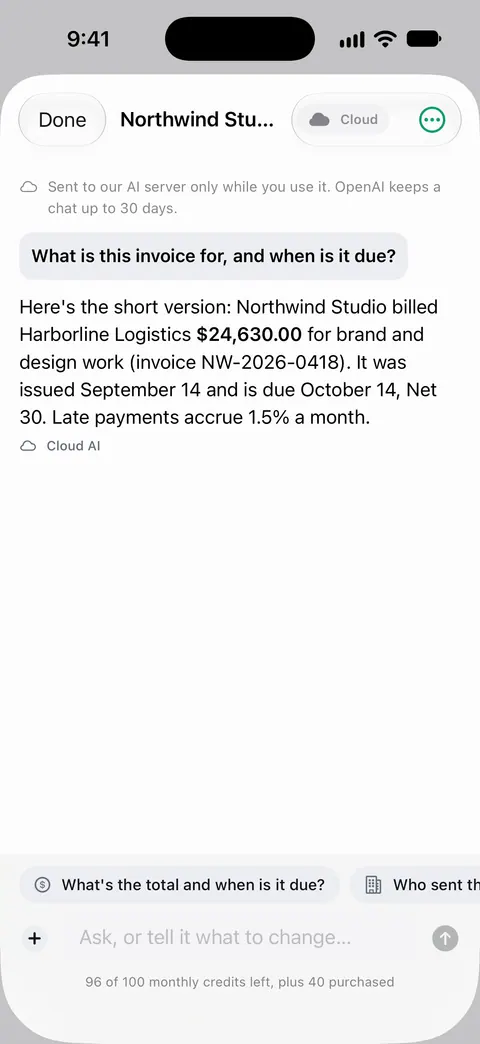
Ask your documents anything. When does the lease end? What did I spend at the shop? The answer comes back with the page it came from. You can ask when the new rent starts, or how much notice you must give, and see the page the answer came from. On a free account you can ask 3 questions a day.
What changed compares the new version of a lease or policy with the one you signed.
You can sign and annotate documents. Free accounts can sign and mark up 3 documents a month. If you send the signed renewal from a free account, On a free account, pages you share, print or export carry a small “Scanned with Scanner One” label at the bottom right. Pro removes it.
If your renewal is one page that only changes the rent and dates, reading it next to your lease takes ten minutes and needs no app.
Questions and answers
How much notice does a landlord have to give before raising the rent?
It depends on your state and sometimes your city. In New York, for example, the Attorney General’s guide says 30, 60 or 90 days, depending on how long you have lived there. Your state’s tenant guide or attorney general has the rule where you live.
Can my landlord change the lease terms at renewal?
For apartments that are not rent-regulated, a renewal is usually a new agreement, and New York’s guide says the landlord does not have to renew at all. Some regulated apartments must be renewed on the same terms: New York’s guide says rent-stabilized renewals must be on the same terms and conditions as the prior lease. Read every clause and ask about any change.
What if I don’t respond to a lease renewal?
Check your current lease and your state’s rules. Some leases have an automatic renewal clause, and some switch to month to month. Answer in writing before the deadline in the offer so there is no doubt.
Should I keep my old lease after renewing?
Yes, at least until you move out and your deposit is returned. The old lease is what you compare the renewal with, and it shows the terms you lived under.
Sources
What this page says about Scanner One was checked against the app on .
- USAGov, How to file a complaint against a landlord — read your lease carefully, and find your state’s tenant rights agency or handbook; read 2026-11-13
- New York State Attorney General, Residential Tenants' Rights Guide — an example of state rules: 30, 60 or 90 days' notice of a rent increase or nonrenewal, notice of automatic renewal clauses, renewal leases for rent-stabilized apartments, security deposits, and lease changes initialed by both parties; read 2026-11-13
- FTC Consumer Alert, Protecting your personal information: Which documents to keep and which to shred — rental agreements and leases in the keep-while-you-own group; dated 10 June 2025
- Scanner One on the App Store — the app’s own listing
Get Scanner One
Scanner One is free, with generous limits: scanning, clean PDFs and text search never stop.

Scanner OneScan, sign and ask anything
Scanner One is free, with generous limits: scanning, clean PDFs and text search never stop.