
Checklist
Documents you need to buy a house, from preapproval to keys
Before you shop, gather the loan packet: pay stubs, W-2s and tax returns for 2 years, bank statements, down payment proof, ID. Once you make an offer, you add the purchase contract, the earnest money receipt, the seller’s disclosures, the inspection report, homeowners insurance and the appraisal. At least 3 business days before closing you get the Closing Disclosure. At closing, bring your ID and the funds as your closing agent instructs. Afterward, keep the Closing Disclosure, the promissory note, the mortgage or deed of trust and the deed.

This is general information, not legal or financial advice. Purchase contracts, disclosures and closing customs differ by state, and lenders set their own rules. Ask your agent, lender or closing attorney about yours.
Buying a house runs on paper in a set order. This list follows that order, so you can tick off each stage and keep each stage’s papers together.
Stage 1: before you make an offer
The lender’s packet, which the CFPB lists as:
- Pay stubs: for the last 30 days.
- W-2 forms: for the last 2 years.
- Signed federal tax returns: for the last 2 years.
- Proof of other income: benefits, child support or rental income.
- Bank statements: the 2 most recent.
- Proof of your down payment: statements with at least 2 months’ history, and a signed gift letter if someone is giving you money.
- Photo ID and Social Security number.
- Name change papers: if your name changed recently.
- Homebuyer education certificate: if you have one.
- VA Certificate of Eligibility: for a VA loan.
The full list, with the self-employed extras, is in mortgage application documents. Out of this stage you get:
- Preapproval letter: to send with your offer.
- Loan Estimates: one from each lender you apply to, to compare.
Stage 2: under contract
- Purchase agreement: every page and addendum, signed by both sides.
- Earnest money receipt: or the wire confirmation.
- Seller’s disclosure form: many states require one, and the form differs by state.
- Lead paint disclosure: for a home built before 1978, the seller must disclose known lead paint, hand over any reports, give you the EPA’s pamphlet and include a lead warning statement in the contract. You get 10 days for a lead inspection, unless you both agree otherwise in writing.
- HOA documents: the rules, budget and fees, for a condo or a home in an association.
- Inspection report: from the inspector you hire, with photos.
- Repair requests and the seller’s response: in writing, signed.
Stage 3: the loan moves forward
- Fresh pay stubs and statements: lenders ask again as weeks pass.
- Letters of explanation: for any deposit or credit item the underwriter asks about.
- Homeowners insurance: lenders typically require it. Get written quotes, pick a policy and send the details to your loan officer. Standard policies usually exclude flood, so ask whether you need a separate flood policy.
- Appraisal report: ordered by the lender.
- Title papers: the title commitment and your title insurance choices.
- Revised Loan Estimate: if something about the loan changes.
Stage 4: just before closing
- Closing Disclosure: by law you must get it at least 3 business days before closing. Compare it with your last Loan Estimate, line by line, starting with the APR.
- The documents you’ll sign: ask to see the promissory note, the mortgage (also called the security instrument or deed of trust) and the deed with the Closing Disclosure, so you can read them at home.
- Wiring instructions: confirmed by phone with your closing agent, at a number you already had.
- Final walk-through: check the agreed repairs were made and the agreed items stayed.
Stage 5: closing day
- Photo ID: for every buyer.
- Closing funds: usually a wire or a cashier’s check. You generally can’t bring cash.
- Proof of insurance: if the closing agent asks for it.
- Anything the agent asked you to bring: a power of attorney, a trust document, a lender’s final request.
Don’t sign blank documents, or documents that differ from what you agreed. You can ask questions and take your time.
After closing: what to keep
The CFPB says to keep the whole stack, on paper or as a file, and to make sure you have these 4:
- The Closing Disclosure
- The promissory note
- The mortgage or deed of trust
- The deed: often mailed to you after the county records it.
Also keep the inspection report, the appraisal, the insurance policy, warranties for the home and its appliances, and every receipt for improvements. How long to keep the papers from buying a home explains which ones you’ll want when you sell. Your name and loan become public record after closing, so expect mail that looks like it’s from your lender and isn’t.
Mistakes that delay a closing
- New debt or a job change during underwriting.
- Missing pages on statements.
- Waiting until closing week to buy insurance.
- Wiring money to instructions that came by email.
- Not reading the Closing Disclosure until the closing table.
Scan and keep them safely
Scan each stage’s papers into one PDF as you go, so the whole purchase is in a handful of files: scan several pages into one PDF. Lender portals often cap upload sizes: make a PDF smaller. When you share a copy by email, password-protect it. When you move, the moving paperwork picks up from here.
Where Scanner One helps, and where it doesn’t
Some closings send the final documents as PDFs. If yours does, save them to the Files app with a backup and you may never need a scanner.
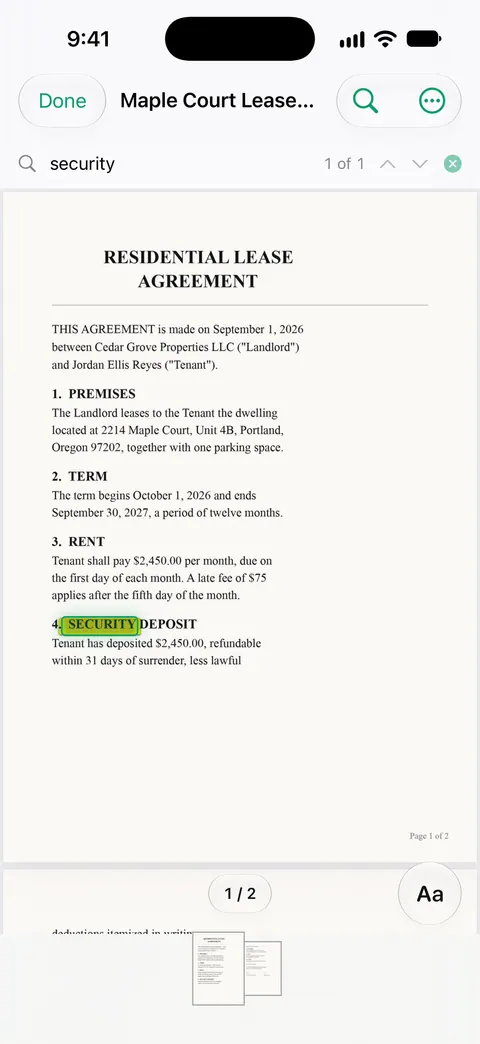
Scanner One helps when the stack is paper, or when you want to find one line years later. A scan can have many pages, and you can reorder them. Scanner One makes searchable PDFs. Search looks inside the text of every document and shows the matching line and page. Ask your documents anything. When does the lease end? What did I spend at the shop? The answer comes back with the page it came from. Free accounts can ask 3 questions a day.
You can sign and annotate documents. Free accounts can sign and mark up 3 documents a month. On a free account, pages you share, print or export carry a small “Scanned with Scanner One” label at the bottom right. Pro removes it. Documents stay on your iPhone unless you share them or turn on iCloud Sync.
Scanner One doesn’t review a contract or a Closing Disclosure for you, and it isn’t a closing platform. Your agent, lender and closing agent are the people to ask.
Questions and answers
When do I get the Closing Disclosure?
By law you must receive it at least 3 business days before closing. Ask your lender or closing agent about a week ahead how it will reach you, then compare it line by line with your latest Loan Estimate.
What should I bring to closing?
A photo ID, the closing funds in the form your closing agent asks for (usually a wire or a cashier’s check, generally not cash), and any documents the agent requested. Confirm wiring instructions by calling a number you already know, never from an email.
Which home buying documents should I keep forever?
Keep the deed, the Closing Disclosure and records of what you paid for improvements for as long as you own the home and for several years after you sell it, since they help work out your tax on the sale. The promissory note and the mortgage or deed of trust matter until the loan is paid off.
Do I get a copy of the inspection and appraisal?
The inspection report is yours: you hired the inspector. Ask your lender for a copy of the appraisal if one doesn’t arrive before closing.
Sources
What this page says about Scanner One was checked against the app on .
- CFPB, Create a loan application packet — the documents to gather before you apply for a mortgage; last modified 2024-12-12
- CFPB, Review documents before closing — the Closing Disclosure 3 business days before closing, documents to request in advance; last modified 2025-08-21
- CFPB, After closing — the 4 key documents to keep, junk mail after closing; last modified 2024-12-12
- CFPB, Shop for homeowner’s insurance — lenders require homeowner’s insurance, flood is usually excluded; last modified 2024-12-12
- EPA, Real estate disclosures about potential lead hazards — pre-1978 homes: disclosure, pamphlet, warning statement, 10 days to inspect; updated 2026-05-27
- CFPB, Mortgage closing scams: how to protect yourself and your closing funds — never follow wiring instructions from an email; archived post, last modified 2026-06-25
- Scanner One on the App Store — the app’s own listing
Get Scanner One
Scanner One is free, with generous limits: scanning, clean PDFs and text search never stop.

Scanner OneScan, sign and ask anything
Scanner One is free, with generous limits: scanning, clean PDFs and text search never stop.