
Guide
Keep HSA and FSA receipts so reimbursement is easy
Keep an itemized receipt or an insurer’s explanation of benefits for every medical expense: it should show the patient, provider, date of service, what it was for and the amount. Scan it the day you get it and file it by year. For an HSA, the IRS says you must keep records showing distributions paid qualified medical expenses not reimbursed elsewhere, so keep receipts until the return for the year you withdrew the money can no longer be examined. FSAs need a third-party statement for each claim.

This page is general information from IRS Publication 969, not tax or legal advice. Rules and amounts change every year, and your plan may set its own deadlines, so check the IRS page and your plan’s documents.
This page is about keeping health account receipts so claims go through and your records hold up later. For medical bills in general, see how long to keep medical bills. For everyday receipts, see how long to keep receipts.
HSA and FSA receipts are kept for different reasons
| HSA (health savings account) | Health FSA (flexible spending account) | |
|---|---|---|
| Who checks the receipt | Usually no one at the time; the IRS can ask later | The plan administrator, before paying a claim |
| What the IRS asks for | Records showing distributions paid qualified medical expenses, not reimbursed elsewhere and not itemized | A written statement from an independent third party that the expense was incurred, plus your statement it wasn’t reimbursed elsewhere |
| Deadline to use money | Money stays in the account | Generally use-it-or-lose-it, with a possible grace period or carryover |
| How long to keep | Until the return for the year of the withdrawal can’t be examined | Until the claim is paid, then with your tax records |
What a good receipt shows
Whether it’s for an HSA or an FSA, the strongest record is itemized. It should show:
- Patient name (you, a spouse or a dependent)
- Provider or seller name
- Date of service or purchase
- What it was for: the service, the prescription, the item
- Amount you paid after insurance
The best sources:
- Explanation of benefits (EOB) from your insurer, which shows the service, the date and what you owe
- Itemized receipt or statement from the doctor, dentist, pharmacy or optician
- Pharmacy printout listing prescriptions for the year
A credit card slip or a bank line shows only that you paid something. Keep it with the itemized record, not instead of it.
Why HSA receipts can matter for years
Publication 969 says that for HSA distributions you must keep records showing they were exclusively to pay or reimburse qualified medical expenses, that those expenses weren’t paid from another source, and that you didn’t also claim them as an itemized deduction. Keep those records with your tax records.
Many people pay medical bills out of pocket and leave the HSA invested, planning to reimburse themselves later. If you do that, the receipt has to survive until you take the money out, and then until the return for that year can no longer be examined. The IRS’s usual period is 3 years after you file, longer in some cases. A receipt from today could need to be readable in 10 or 20 years, and thermal paper won’t last that long. Scan it.
Two more details from Publication 969:
- Expenses from before you opened the HSA don’t qualify. Keep a record of the date your HSA was established.
- Don’t double-dip. If an expense was reimbursed by insurance, an FSA or anyone else, it can’t also come out of the HSA. Your files should make that clear.
FSA claims: get them in on time
- Your plan needs the third-party statement for each claim. Upload the EOB or itemized receipt when you submit.
- FSAs are generally use-it-or-lose-it. Publication 969 says a plan may allow a grace period of up to 2 1/2 months after the plan year, or let you carry over a limited amount, but not both.
- Your plan sets the last day to submit claims for the year. Put it in your calendar.
A simple system on your iPhone
- Scan the day you get it. In Notes or Files, use Scan Documents. Pick a grayscale or black-and-white filter for paper receipts, and fill the frame. More tips in scanning a receipt on iPhone.
- One folder per year: Health, HSA, 2026. Put EOBs in the same folder.
- Name files so they sort and match: 2026-04-02 CVS 18.40 Maya prescription.
- Track HSA reimbursements. Keep a simple list with the date, provider, patient, amount, and whether and when you reimbursed yourself. When you take money out, you’ll know exactly which receipts it covers.
- Back it up to iCloud Drive or another cloud service, so a lost phone doesn’t take years of receipts with it.
If a bill doesn’t make sense, sort it out before you pay or claim it: see a medical bill you don’t understand.
Where Scanner One helps, and where it doesn’t
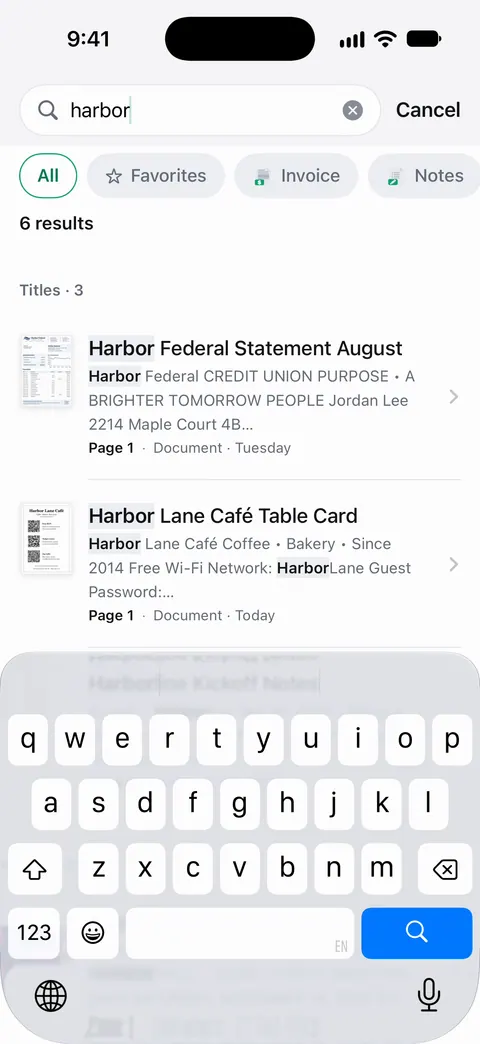
Scans come with Auto Clean, Color, Grayscale and Receipt filters. The Receipt filter is made for pharmacy and copay slips. Search looks inside the text of every document and shows the matching line and page. So you can search for a pharmacy, a name or an amount when it’s time to reimburse yourself. Scanner One exports to Word, keeping headings, lists and tables, and to Excel and CSV. A CSV is a quick start on a reimbursement list.
Documents stay on your iPhone unless you share them or turn on iCloud Sync. On a free account, pages you share, print or export carry a small “Scanned with Scanner One” label at the bottom right. Pro removes it. That label appears on receipts you upload to an FSA or HSA portal from a free account.
Bills on Home. Needs You gathers bills due, return windows and IDs about to expire on Home, from your own papers.
What it doesn’t do: it doesn’t know your plan’s rules or decide what’s a qualified medical expense. The IRS and your plan administrator decide that.
When the built-in way is enough: a yearly folder in Files and a naming habit keep HSA receipts in order for free. For the rest of your health papers, see keeping medical records on your iPhone.
Questions and answers
How long should I keep HSA receipts?
Keep each receipt until the tax return for the year you took the money out of the HSA can no longer be examined, usually 3 years after you file it. If you pay out of pocket now and reimburse yourself later, that clock starts at the reimbursement, so the receipt may need to last many years.
Is a credit card slip enough for an FSA claim?
Usually not. The IRS requires a written statement from an independent third party showing the expense was incurred, plus your statement that it wasn’t reimbursed elsewhere. An itemized receipt or an explanation of benefits from your insurer does that; a card slip shows only an amount.
Do I send HSA receipts with my tax return?
No. Publication 969 says to keep the records with your tax records rather than send them in. You need them if the IRS asks.
What happens to FSA money I don’t use?
FSAs are generally use-it-or-lose-it. A plan may allow a grace period of up to 2 1/2 months or a limited carryover, but not both. Your plan’s documents say which, and the deadline to submit claims.
Sources
What this page says about Scanner One was checked against the app on .
- IRS, Publication 969 (2025), Health Savings Accounts and Other Tax-Favored Health Plans — HSA records showing distributions were for qualified medical expenses, not paid from another source and not itemized; expenses before the HSA was established don’t qualify; FSA third-party statement, use-it-or-lose-it, grace period up to 2 1/2 months or a carryover, not both; for 2025 returns
- IRS, How long should I keep records? — the 3, 6 and 7 year periods of limitations; last reviewed 30 June 2026
- Apple Support, How to scan documents on your iPhone or iPad (article 108963) — scanning in Notes and Files; published 2026-02-13
- Scanner One on the App Store — the app’s own listing
Get Scanner One
Scanner One is free, with generous limits: scanning, clean PDFs and text search never stop.

Scanner OneScan, sign and ask anything
Scanner One is free, with generous limits: scanning, clean PDFs and text search never stop.