
Situation
Going through a divorce: getting your financial papers together
Gather the last 2 to 3 years of tax returns, recent pay stubs, and current statements for every bank, credit card, loan, mortgage, investment and retirement account, plus deeds, car titles and insurance policies. Pull your credit report to find accounts you didn’t know about. Make copies, keep the originals, and store the copies somewhere only you can open. California’s courts, for example, ask each spouse to share the last 2 years of tax returns and 2 months of pay stubs.

If you’re going through a divorce, the paperwork can feel like one more weight on a hard time. This page is only about the money side: which papers to find, and how to copy and keep them safely. For a general look at your finances when there’s no separation involved, see the personal budget review checklist.
This page is general information, not legal or tax advice. Divorce law and the forms courts use differ by state and change. Your lawyer, your court’s self-help center and the official pages linked here have the details for your case.
First: copies, privacy, and no big moves
Three things to do before anything else:
- Copy what you can see now. Statements and returns are easiest to gather while you still have access. Keep the originals where they are and work from copies; California’s court guide also says to make copies and keep originals.
- Keep your copies private. Use a phone, email account and passcode that are yours alone. If your phone shares an Apple Account or iCloud with your spouse, new notes and files may appear on their devices too. Check before you scan anything.
- Don’t move or hide money without talking to a lawyer. Courts take that seriously.
The papers to gather
Income
- Tax returns for the last 2 to 3 years, with all schedules and W-2s and 1099s
- Recent pay stubs: California, for example, asks for the last 2 months
- Proof of other income: rental income, business records, bonuses, benefits
What you own
- Bank statements for every checking and savings account, joint and separate
- Investment and brokerage statements
- Retirement account statements: 401(k), IRA, pension
- Deed and mortgage statements for your home and any other property
- Car titles and loan statements
- Life insurance policies, with their cash value if any
- Business records, if either of you owns a business
What you owe
- Credit card statements
- Loan statements: student loans, personal loans, car loans, home equity lines
- Your credit report. The FTC says you can get it free every week at AnnualCreditReport.com, from all three bureaus. It shows debts in your name that you might not know about.
Monthly spending
- Recent household bills: utilities, insurance, phone, child care, school costs
- A simple list of monthly expenses. Courts often ask for one; California’s Income and Expense Declaration is an example.
Other papers
- A prenuptial or postnuptial agreement, if you have one
- Children’s records: school and medical costs, child care receipts
- Records of property you owned before the marriage or inherited, since it may be treated differently
How courts use them
Many states ask each spouse to share financial information early. In California, for instance, each spouse fills in a Declaration of Disclosure, an Income and Expense Declaration, and a schedule of assets and debts, and attaches the last 2 years of tax returns, 2 months of pay stubs and statements for what they own and owe. These go to the other spouse, not to the court, within 60 days of filing. Your state will have its own version; your court’s self-help pages explain it.
Tax questions to raise
IRS Publication 504 covers the questions that come up most:
- Filing status depends on whether you’re married on the last day of the year. A final decree by December 31 means you’re unmarried for that whole year.
- Alimony under agreements signed after 2018 isn’t deductible for the payer or taxable for the recipient.
- Children: the parent the child lived with for more nights generally claims them, unless that parent signs Form 8332 to release the claim.
- Property transfers between spouses because of a divorce have their own rules.
Keep the final decree and every tax-related agreement with your tax records. Our guide to how long to keep tax records helps decide for how long.
Social Security also notes that ex-spouses may be eligible for family benefits based on a former spouse’s work. Keep the marriage certificate and the final decree, and ask Social Security later whether you qualify.
Organizing and sending
- One folder per topic: income, accounts, debts, property, children. Name each scan clearly: “Chase checking, 2026-09”.
- Password-protect sensitive PDFs before emailing them to your lawyer or mediator. Our guide to password-protecting a PDF shows how, and sending documents securely covers the rest.
- Keep a log of what you sent, to whom and when.
Where Scanner One helps, and where it doesn’t
Scanner One doesn’t give legal or tax advice, and it can’t tell you which papers your state requires. It helps you keep a growing stack in order.
Then it reads the text, names the document, tags it and puts it in the right folder. Search looks inside the text of every document and shows the matching line and page. So you can find every statement that mentions one account number. Our guide to finding a document by a word inside it shows how search works.
The PDF tools merge, split, compress, password-protect, add page numbers and watermarks, and extract text. That includes the password protection you’d want before sending financial papers.
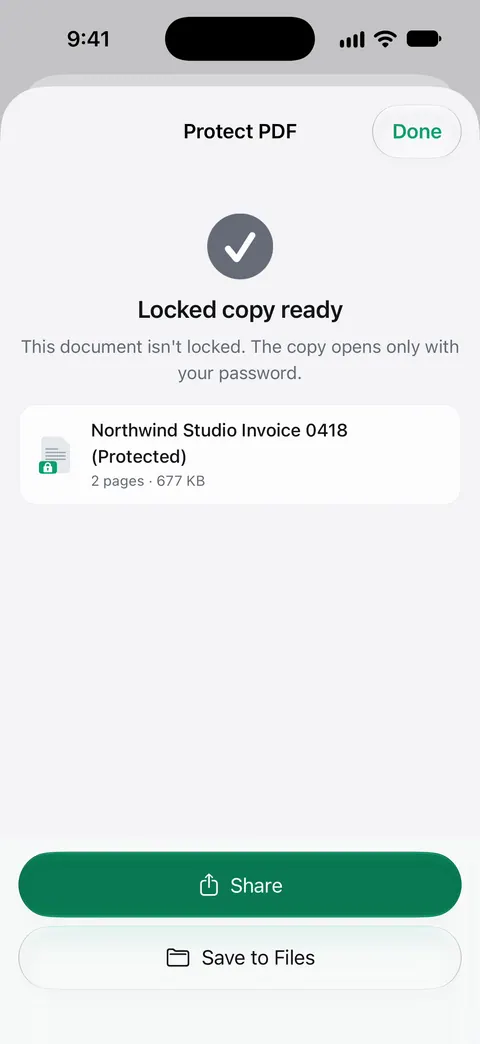
Documents stay on your iPhone unless you share them or turn on iCloud Sync. Scanner One needs no account and does no tracking. You can lock the app with Face ID. If iCloud is shared with your spouse, keep iCloud Sync off until that changes.
Free accounts can run the PDF tools and the Word, Excel and CSV exports 3 times a week, from one shared allowance. On a free account, pages you share, print or export carry a small “Scanned with Scanner One” label at the bottom right. Pro removes it.
Questions and answers
What financial documents do I need for a divorce?
Usually: tax returns for the last few years, recent pay stubs, statements for bank, credit card, loan, mortgage, investment and retirement accounts, deeds and car titles, insurance policies, and a list of monthly expenses. Courts have their own forms; California’s, for example, ask for 2 years of returns and 2 months of pay stubs.
Should I make copies of joint financial records?
Yes, copies of records you have a right to see, made early, before anything goes missing. Keep the originals where they belong and store the copies somewhere private. Ask your lawyer if you’re unsure what you may copy.
How do I find accounts I don’t know about?
Start with your credit report: it lists loans and credit cards in your name, and the FTC says you can get it free every week at AnnualCreditReport.com. Then look at tax returns, where interest and dividends point to accounts, and at bank statements for transfers you don’t recognize.
Is alimony taxable?
For divorce or separation agreements signed after 2018, the IRS says alimony is not deductible by the person who pays it and is not income for the person who receives it. Older agreements follow the old rules unless changed. IRS Publication 504 explains the details.
How do I keep my documents private from my spouse?
Use a device, account and passcode your spouse doesn’t know, check that shared iCloud or family accounts don’t sync your new files to a shared device, and password-protect sensitive PDFs before sending them to your lawyer.
Sources
What this page says about Scanner One was checked against the app on .
- California Courts Self-Help Guide, Gather and share financial information — the disclosure forms (FL-140, FL-150, FL-142 or FL-160), tax returns from the last 2 years, 2 months of pay stubs, statements for what you own and owe, copies not originals, disclosures go to the spouse, not the court; no date shown, read 2026-11-13
- IRS, Publication 504 (2025), Divorced or Separated Individuals — filing status on the last day of the year, alimony under agreements after 2018, property transfers, Form 8332 for claiming a child; for 2025 returns, read 2026-11-13
- FTC Consumer Advice, Free credit reports — free weekly reports from all three bureaus at AnnualCreditReport.com; dated June 2026
- Social Security, Family benefits — spouses and ex-spouses may be eligible for benefits based on a family member’s work; no date shown, read 2026-11-13 in a browser
- Scanner One on the App Store — the app’s own listing, for the closing section
Get Scanner One
Scanner One is free, with generous limits: scanning, clean PDFs and text search never stop.

Scanner OneScan, sign and ask anything
Scanner One is free, with generous limits: scanning, clean PDFs and text search never stop.