
Situation
Clearing out a parent’s house: what papers to keep
Don’t throw anything away in the first pass. Set aside originals first: the will, trusts, deeds, car titles, birth, marriage and military papers, insurance policies and the latest statements for every account. Give those to the executor. Keep tax returns and their records until the estate’s final returns are done and the time the IRS can ask has passed, generally at least 3 years. Scan letters and photos you want to remember. Shred the rest, because papers with a name and account numbers can be misused.

If you’re clearing out a parent’s home, we’re sorry for your loss. This page is about the physical sort: the boxes, drawers and filing cabinets. The legal steps after a death, such as death certificates, who to notify and the final tax return, are on a separate page: after someone dies: the documents you will be asked for.
This page is general information, not legal or tax advice. Estate rules differ by state. If there is an executor or a lawyer, ask them before you discard anything that might be a financial or legal record.
Before you start: two rules
- Don’t throw anything away on the first pass. Sort first, decide later. A bank letter that looks like junk can be the only clue to an account.
- Agree who decides. Usually the executor named in the will, or the person the court appoints. If you’re not that person, keep them in the loop.
Bring boxes or folders labeled Executor, Keep, Scan, Shred and Not sure. Work one room or one drawer at a time.
Box 1: Executor (originals to hand over)
These are the papers that settle the estate. Keep the originals flat and together, and give them to the executor:
- The will and any codicils, trust documents, and powers of attorney
- Deeds, mortgage papers and property tax bills
- Car titles and registrations
- Life insurance policies and annuity contracts
- The latest statement for every account: bank, brokerage, retirement, pension
- Recent bills: credit cards, loans, utilities, medical
- Stock certificates, savings bonds and safe deposit box keys
- Business papers, if your parent owned a business
Even an old statement for a closed account is worth keeping in this box until the executor has seen it. It may point to money that was moved, not closed.
Box 2: Keep (personal records)
- Birth certificate, marriage and divorce certificates, citizenship papers: vital records that are slow to replace and useful for family history
- Military discharge papers, which can matter for veterans’ burial and survivor benefits
- Tax returns and the records behind them for the last several years
How long to keep the tax papers: the IRS generally has 3 years to ask about a return, longer in some cases (6 years if income was left out, 7 for a bad debt claim, and indefinitely if a return wasn’t filed). Property records should be kept until the period ends for the year the property is sold. So keep your parent’s returns at least until the estate’s final returns are done and that time has passed.
Box 3: Scan (memories and family history)
Letters, cards, recipes, certificates, report cards, photos. These are the papers people most want to share and least want to split up. Scan them so every sibling or grandchild can have a copy, then decide calmly which originals to keep. Our guides to scanning old photos with your iPhone and scanning genealogy records cover fragile paper and faded ink.
The iPhone’s Notes app scans well for this: open a note, tap the Attachment button, tap Scan Documents, and keep adding pages to the same scan.
Box 4: Shred
Old utility bills, expired insurance, years-old bank statements once the executor has checked them, junk mail, catalogs, canceled checks from long ago. Anything with a name and an account number, Social Security number or signature goes through a shredder or a shredding service, never the recycling bin. Our keep or shred chart gives typical times for each kind of paper.
Protect their identity while you sort
Identity theft of people who have died is a known problem, and a house full of papers is exactly what a thief wants. New York’s Department of State suggests:
- Keep your parent’s information with one person, shared with family only as needed
- Notify banks and the three credit bureaus in writing, with a certified death certificate, and ask the bureaus to put a deceased alert on the file
- Order several certified death certificates; many offices will want one
Forward your parent’s mail to the executor so new statements and bills don’t sit in an empty house.
When you’re overwhelmed
It’s normal to stop halfway. Close the boxes, label them, and come back. Nothing in the Scan box has a deadline. If there’s a filing cabinet full of decades of paper, our guide to digitizing a filing cabinet breaks it into sessions. If you’re helping a parent who is still living, our page on helping a parent with paperwork may be more useful.
Where Scanner One helps, and where it doesn’t
A scanner app is useful for the Scan box and for keeping copies of what goes to the executor. It can’t tell you what the estate needs, and a scan never replaces an original will, deed or certificate.
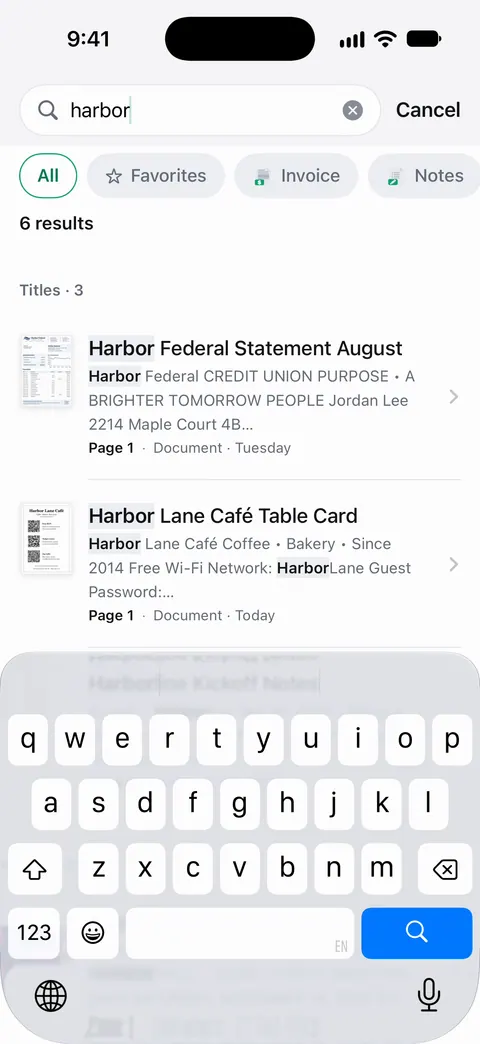
A scan can have many pages, and you can reorder them. Search looks inside the text of every document and shows the matching line and page. So a letter that mentions a bank or an insurer can be found later by searching for its name.
Documents stay on your iPhone unless you share them or turn on iCloud Sync. On a free account, pages you share, print or export carry a small “Scanned with Scanner One” label at the bottom right. Pro removes it. For a box of family letters, the Notes scanner works too.
Questions and answers
What papers should I keep after a parent dies?
Keep the originals of the will and any trust, deeds, car titles, birth, marriage and military records, insurance policies, and the latest statements for every bank, investment and retirement account. Keep tax returns and records until the estate is settled and the IRS’s time to ask has passed. Give all of these to the executor.
How long should I keep my parent’s tax records?
Until the final returns for your parent, and for the estate if there is one, are filed, and then generally at least 3 more years, which is how long the IRS usually has to ask questions. Some situations are longer, and records for property should be kept until the period ends for the year it was sold.
Is it safe to throw away a parent’s old bank statements?
Shred them rather than putting them in the recycling. Statements, bills and letters with a name, address and account or Social Security numbers can be used for identity theft, which is a real risk after a death.
What about letters, cards and photos?
These are the hardest to decide on and the easiest to share. Scan the ones that matter so every sibling can have a copy, keep a few originals, and let the rest go when you’re ready. There’s no deadline for this part.
Sources
What this page says about Scanner One was checked against the app on .
- IRS, How long should I keep records? — 3 years in general, 6 or 7 in some cases, indefinitely if a return wasn’t filed, property records until the period ends for the year the property is sold; last reviewed 2026-06-30
- New York Department of State, Key steps to protecting a deceased loved one’s identity — multiple certified death certificates, notifying banks and credit bureaus in writing, a deceased alert, keeping the information with one person; no date shown, read 2026-11-13
- USAGov, How to replace lost or damaged vital documents — where birth, marriage and other vital records come from, and that many replacements need one of them; last updated 2025-11-17
- Scanner One on the App Store — the app’s own listing, for the closing section
Get Scanner One
Scanner One is free, with generous limits: scanning, clean PDFs and text search never stop.

Scanner OneScan, sign and ask anything
Scanner One is free, with generous limits: scanning, clean PDFs and text search never stop.