
Comparison
Scanner One vs the Files app scanner
The Files app scans to a PDF and saves it straight into a folder you choose, in iCloud Drive, on the iPhone or in a cloud like Dropbox: tap the More button, tap Scan Documents, capture the pages, tap Done, choose a location and tap Save. If you already keep papers in folders and name them yourself, that is enough. Scanner One helps when you want each page read, named and filed for you, found by any word inside, or turned into Word or a smaller PDF. Its free PDF tools run 3 a week.

Scanner One is our app. The Files app is free, built into the iPhone, and enough for many people. The steps below come from Apple’s own pages, read on November 13, 2026.
When Files is enough
Use the Files app and skip a scanner app if this sounds like you:
- You already keep papers in folders, in iCloud Drive, on the iPhone or in Dropbox, and you want scans to land there.
- You name files yourself and find them by name.
- You scan a few documents a month and send them on.
- You don’t need Word files, redaction or answers from your papers.
Files is free, and it saves the scan exactly where you say.
How to scan with the Files app
These are Apple’s steps from its support article, published February 13, 2026.
- In the Files app, tap the More button.
- Tap Scan Documents.
- Place the document in view of the camera. In iOS 26 you can also choose flash or an image filter.
- In Auto mode the page scans by itself. Otherwise tap the Shutter button or press a volume button, drag the corners to fit the page, and tap Keep Scan.
- Tap Done, or keep scanning more pages.
- Choose a location, then tap Save.
Our guide to scanning with the Files app adds tips on light and naming, and how to name scanned documents gives a naming scheme that keeps Files tidy.
Files and Scanner One side by side
Checked on November 13, 2026, against Apple’s pages.
| Files | Scanner One | |
|---|---|---|
| Price | Free, built into iOS | Free download. Pro at $4.99 a month, $29.99 a year or $59.99 once |
| Where the scan goes | The folder you choose: on the iPhone, iCloud Drive, Dropbox, Box, OneDrive and more | Documents stay on your iPhone unless you share them or turn on iCloud Sync. |
| Naming | You type the name | Then it reads the text, names the document, tags it and puts it in the right folder. Free: 10 documents a month |
| Finding it | Search by filename, folder name or document type | Search looks inside the text of every document and shows the matching line and page. |
| Page cleanup | Flash and an image filter in iOS 26 | Scans come with Auto Clean, Color, Grayscale and Receipt filters. |
| After the scan | Compress, rename, share, move between folders and drives | The PDF tools merge, split, compress, password-protect, add page numbers and watermarks, and extract text. |
| Mark on the page | None mentioned in Apple’s guide | Free: a small “Scanned with Scanner One” label on shared pages |
| Privacy label | Not linked to you: Usage Data, Other Data | No account, no tracking |
Where Files stops
Files is a file manager with a scanner in it. That shapes what it does well and where it stops.
- You do the naming. Apple’s guide describes searching Files by filename, folder name or document type, so a scan saved in a hurry with a vague name is hard to find later.
- The folder is the filing system. Files keeps scans where you save them. Sorting a pile into folders is your job.
- The tools are for files, not pages. Apple lists compressing, renaming, sharing and moving. For merging PDFs, splitting one, or making Word from a scan, our guides to merging PDFs and PDF to Word show the free routes first.
What Scanner One adds
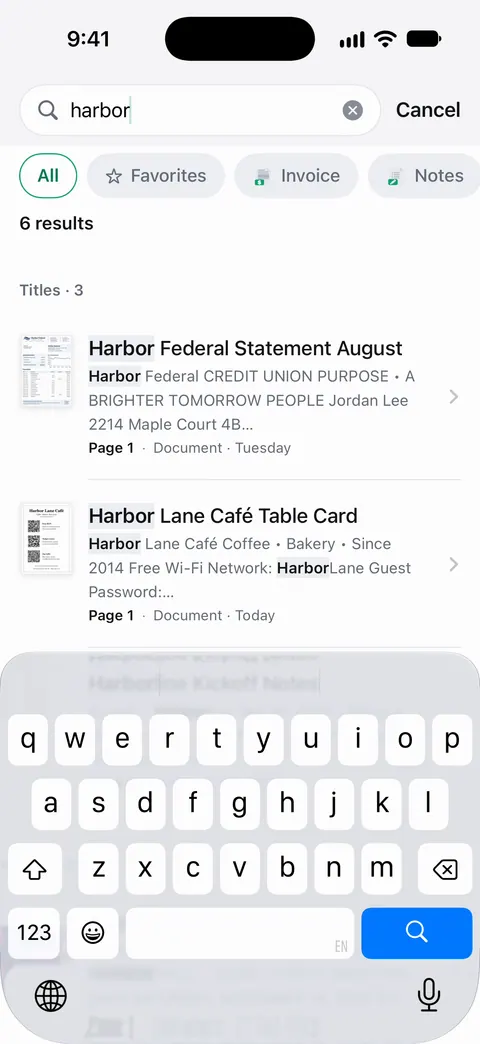
Scanner One does the reading and the sorting. Point your camera at any piece of paper. Scanner One finds the edges, straightens the page, cleans it up and saves a real PDF. Then it reads the text, names the document, tags it and puts it in the right folder. Later, Search looks inside the text of every document and shows the matching line and page.
It also covers the jobs between scanning and sending. Scanner One exports to Word, keeping headings, lists and tables, and to Excel and CSV. ID cards and passports are scanned with both sides on one printable page. Book spreads are split into two pages and curved lines are flattened. Ask your documents anything. When does the lease end? What did I spend at the shop? The answer comes back with the page it came from.
Pick Files if
- You have your own folders and naming habit, and want scans to drop straight in.
- You keep files in Dropbox, Box or OneDrive and want scans there with no extra step.
- You scan now and then and don’t want to pay for anything.
Pick Scanner One if
- Your scans pile up and you want them named and filed for you.
- You find papers by what’s in them, not what you called them.
- You need Word or Excel files, ID cards on one page, or redaction (a Pro feature).
Where Scanner One helps, and where it doesn’t
Scanner One helps once scanning becomes routine: every page is read, named and filed, and found again by any word. Scanner One needs no account and does no tracking. You can lock the app with Face ID.
Where Files is the better choice:
- For occasional scans into your own folders, Files is free and puts the PDF exactly where you want it. On Scanner One’s free plan, On a free account, pages you share, print or export carry a small “Scanned with Scanner One” label at the bottom right. Pro removes it.
- Caps. Scanner One’s free PDF tools run 3 a week and smart filing 10 documents a month.
- Where files live. Files saves straight into Dropbox, Box or OneDrive. Scanner One keeps documents in its own Library; Pro adds redaction, the smart eraser, edit text, auto-export and five alternate app icons.
- Platforms. Scanner One runs on iPhone and iPad. There is no Mac version of Scanner One.
Apple’s other free scanners are compared in Scanner One vs Notes and Scanner One vs Preview, and every limit is on Free and Pro.
Questions and answers
Where does the Files app save a scan?
Wherever you choose. Apple’s steps end with choosing a location and tapping Save, and Files works with the iPhone itself, iCloud Drive and services such as Dropbox, Box and OneDrive.
Can I scan to a PDF with the Files app?
Yes. In Files, tap the More button, then Scan Documents. Capture the pages, tap Done, choose a location and tap Save. In iOS 26 you can also pick flash or an image filter while scanning.
How do I find a scan later in Files?
Apple’s guide describes searching Files by filename, folder name or document type, so a clear file name helps. In Scanner One, Search looks inside the text of every document and shows the matching line and page.
Is a scanner app better than Files?
Only if you scan often or need more than a PDF in a folder. Then it reads the text, names the document, tags it and puts it in the right folder. Scanner One’s free version has caps, such as 3 a week for PDF tools, and labels shared pages.
Sources
What this page says about Scanner One was checked against the app on .
- Apple Support, How to scan documents on your iPhone or iPad (108963) — the Files scanning steps and the iOS 26 flash and filter options; page published 2026-02-13
- iPhone User Guide, Find and view files and folders in Files — search by filename, folder name or document type; Quick Look; read 2026-11-13
- iPhone User Guide, Files basics — folders, compress, rename, share, iCloud Drive; read 2026-11-13
- Files on the App Store — cloud services and drives Files works with, and its privacy label; read 2026-11-13
- Scanner One on the App Store — the app’s own listing
Get Scanner One
Scanner One is free, with generous limits: scanning, clean PDFs and text search never stop.

Scanner OneScan, sign and ask anything
Scanner One is free, with generous limits: scanning, clean PDFs and text search never stop.